
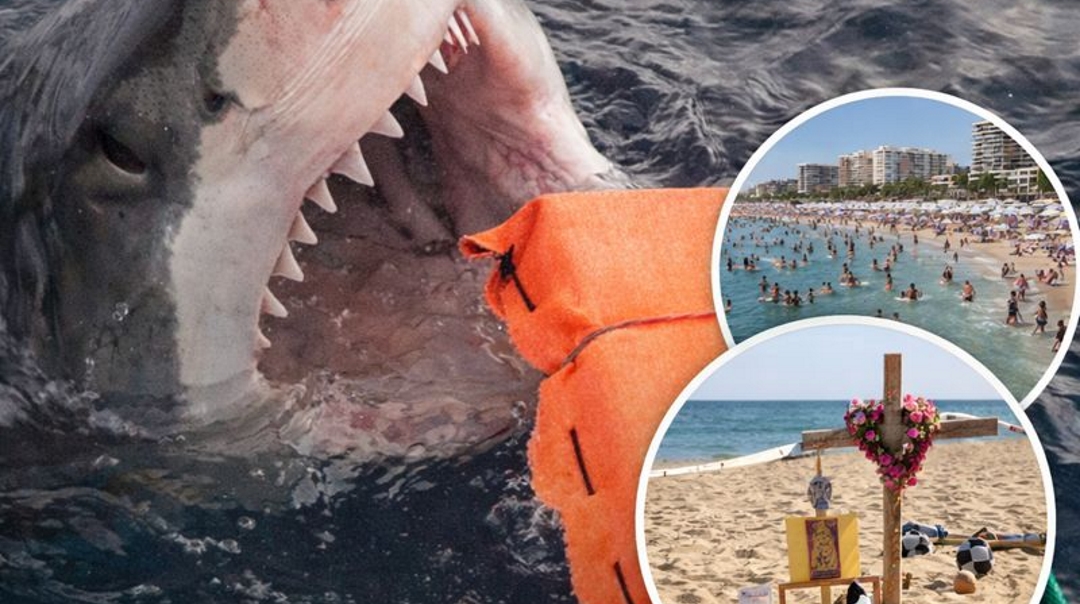
A family vacation ended in tragedy after a 13-year-old boy was killed in a shark attack at a popular tourist beach, an incident that has left an entire community shaken and raised renewed questions about safety in heavily trafficked coastal areas.
The attack occurred in shallow waters at a beach known for attracting thousands of visitors each year. Witnesses say the boy was swimming close to shore when a shark suddenly emerged from the water, attacking without warning. Screams from the water alerted nearby beachgoers, who rushed to help as lifeguards and emergency crews were dispatched.
Despite immediate efforts to rescue the boy and provide medical assistance, his injuries were catastrophic. Paramedics attempted lifesaving measures on the sand before rushing him to a nearby hospital, where he was later pronounced dead.
Authorities confirmed that the victim was a tourist visiting the area with his family. His name has not been released publicly out of respect for his relatives, who are said to be devastated by the loss.
Eyewitnesses described a chaotic and horrifying scene. Several beachgoers reportedly entered the water in an attempt to help pull the boy to safety, while others tried to warn swimmers to get out of the ocean. Lifeguards quickly cleared the beach as emergency sirens echoed across the shoreline.
Local officials said the shark involved has not been definitively identified, though experts believe it was likely a large predatory species commonly found in the region’s waters. Marine biologists assisting in the investigation stressed that such attacks remain extremely rare, even in areas where sharks are known to inhabit.
“This is an unthinkable tragedy,” one official said during a press briefing. “Our hearts are with the family, and we are doing everything possible to understand how this happened and whether additional safety measures are needed.”
Following the incident, the beach was immediately closed to the public. Drone surveillance and patrol boats were deployed to monitor nearby waters, while warning flags were raised along adjacent stretches of coastline. Officials urged residents and tourists to follow all safety guidance as authorities assessed the situation.
The attack has sent shockwaves through the local tourism industry, which relies heavily on visitors drawn by the area’s pristine beaches and calm waters. Many tourists were seen leaving the beach in silence, while others gathered in small groups, visibly shaken by what they had witnessed.
Marine experts note that shark attacks often occur due to mistaken identity, particularly in murky or turbulent water conditions where sharks may confuse humans for prey. Still, the severity of this incident has reignited debate over whether enough is being done to protect swimmers in high-traffic tourist destinations.
In recent years, several coastal regions around the world have reported an increase in shark sightings, a trend scientists attribute to a combination of environmental changes, shifting prey patterns, and growing human activity in marine habitats.
Data from international shark attack monitoring organizations shows that while fatal attacks are exceptionally uncommon, each incident carries enormous emotional weight, particularly when children are involved. The psychological impact on witnesses and first responders can also be long-lasting.
Local authorities confirmed that grief counselors have been made available to lifeguards, emergency personnel, and members of the public who witnessed the attack. “These events leave a lasting mark,” one emergency responder said. “No one forgets something like this.”
The boy’s family has asked for privacy as they mourn. Messages of condolence have poured in from around the world, with many expressing heartbreak and anger that a child’s life was cut short in what should have been a place of joy and relaxation.
A detailed report on the incident and the official response can be read here in coverage outlining what authorities have confirmed so far.
Experts continue to stress that shark encounters remain statistically rare, but they acknowledge that even a single fatality is one too many. Some are calling for expanded use of shark detection technology, including drones and underwater monitoring systems, in popular swimming areas.
Others caution against reactionary measures that could harm marine ecosystems, emphasizing that sharks play a critical role in maintaining ocean health. Balancing human safety with environmental protection remains a complex and emotionally charged challenge.
For now, the beach remains closed as investigations continue. Officials have not announced when it may reopen, saying safety assessments must be completed first.
The tragedy serves as a stark reminder of the unpredictable power of nature and the risks that can exist even in places that feel safe and familiar. A young life has been lost, and a community is left searching for answers — and for a way to prevent such a devastating event from happening again.
Additional information about global shark attack statistics and safety guidance can be found through international monitoring data maintained by marine researchers.