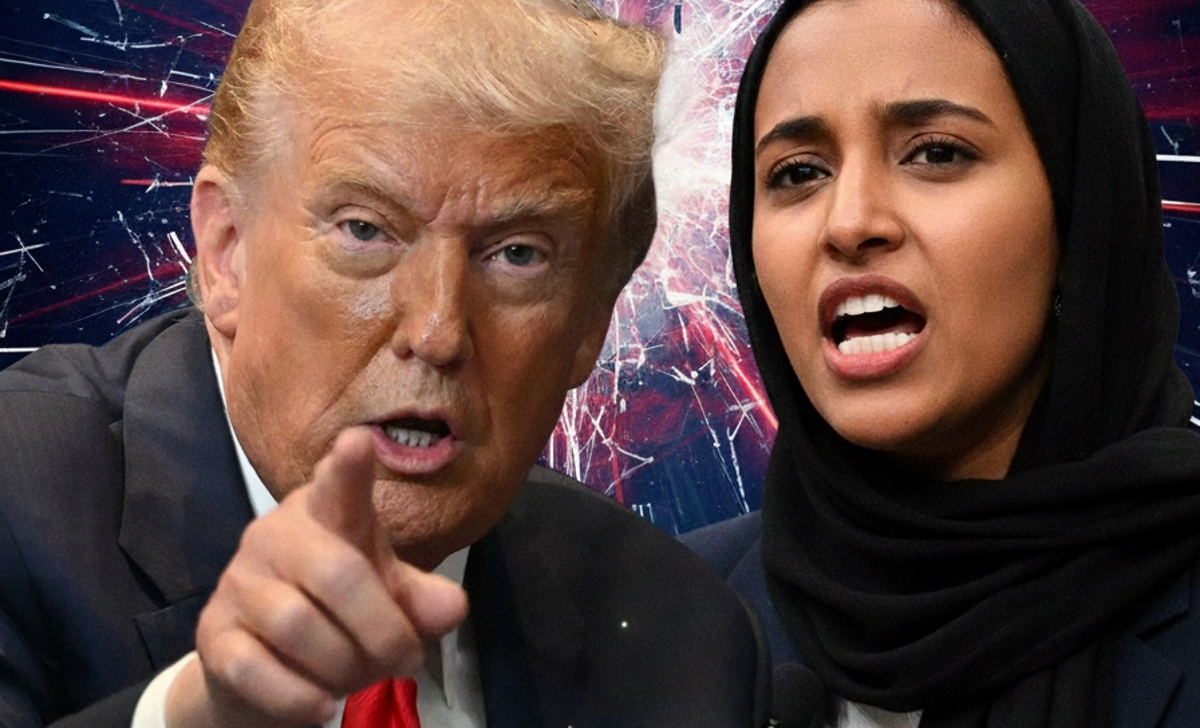
Rep. Ilhan Omar did not mince words as she tore into former President Donald Trump, branding him a “national embarrassment” in remarks that instantly reignited one of the most combustible rivalries in American politics. Her comments landed amid a fresh wave of political turmoil, as Trump dominated headlines once again over investigations, campaign rhetoric, and his growing influence inside the Republican Party, a moment closely followed in ongoing coverage of U.S. political developments that has tracked the escalating war of words.
Omar’s condemnation came during a public exchange where she accused Trump of degrading democratic norms and fueling division, language that echoed her past critiques documented in a long-running record of her clashes with Trump and his allies. This time, however, the tone was sharper, reflecting the intensity of a political moment where tempers on both sides appear increasingly raw.
Donald Trump is a national embarrassment. The chaos, the lies, the cruelty — Americans deserve better than this. — Rep. Ilhan Omar (@IlhanMN) Dec 2025
The remark ricocheted across social media and cable news within minutes, drawing cheers from progressives and fury from conservatives who accused Omar of grandstanding. Republican figures were quick to fire back, accusing her of hypocrisy and reviving long-standing disputes over her own controversial statements, arguments that analysts revisited in recent reporting on congressional infighting that shows how personal attacks have become central to modern political combat.
Omar’s criticism zeroed in on Trump’s continued grip on the GOP, arguing that his rhetoric damages America’s standing abroad and deepens domestic fractures. Foreign-policy observers have made similar points in analysis of how U.S. political discourse affects global perception, noting that high-profile insults and public feuds often reverberate far beyond Washington.
Watching this unfold feels like the same fight on repeat — but with higher stakes every time. — Nadia R. (@NadiaPolicy) Dec 2025
Trump, for his part, has a long history of responding aggressively to critics, particularly Omar, whom he has singled out repeatedly at rallies and online. Past exchanges between the two have been dissected in coverage of Trump’s rhetorical style that highlights how he often turns criticism into a rallying cry for supporters.
Supporters of Omar argued that her blunt language reflects frustration shared by millions of voters who view Trump as a destabilizing force. Polling trends cited in recent public-opinion research suggest that while Trump maintains intense loyalty among his base, he also remains one of the most polarizing figures in modern American history.
Critics, however, warned that the exchange exemplifies how political discourse has deteriorated into personal insult rather than substantive debate. Media scholars examining this pattern in analysis of partisan rhetoric argue that such clashes energize supporters but leave little room for consensus or policy-driven discussion.
When leaders trade insults, everyone else pays the price. This isn’t debate — it’s permanent outrage. — Ethan L. (@EthanWrites) Dec 2025
Still, Omar showed no sign of backing down. Allies say her comments were meant to draw a clear moral line, not to soften her tone for bipartisan appeal. That approach has defined much of her career, as outlined in profiles examining her rise and controversies, which note that confrontation has often amplified her national profile.
As the reaction continued to build, the episode underscored a broader reality: Trump remains a gravitational force in American politics, capable of drawing fierce opposition and unwavering loyalty in equal measure. Omar’s words may fade from the headlines, but the conflict they represent — over power, rhetoric, and the future direction of the country — shows no sign of cooling.