
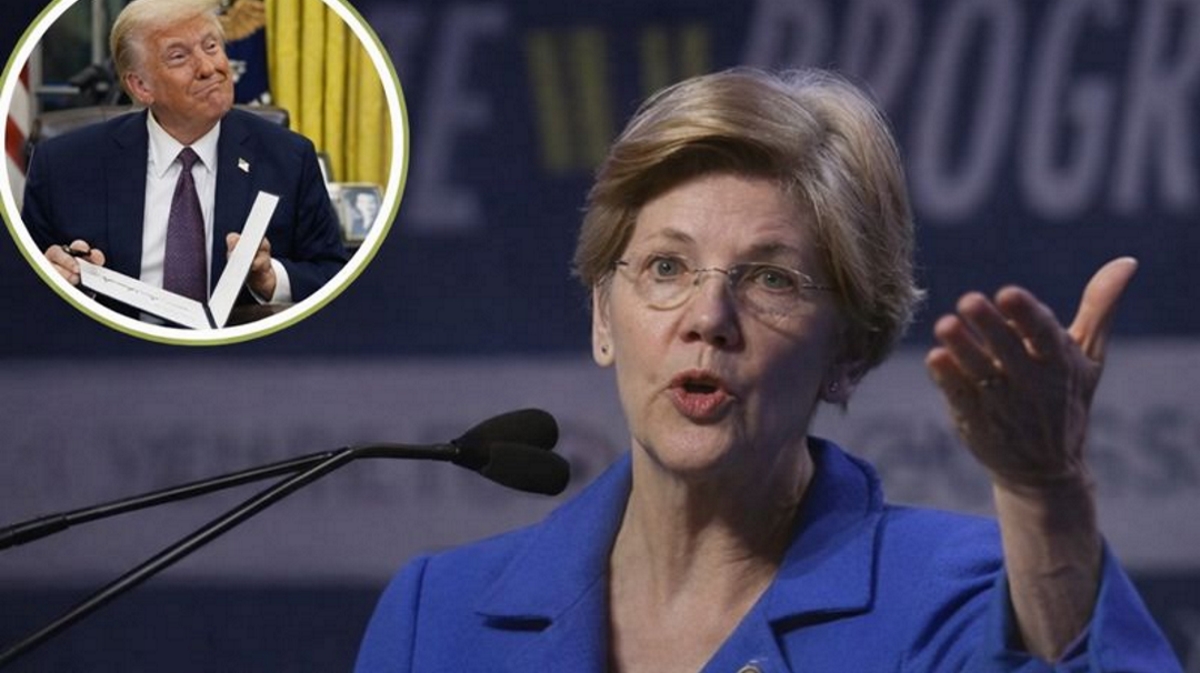
Senator Elizabeth Warren has sharply criticized Donald Trump after he warned Americans about what he described as “Black Friday debt,” accusing the former president of exploiting financial anxiety while ignoring the policies she says helped push families deeper into the red. The exchange has quickly turned into a broader political fight over who bears responsibility for rising household debt — and who has the right to lecture struggling consumers.
Trump’s comments came as millions of Americans prepared for Black Friday shopping amid high interest rates and lingering inflation pressures. Framing himself as a voice of caution, Trump urged families to avoid reckless spending, warning that growing credit card balances were a sign of economic failure. His remarks circulated widely, tapping into real fears as more households rely on credit to cover basic expenses.
Warren wasted little time firing back. She accused Trump of “economic fearmongering,” arguing that he was blaming consumers for problems created by corporate greed and policy choices. Speaking to reporters, said Americans don’t rack up debt because they enjoy overspending, but because wages haven’t kept up with costs.
“Families are drowning in high interest rates and rising prices,” Warren said, “and Donald Trump wants to pretend it’s all about bad shopping decisions.” Her comments echoed arguments she has long made about the structural drivers of debt, including housing costs, medical bills, and aggressive lending practices.
Trump allies defended his warning, insisting it was common sense to caution people against overextending themselves during the holidays. They argued that personal responsibility still matters and accused Warren of dismissing legitimate concerns about household finances. Supporters framed Trump’s message as financial realism rather than moral judgment.
But Warren pushed back hard on that framing, pointing to Trump’s own economic record. She reminded critics that the national debt ballooned during his presidency, a point frequently cited in figures that often get glossed over in political debates about fiscal discipline. For Warren, Trump’s Black Friday warning felt less like concern and more like deflection.
Scolding families about debt while handing giveaways to billionaires is not leadership. — Sen. Elizabeth Warren (@SenWarren) Dec 2025
The clash arrives at a moment when consumer debt is once again climbing. Credit card balances have surged as higher prices and interest rates squeeze household budgets, a trend tracked quietly in data that doesn’t usually go viral. For many families, Black Friday deals now come paired with anxiety about how long it will take to pay them off.
Warren argues that focusing on shopping behavior misses the real problem. She says lenders profit from desperation, charging sky-high interest rates that turn short-term purchases into long-term burdens. Her criticism aligns with warnings raised in research few politicians like to quote, which links rising debt to widening inequality.
Trump, meanwhile, has increasingly leaned into economic warnings as part of his political messaging. By highlighting debt, inflation, and financial instability, **:contentReference[oaicite:1]{index=1}** positions himself as a blunt truth-teller willing to sound the alarm. Critics say that approach amplifies fear without offering meaningful solutions.
The disagreement also reflects a deeper philosophical divide. Warren views consumer debt as a systemic failure that requires stronger oversight and corporate accountability. Trump frames it as evidence of broader economic decline and personal mismanagement, often tying it to leadership rather than market structure.
Public opinion sits uneasily between those views. Many Americans worry about their own debt but bristle at being blamed for it, a tension captured in survey findings that rarely fit neatly into partisan boxes. That ambivalence makes debt a potent but volatile political issue.
Warren’s attack also carried a strategic edge. By challenging Trump on debt, she sought to flip a traditionally conservative talking point into an argument for stronger consumer protections. She accused Trump of ignoring the role of tax cuts and deregulation in leaving families more exposed when economic shocks hit.
Debt isn’t a moral failing — it’s a warning sign of a broken system. — Economic advocate (@FairEconomyNow) Dec 2025
Trump supporters counter that Warren’s approach risks encouraging irresponsibility and overregulation. They argue that warning people about debt is not the same as shaming them, and that ignoring personal choices doesn’t help families in the long run.
Economists watching the exchange caution that both sides simplify a complex issue. Debt can signal stress, but it can also reflect confidence or necessity. What worries experts most, they say, is how quickly rising balances can spiral when interest rates remain high.
As the holiday shopping season unfolds, the argument over Black Friday debt is likely to intensify. For Warren, the issue underscores her broader message about corporate accountability and consumer protection. For Trump, it feeds into a narrative of economic decline that he believes strengthens his political case.
What’s clear is that debt has become more than a financial statistic. It’s now a symbol of competing economic visions — one that blames systems, and another that warns individuals. And as Warren and Trump continue to trade blows, millions of Americans are left navigating both rising balances and rising political noise.