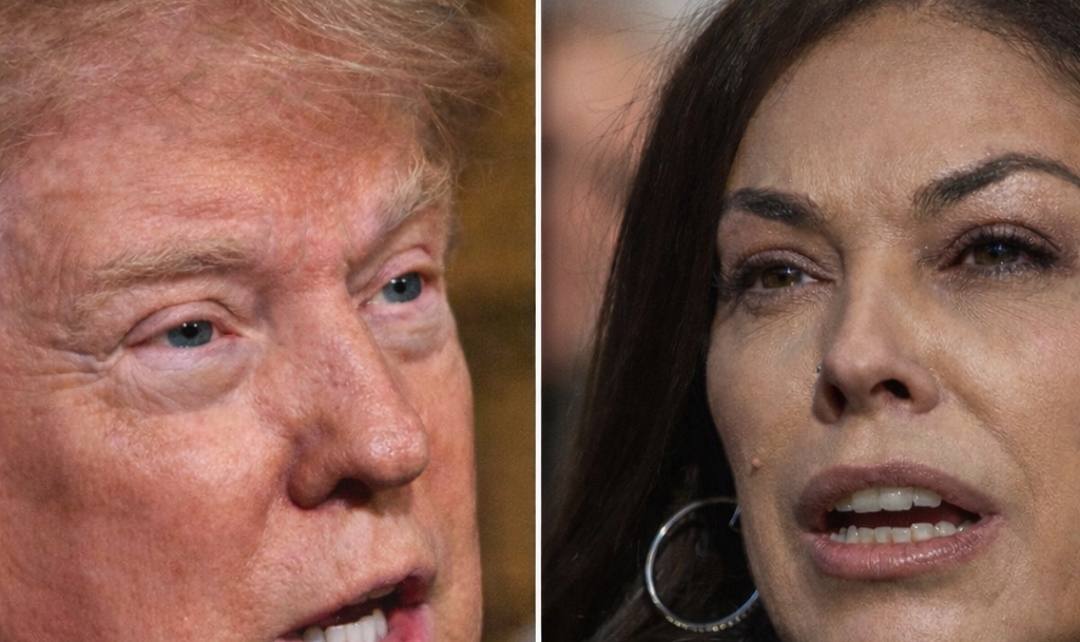
A survivor of Jeffrey Epstein’s abuse has ignited a new political firestorm after making explosive public claims involving Donald Trump, demanding accountability and renewed scrutiny as long-buried connections resurface. The remarks, delivered with raw emotion, immediately ricocheted across social media and cable news, reopening a case many believed had gone as far as it ever would.
The survivor, who has spoken publicly before about Epstein’s network, said the focus has remained too narrowly fixed on Epstein himself while powerful figures escaped sustained examination. Her comments did not allege new criminal conduct backed by court filings, but they forcefully challenged what she described as selective accountability.
At the center of the renewed controversy is Trump, whose past social proximity to Epstein has long been documented but never resulted in charges. Trump has repeatedly said he cut ties with Epstein years before his arrest and has denied any involvement in Epstein’s crimes.
The survivor argued that political power and public narrative helped shield influential men from deeper scrutiny. She pointed to photographs, social events, and overlapping social circles that have circulated for years, saying they were treated as curiosities rather than warning signs. Those dynamics were examined extensively in investigations that reshaped the case, which detailed how Epstein cultivated access and legitimacy.
Her remarks went further, calling for impeachment-level accountability for leaders who, in her view, benefited from a system that failed victims. Legal experts quickly noted that impeachment requires evidence of official misconduct while in office, not moral outrage alone. Still, the demand underscores a broader frustration with how justice unfolded after Epstein’s death.
Supporters of Trump dismissed the claims as politically motivated, arguing that resurfacing old associations without new evidence amounts to character assassination. They emphasized that multiple reviews and investigations have not produced charges against Trump related to Epstein.
Others countered that the absence of charges does not equal the absence of responsibility. They argue that Epstein’s ability to operate depended on social validation from powerful people, a problem explored in analysis of elite protection that continues to circulate whenever new voices come forward.
This isn’t about one man — it’s about a system that let predators thrive. — Survivor advocate (@JusticeNow) Dec 2025
The survivor also criticized what she described as a rush to close the book after Epstein’s death, saying it robbed victims of a public reckoning. Epstein died in federal custody in 2019, ending the possibility of a trial that could have exposed the full scope of his network. That unresolved ending remains a source of anger, detailed in victim-centered perspectives urging attention beyond headlines.
Her comments come amid renewed calls to release remaining Epstein-related records, including sealed documents and contact logs. Advocates say transparency is the only way to restore trust, while critics warn that indiscriminate release risks fueling speculation rather than clarity. That tension is explored in debates that keep resurfacing whenever new material appears.
Political reaction has been swift but divided. Progressive lawmakers echoed calls for deeper investigation, framing the survivor’s words as a reminder that power often escapes consequence. Conservative voices accused opponents of weaponizing trauma to score political points, urging restraint until verifiable evidence emerges.
Survivors speaking out shouldn’t be reduced to partisan noise. — Human rights lawyer (@VictimCentered) Dec 2025
Legal scholars emphasize that public testimony, while powerful, must be paired with documentary proof to produce legal outcomes. At the same time, they acknowledge that survivor accounts have historically been the catalyst for uncovering hidden systems of abuse.
For many observers, the moment highlights an unresolved contradiction. Epstein’s crimes are widely acknowledged, yet the structures that enabled him remain only partially exposed. Each new voice reopens that gap between what is known and what has been formally addressed.
The survivor said she does not expect immediate action, but hopes sustained pressure will prevent the story from being quietly buried again. “Silence is what protected him,” she said, arguing that continued scrutiny is the only antidote.
As reactions continue to ripple, the episode serves as a stark reminder that Epstein’s legacy is not confined to the past. It lives on in unanswered questions, fractured trust, and a growing demand that influence no longer outweigh accountability.
Whether the renewed attention produces concrete outcomes remains uncertain. But the survivor’s message has already landed: the story is not finished, and forgetting it would be a choice — not an inevitability.