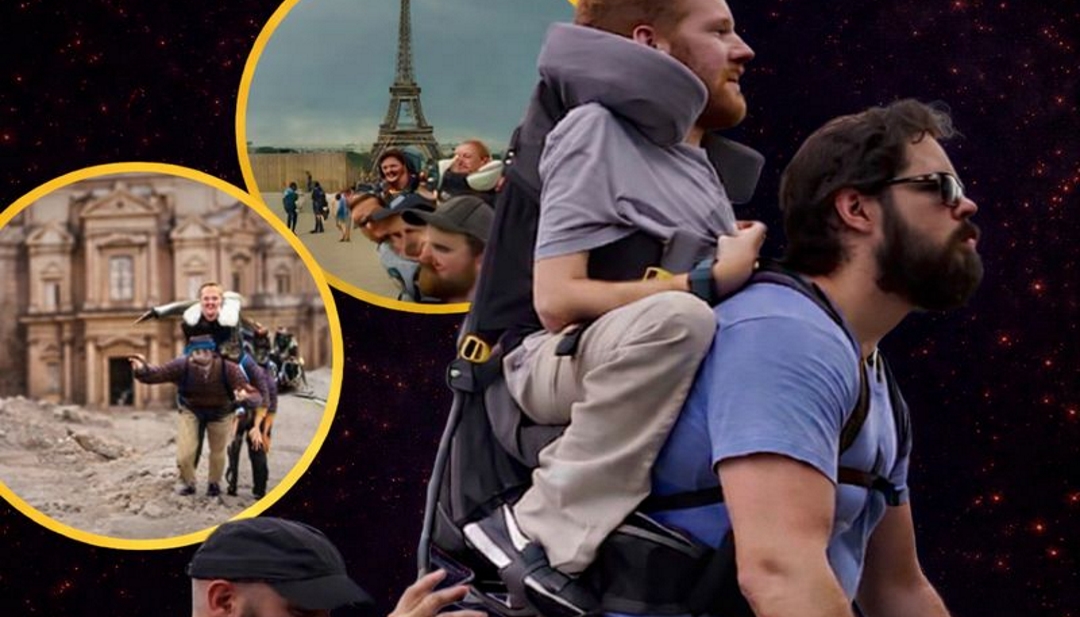
The image looks almost cinematic. A group of friends climbing uneven ground, one man strapped securely to another’s back, faces set with focus and determination. Circles highlight moments from across the globe — Paris, historic streets, crowded landmarks — all pointing to a single idea: this was not an ordinary trip.
As the image began circulating online, the caption attached to it stopped people cold. It claimed a connection to Tommy Lee Jones’ daughter and described a group of friends helping a disabled man fulfill his dream of traveling the world.
Within hours, the post had spread across Facebook and X, drawing millions of views and thousands of emotional reactions. Some shared it as proof that kindness still exists. Others questioned the celebrity reference, asking whether the story had been exaggerated to grab attention.
What no one disputed was the power of the images themselves.
The man shown being carried reportedly lives with a severe physical disability that makes independent travel nearly impossible. According to accounts shared alongside the photos, he had long dreamed of seeing famous landmarks in person — not through screens, not through postcards, but by being there.
That dream might have stayed impossible if not for a tight-knit group of friends who decided to turn logistics into muscle, planning into action, and limitations into something to work around rather than surrender to.
Online commenters compared the effort to stories highlighted in recent features on accessible travel, noting how rarely such journeys are shown without filters or pity.
Instead of wheelchairs and ramps, the photos show harnesses, backpacks, and human strength. The group adapted to environments that were never designed with disability in mind — cobblestone streets, ancient staircases, crowded plazas.
One image shows the Eiffel Tower looming behind them. Another captures the group laughing mid-climb. These moments, supporters say, are the real story — not the celebrity angle.
Still, the claim involving Tommy Lee Jones’ daughter fueled debate. Some users alleged that one of the organizers had ties to the actor’s family, while others argued the name was added later to boost reach. No official confirmation has publicly linked Jones or his family to the journey.
Media analysts pointed out that viral stories often attach famous names to emotional narratives, referencing patterns seen in past online campaigns.
But even skeptics admitted the core story didn’t need embellishment.
Traveling with a disabled companion at this scale requires planning most people never consider — medical contingencies, transportation permissions, physical endurance, and constant trust. It’s the kind of effort usually reserved for expeditions, not vacations.
Supporters shared similar stories, linking the post to guides on inclusive travel and arguing that visibility matters more than perfect accuracy in moments like this.
The group involved has reportedly avoided interviews, letting the images speak for themselves. That silence has only amplified curiosity.
Whether the celebrity part is true or not, the way those friends showed up for him is unreal. That’s the story.— GlobalNomad (@GlobalNomadView) December 2025
Others pushed back harder, warning against emotionally manipulative framing and urging people to verify before sharing. Articles on viral human-interest content highlight how easily good intentions can be tangled with misinformation.
Yet the emotional impact was undeniable.
Parents of disabled children commented that the images gave them hope. Disabled adults shared that seeing someone carried — not hidden, not apologized for — felt empowering rather than demeaning.
In one widely shared reply, a user wrote that the photos “reframed dependence as teamwork.”
This is what accessibility looks like when the world isn’t built for you — people building it anyway.— AccessMatters (@AccessMattersNow) December 2025
As the story continues to circulate, the truth behind the celebrity mention may eventually surface. But for many, it has already faded into the background.
What remains is the image of friends turning their own bodies into bridges, choosing effort over convenience, and refusing to let a dream be downsized by reality.
In a feed crowded with outrage and despair, that choice is what made people stop scrolling.