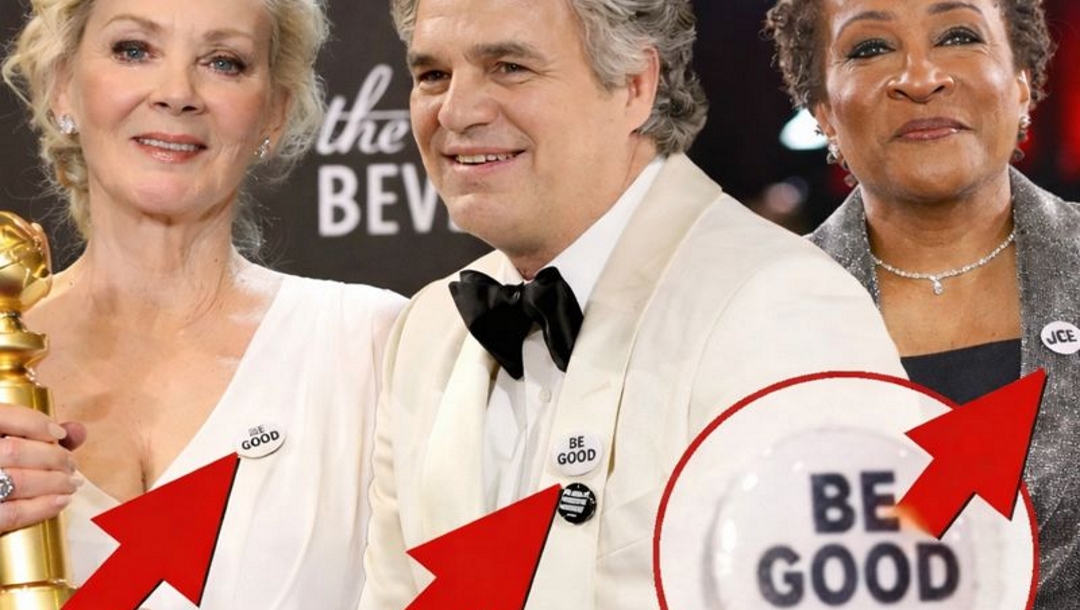
What was supposed to be a night celebrating film and television quickly turned into a flashpoint for political symbolism after several Golden Globes stars stepped onto the red carpet wearing small but highly charged “Be Good” pins. The pins, subtle in size but loud in message, were immediately interpreted as a pointed statement aimed at U.S. Immigration and Customs Enforcement.
Photos of the pins began circulating online almost instantly, with red arrows and zoomed-in close-ups amplifying the moment across social media. Viewers at home spotted the matching accessories on multiple celebrities, sparking a wave of speculation about coordination, intent, and whether Hollywood was once again inserting itself directly into immigration politics.
The phrase itself — “Be Good” — appeared deceptively gentle. But in the current climate surrounding immigration enforcement, critics and supporters alike understood the implication. The pins echoed language often used by activists calling for restraint, reform, or outright dismantling of ICE, a theme that has appeared repeatedly in celebrity-led advocacy campaigns over the past several years.
Those wearing the pins did not initially offer public explanations during the ceremony, which only intensified online reaction. Some applauded the move as a quiet but powerful act of solidarity with immigrant communities. Others accused the stars of performative activism, arguing that symbolic gestures do little to address real-world policy consequences.
Conservative commentators quickly seized on the moment, framing it as proof that Hollywood elites were once again lecturing the public from a position of privilege. On talk shows and comment threads, critics questioned whether celebrities who live behind gates and security details truly grasp the complexities of border enforcement.
Supporters fired back just as forcefully. Many argued that visibility matters, especially at globally televised events watched by millions. The Golden Globes, they said, provided a rare platform to highlight humanitarian concerns tied to detention practices, deportations, and family separations — issues widely documented in investigative reporting.
That “Be Good” pin may be small, but the message isn’t. Art has always pushed back against power. — Culture Watch (@CultureWatchers) January 2026
Behind the scenes, sources familiar with the event suggested the pins were not mandated by organizers but rather worn voluntarily by select attendees. Whether coordinated privately or inspired organically, the result was unmistakable: a visual through-line that dominated post-show coverage almost as much as the awards themselves.
Some immigration advocates praised the move for keeping the issue in the public eye at a moment when policy debates have grown increasingly polarized. They pointed to ongoing legal battles over detention conditions as evidence that sustained attention remains critical.
Still, skepticism lingered. Detractors noted that similar gestures in the past often fade once the cameras shut off. Without concrete follow-up — donations, lobbying, or legislative pressure — symbolic acts risk becoming fleeting viral moments rather than catalysts for change.
The controversy also reignited a familiar question: should award shows remain politically neutral, or has that era already passed? From Vietnam War protests to modern-day movements, Hollywood has a long history of blending entertainment with activism, whether audiences welcome it or not.
If you don’t like politics at award shows, you haven’t been paying attention for the last 60 years. — Film Historian (@CinemaContext) January 2026
As the backlash and praise continue to ripple outward, one thing is clear: the “Be Good” pins accomplished exactly what subtle symbolism is designed to do — provoke conversation. Whether that conversation leads to tangible outcomes or simply fuels another cycle of outrage remains to be seen.
For now, the pins have secured their place in Golden Globes history as more than a fashion choice. They became a political statement stitched into an awards ceremony, reminding audiences that even the smallest accessories can carry outsized meaning when worn on the world’s biggest stages.