
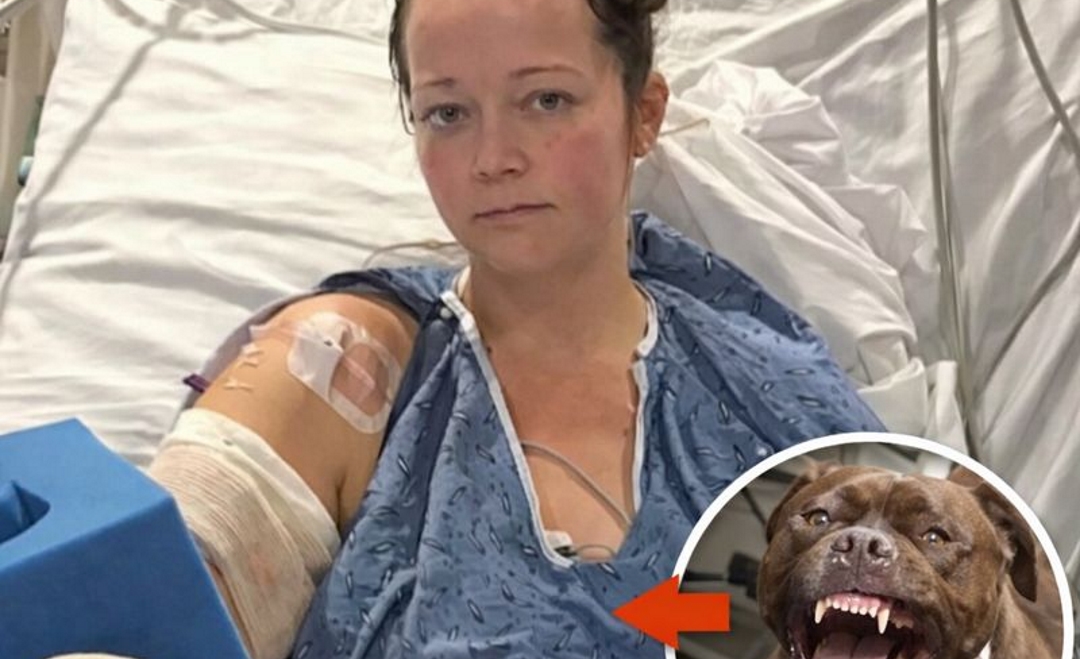
The hospital photo is hard to look at. A Tennessee mother lies propped up in a white bed, arms wrapped in bandages, her expression exhausted but steady. What the image doesn’t immediately show is what doctors were forced to do next — amputate her leg after a brutal attack by the dog she had raised inside her own home.
The incident unfolded in a matter of minutes, according to accounts shared by family members and local responders. The dog, described as a familiar household pet with no widely reported history of extreme aggression, suddenly turned violent inside the home. By the time help arrived, the injuries were already catastrophic.
Emergency responders reportedly found massive trauma to her lower body and arms, injuries consistent with prolonged biting and tearing. One responder later described the scene as “unlike anything we usually encounter,” a sentiment echoed by medical staff once she was rushed into surgery. Doctors attempted multiple procedures to save her leg, but complications mounted rapidly, as detailed in public safety briefings on severe dog attacks.
Ultimately, surgeons were left with no choice. Infection risk, tissue destruction, and blood loss made amputation the only life-saving option. The decision came fast, leaving her family stunned and scrambling to understand how a normal day had turned into a life-altering catastrophe.
As news of the attack spread online, reactions were immediate and deeply divided. Some focused on the brutality of the injuries, while others fixated on the breed of the dog involved, reigniting a familiar and emotionally charged debate. Animal behavior experts quickly cautioned against oversimplification, noting that severe attacks often involve a complex mix of stress, environment, and warning signs that go unnoticed according to veterinary risk studies.
This story is devastating. People forget how quickly things can go wrong, even with dogs you love and trust. — Emergency Watch (@EmergencyWatch) February 2026
Family members say the dog had lived with the household for years and had never shown signs that would suggest this kind of violence. That detail has only made the incident more disturbing. Investigators are now reviewing veterinary records, prior incidents, and the moments leading up to the attack to determine whether any triggers can be identified.
In the days following the surgery, the woman began sharing updates through loved ones, focusing less on blame and more on survival. She is reportedly undergoing intensive rehabilitation and facing a long road of physical therapy, prosthetic planning, and emotional recovery. Medical professionals say trauma of this scale often carries psychological consequences as heavy as the physical ones according to trauma recovery research.
The story has also renewed attention on how quickly dog attacks can escalate once they begin. Studies show that in severe cases, victims often have only seconds to react, especially when attacks occur indoors where escape routes are limited. Advocacy groups stress the importance of recognizing early warning behaviors and understanding that familiarity does not equal immunity from risk as noted in recent safety analyses.
No one expects the danger to come from inside their own home. That’s what makes this so haunting. — Real World News (@RealWorldNewsHQ) February 2026
Local authorities have not released final determinations regarding the dog’s fate, though officials confirmed that protocols were followed after the attack. Meanwhile, community members have rallied around the family, launching fundraisers to help cover mounting medical costs and future mobility needs.
What remains is a sobering reminder of how fragile routine can be. One moment, a mother is at home with her pet. The next, she is waking up in a hospital bed, adjusting to a body forever changed. Her story has become a painful flashpoint — not just about dogs or safety, but about how quickly life can fracture without warning.