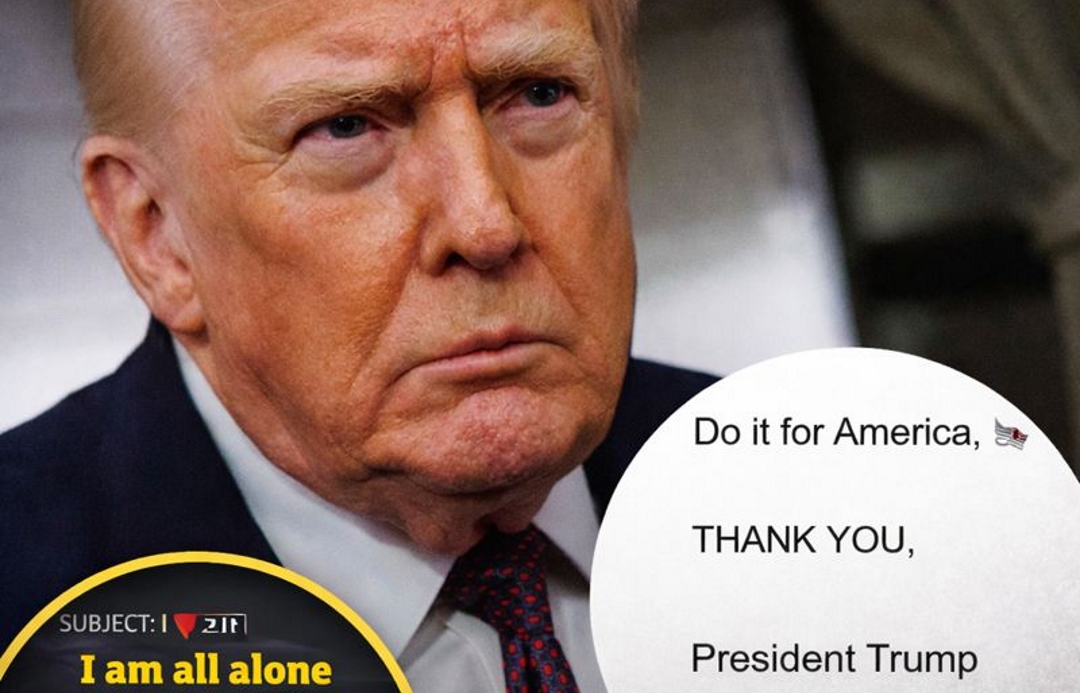
The email landed quietly in inboxes late at night, stripped of the usual bravado and campaign-style chest-thumping. Instead, the tone was subdued, almost heavy. Donald Trump told supporters he felt alone, describing the moment as dark and emotionally draining, before pivoting quickly to a familiar request: financial support.
For longtime observers of his political messaging, the shift stood out. Trump’s emails are typically aggressive, urgent, and defiant. This one leaned inward. “I am all alone,” the message read, according to multiple screenshots shared online, framing his current situation as isolating and deeply personal rather than purely political.
The appeal came as Trump continues to juggle mounting legal pressures, campaign expenses, and an increasingly crowded media environment. Analysts note that fundraising language often mirrors internal campaign stress, something seasoned campaign reporters have tracked for years. Still, the emotional phrasing raised eyebrows even among allies.
Within hours, screenshots of the email circulated widely on social platforms. Some supporters described the message as honest and humanizing. Critics, however, accused Trump of leveraging vulnerability as a political tactic. The contrast fueled debate about whether the message represented genuine reflection or a calculated appeal timed for maximum impact.
Campaign finance experts say emotionally charged fundraising has become increasingly common across the political spectrum. Studies into emotion-driven donor behavior show that fear, urgency, and personal struggle often outperform policy-heavy appeals. Trump’s message appeared to lean heavily into that reality.
What made this email different was the language of isolation. Trump framed himself as standing alone against powerful forces, a narrative he has leaned on before, but rarely with such stripped-down phrasing. “Do it for America,” the message urged, signing off with his name in bold.
Trump’s latest email is striking not for what it asks, but for how personal it sounds. That’s new. — Maggie Haberman (@maggieNYT) March 2026
Behind the scenes, the timing matters. Trump’s political operation has been spending heavily on legal costs while trying to maintain campaign momentum. Financial disclosures and reporting on where the money is going show a strain that even loyal donors have begun to question.
Supporters responding to the email said they felt a sense of urgency. Some described it as a call to stand by him when he feels most vulnerable. Others said the message crossed an uncomfortable line, blurring the boundary between personal hardship and political fundraising.
Political psychologists point out that leaders who frame themselves as isolated often trigger protective instincts among followers. Research into bonding through perceived persecution suggests this dynamic can strengthen loyalty, even amid controversy.
Whether strategic or sincere, this email signals a campaign under real pressure. — Rick Wilson (@TheRickWilson) March 2026
Still, the response was not universally sympathetic. Critics argued that the email ignored the broader context of Trump’s legal battles, framing consequences as personal suffering rather than accountability. Others noted that many Americans facing hardship lack a massive donor list to fall back on.
Inside political circles, the message is being read as a sign of where the campaign is heading. Less spectacle, more survival. Less dominance, more defense. Whether that approach energizes supporters or exhausts them remains an open question.
For now, the email stands as one of the more revealing pieces of Trump’s recent messaging — not because of policy promises or attacks on opponents, but because of what it suggested about his state of mind and the financial realities closing in around his campaign.
In a race increasingly defined by pressure and persistence, the message made one thing clear: the next phase of the campaign may be fought as much on emotion as on ideology.