
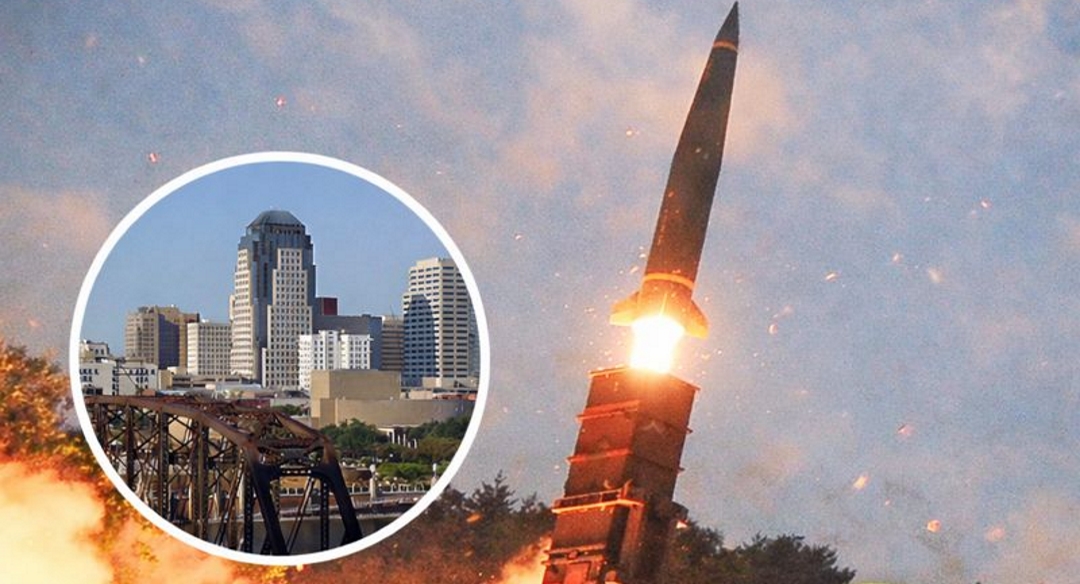
The image is jarring by design: a missile rising from the ground, fire and smoke swallowing the foreground, with a familiar U.S. skyline hovering in the background. It taps into a question many people quietly carry but rarely confront directly — if a large-scale global war ever erupted, where would the first blows land?
According to defense analysts and long-standing strategic models, the answer isn’t always the biggest or most famous cities. Instead, it often comes down to infrastructure, logistics, and geography. One expert recently outlined 15 U.S. cities that would likely be considered early targets in a worst-case global conflict scenario, and several of them surprised even seasoned observers.
The analysis draws from decades of publicly available military doctrine, Cold War targeting logic, and modern updates reflecting cyber, satellite, and logistics warfare. As explained in a detailed RAND assessment, modern conflict planning prioritizes disruption over symbolism. Knocking out the right nodes early can paralyze response capabilities.
That’s why many of the cities highlighted are not cultural capitals, but transportation hubs, energy corridors, and command-adjacent metro areas. Ports that handle massive shipping volume, cities near strategic air bases, and regions tied to power distribution repeatedly appear in these models.
One example frequently cited is San Diego, not because of its population size, but due to its dense concentration of naval assets. Similarly, cities near major missile defense systems or satellite uplink facilities often rank higher than people expect. Analysts studying critical infrastructure vulnerabilities say these locations are viewed as force multipliers — remove them, and everything else slows.
The list also includes inland cities. Transportation choke points — rail junctions, fuel pipelines, and freight crossroads — are now considered just as vital as coastal ports. A disruption there can ripple across entire regions within hours.
People assume targets would be obvious. In reality, logistics win wars. Disrupt the arteries, not the headlines. — Mark Hertling (@MarkHertling) February 2026
Another factor reshaping these assessments is modern missile technology. Precision guidance and long-range capabilities mean targets no longer need to be close to borders or coastlines. As outlined in recent strategic commentary, distance is far less protective than it once was.
Importantly, experts emphasize that these lists are not predictions. They are scenario exercises meant to understand vulnerabilities and improve resilience. Emergency planners use similar models to prioritize redundancy, harden systems, and ensure rapid recovery if disruptions occur.
Public reaction to the analysis has been mixed. Some see it as fear-driven speculation. Others argue it’s a sobering but necessary reminder of how interconnected modern life has become. When power, fuel, food distribution, and communication all hinge on a handful of nodes, even distant conflicts can feel uncomfortably close.
Security researchers studying global risk interdependence note that the real danger isn’t a single strike, but cascading failure — when one system goes down and pulls others with it.
Preparedness isn’t panic. It’s understanding where systems are fragile and fixing them before they’re tested. — Juliette Kayyem (@juliettekayyem) February 2026
The expert behind the list stressed that public awareness should lead to smarter planning, not alarm. Cities named in these models already invest heavily in resilience, backup systems, and coordination with federal agencies. The goal is deterrence through preparedness, not inevitability.
Still, the image resonates because it touches something deeply human — the instinct to imagine how global forces intersect with everyday places. The idea that familiar streets, bridges, or skylines could matter in geopolitical calculations is unsettling, but it also underscores how global security and local life are inseparable.
In the end, the list is less about where danger might begin and more about how modern societies can reduce the chances that such scenarios ever move from theory into reality.