
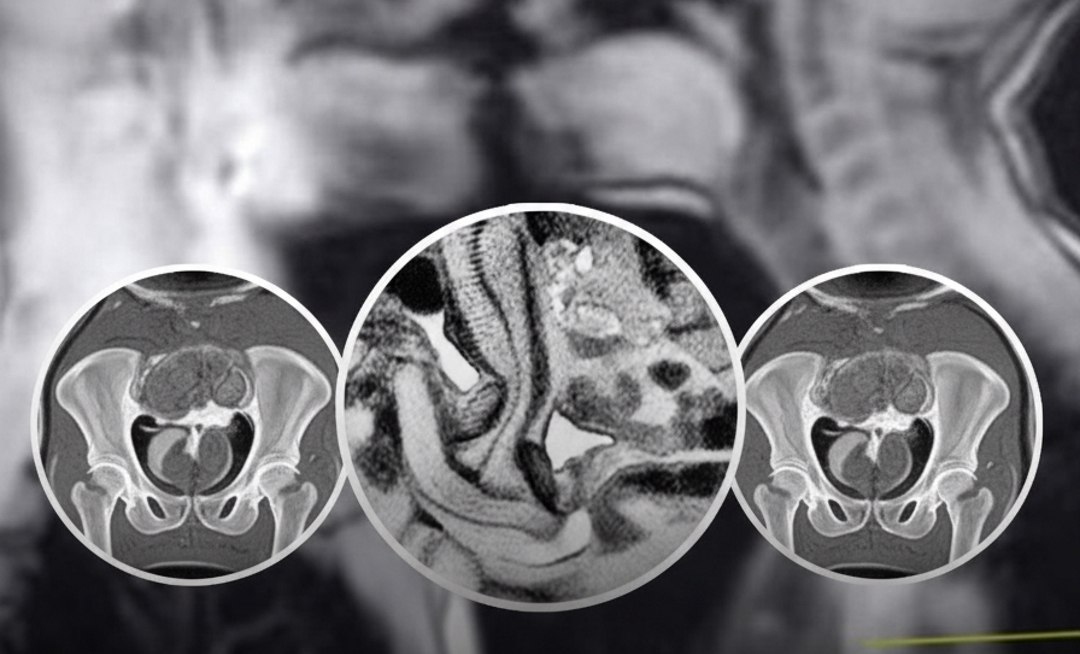
The image looks clinical at first glance: grainy black-and-white MRI scans layered over a human silhouette. But the experiment behind it was anything but abstract. In a groundbreaking medical study, a real couple agreed to have sex inside an MRI scanner so researchers could observe, in real time, what actually happens inside the human body during intercourse.
The study, conducted by researchers in Germany, was not designed to shock or provoke. It was intended to answer long-standing anatomical questions that textbooks, diagrams, and even decades of sexual health education had never fully resolved. Specifically, scientists wanted to understand how male and female anatomy truly interacts during penetration — something that had largely been inferred rather than directly observed.
Using a specially adapted MRI machine, the research team captured high-resolution images during intercourse, allowing them to see soft tissues in motion. Unlike X-rays or CT scans, MRI imaging can safely show muscles, organs, and connective tissue without radiation, making it suitable for such an intimate study. The work was later discussed widely in coverage examining how the images challenged old assumptions.
One of the most significant findings involved the position of the penis during penetration. Popular belief — and even some medical illustrations — had long suggested a simple, linear alignment. The MRI images revealed something very different. Instead of a straight path, the penis curves upward inside the vagina, forming a shape that researchers compared to a boomerang. That curvature appears to be influenced by internal anatomy rather than external positioning.
The scans also showed how the female reproductive organs shift during arousal. The uterus and cervix were seen to lift upward and backward, creating more space within the vaginal canal. This movement, previously theorized but never directly visualized, helps explain why arousal can significantly change comfort and sensation during sex — a point explored further in scientific breakdowns of sexual physiology.
Researchers emphasized that the findings were not about performance or technique, but about anatomy and health. By understanding how bodies move naturally, clinicians can better explain pain during intercourse, address misconceptions about size and fit, and improve treatments for sexual dysfunction.
The MRI sex study wasn’t about shock — it corrected decades of anatomical myths taught as fact. — Science Explained (@SciExplained) September 2023
The study also offered insight into why certain sexual positions may feel more comfortable for some people than others. Internal angles, pressure points, and organ movement varied in ways that external observation could never capture. These nuances are now being referenced in medical literature focused on sexual pain disorders, particularly conditions like dyspareunia.
Despite its clinical intent, the research sparked widespread media attention when it was first published. Headlines often focused on the novelty of “sex in an MRI,” overshadowing the scientific value. Researchers later expressed frustration that the study was treated as a curiosity rather than a meaningful contribution to medical knowledge.
Sex educators and health professionals, however, welcomed the data. Many noted that sexual anatomy has historically been under-studied, especially when it comes to female pleasure and comfort. Direct imaging helped validate experiences that patients had reported for years but struggled to articulate.
Ethics committees closely monitored the study, ensuring full consent, privacy protections, and psychological screening for participants. The couple involved remained anonymous, and no identifying information was ever released. Their contribution, researchers said, helped advance understanding in a field often constrained by cultural discomfort.
Medical research on sex shouldn’t be taboo. This MRI study filled real gaps in anatomy education. — Health Matters (@HealthMattersHQ) September 2023
More than a decade later, the images from that MRI experiment are still cited in textbooks, lectures, and peer-reviewed research. They remain one of the clearest demonstrations that real bodies don’t always behave the way diagrams suggest.
The image circulating now isn’t about sensationalism. It represents a rare moment when science pushed past discomfort to replace assumption with evidence — offering a clearer, more honest understanding of how human bodies actually work.