
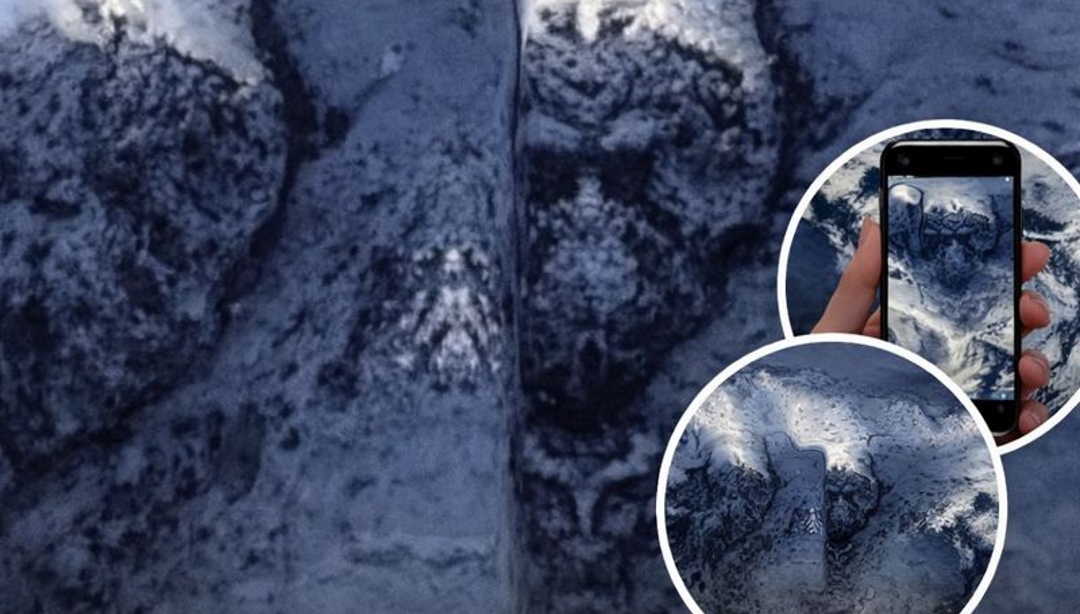
It started the way many unsettling internet discoveries do — with someone casually scrolling across satellite imagery and stopping cold. High above a remote stretch of mountainous terrain, a formation appeared to stare back. Dark hollows where eyes should be. A jagged shape resembling a mouth. The illusion was strong enough that once it was seen, it became impossible to unsee.
Within hours, screenshots began circulating across social media, each one zoomed in tighter than the last. Users described the image as a “demon face,” carved directly into the land itself. Some called it eerie. Others described it as deeply disturbing, claiming the longer they looked, the more human — or inhuman — it appeared.
The formation was spotted using Google Maps’ satellite view, where natural shadows and elevation changes can merge into unexpected shapes. But unlike common cases of people spotting animals in clouds or faces in toast, this image carried a heavier weight. The scale alone made it unsettling. This wasn’t a small rock or a trick of lighting on a building — it spanned an entire section of mountainous terrain.
What made the image travel so quickly was its symmetry. The “eyes” appeared evenly spaced. The central ridge looked like a nose. Below it, darker contours suggested a gaping mouth. Viewers described feeling watched, even after closing the image. Some admitted they felt uneasy returning to the map at all.
Online reaction was swift and polarized. Skeptics dismissed it immediately as pareidolia — the human tendency to see familiar patterns, especially faces, in random stimuli. Others weren’t so sure. Comment sections filled with speculation, folklore references, and theories ranging from ancient carvings to something far more unsettling.
One widely shared post described the image as “too precise to be accidental,” while another joked that Google Maps had “accidentally documented hell’s front door.” But beneath the humor was genuine discomfort. People weren’t just amused — they were rattled.
Experts were quick to point out that satellite imagery exaggerates contrast and shadow, especially in rugged terrain. When sunlight hits mountains at low angles, ridges cast elongated shadows that can create the illusion of depth where none exists. According to geologists, what looks like eyes and a mouth is simply a combination of valleys, rock formations, and shadowed slopes aligning just right.
Still, knowing the explanation didn’t fully erase the unease. The brain is wired to recognize faces — it’s one of the earliest survival mechanisms humans develop. When a “face” appears where it shouldn’t, especially at a massive scale, it can trigger an instinctive sense of alarm.
The phenomenon has been studied extensively. Researchers note that when people encounter face-like imagery in unfamiliar or vast environments, the emotional response tends to be stronger. It taps into something ancient — the fear of being watched, of not being alone, of meaning hidden where there should be none.
A detailed breakdown of pareidolia and why humans experience it so intensely can be found in a scientific explanation of the phenomenon, which helps explain why images like this spread so quickly and linger so powerfully.
Despite rational explanations, many users returned to the image repeatedly, zooming in, adjusting contrast, and sharing alternate angles. Some claimed they noticed new details over time — sharper teeth, deeper eye sockets, expressions that seemed to shift depending on lighting.
Google has not commented on the viral image directly, though the company has previously acknowledged that satellite imagery often produces visual illusions. In the past, similar discoveries — faces on Mars, skull-shaped islands, or symbols etched into deserts — have gone viral for the same reason. They sit at the intersection of science and imagination.
One cultural analyst noted that discoveries like this gain traction because they feel accidental. “It’s not something created to scare you,” she explained. “It feels like you stumbled onto something you weren’t meant to notice.” That sense of accidental discovery amplifies the discomfort.
As the image continued to spread, some users attempted to track down the exact coordinates, while others preferred not to look too closely at all. “I wish I never saw it,” one comment read. “Now every time I open Maps, I feel weird.”
The story was eventually picked up by major outlets, including a viral write-up that documented the internet’s reaction and the psychology behind it, which can be read in a report covering how the image spread online.
In the end, the “demon face” isn’t supernatural. It isn’t intentional. It isn’t watching anyone back. But that hasn’t stopped it from tapping into something primal — the discomfort of seeing meaning emerge from randomness.
And once you see it, the mountains don’t look the same anymore.