
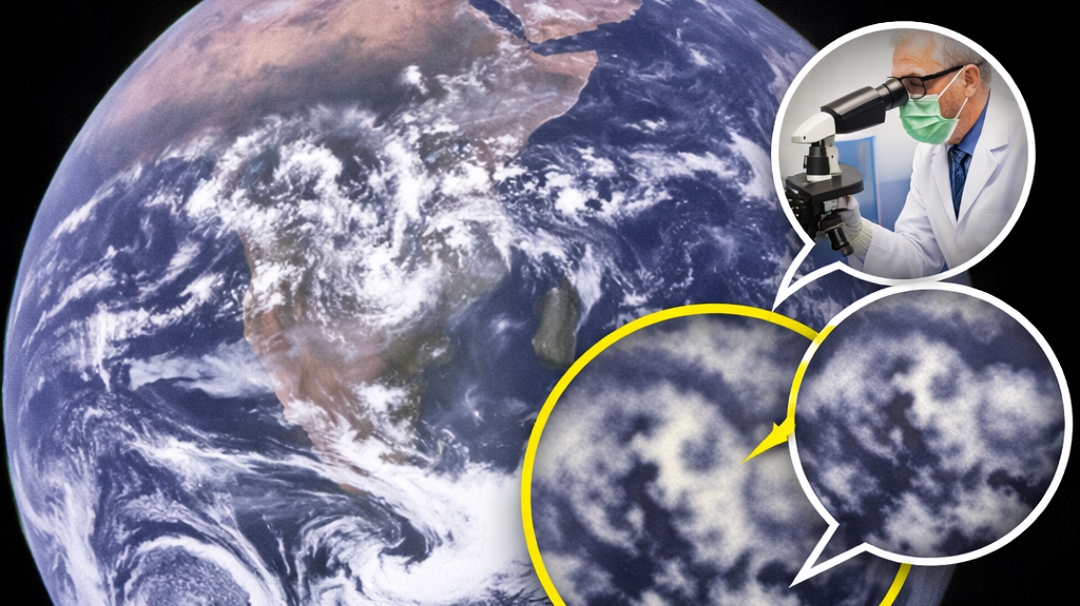
It began, as many modern mysteries do, with a single image shared online.
The photograph shows Earth suspended in darkness — oceans swirling in deep blue, continents edged in white, and cloud systems curling across vast stretches of the atmosphere. But what captured the internet’s imagination was not the scale of the planet itself. It was a particular cloud formation, highlighted and magnified, that some viewers insisted looked unmistakably like a human face gazing back into space.
Within hours, the image was circulating across social platforms, drawing millions of views. Comment sections filled with speculation. Some called it breathtaking. Others called it eerie. A few suggested it was something more.
“It stopped me in my tracks,” one user wrote. “It looks intentional.”
The photo, taken by an Earth-observing satellite operated by an international space agency, is authentic. Scientists confirm it captures a real weather system forming over the southern hemisphere. What is less extraordinary, they say, is the shape people believe they see.
This phenomenon has a name: pareidolia.
Humans are wired to detect faces and patterns. It is a survival instinct that once helped our ancestors quickly identify threats and allies. That same neural shortcut now leads us to see animals in clouds, faces in rock formations and figures on the surface of distant planets.
Dr. Elena Morales, an atmospheric scientist who reviewed the image after it went viral, said the cloud structure is consistent with common cyclonic formations. “There’s nothing structurally unusual about it,” she explained. “It’s a standard swirling system shaped by wind currents, temperature gradients and moisture.”
Yet the emotional response has been anything but standard.
Part of the power of the image lies in timing. In an era defined by climate anxiety, geopolitical tension and rapid technological change, images of Earth often carry symbolic weight. The so-called “Blue Marble” photographs taken decades ago reshaped how people thought about the planet — not as divided territory, but as a fragile, unified sphere.