
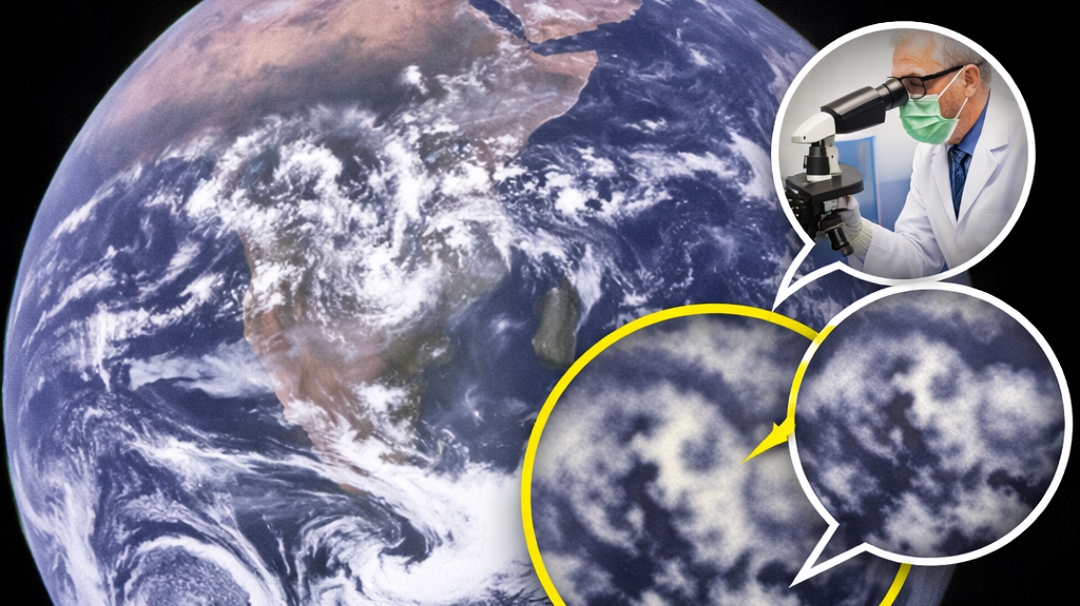
It began, as many modern mysteries do, with a single image shared online.
The photograph shows Earth suspended in darkness — oceans swirling in deep blue, continents edged in white, and cloud systems curling across vast stretches of the atmosphere. But what captured the internet’s imagination was not the scale of the planet itself. It was a particular cloud formation, highlighted and magnified, that some viewers insisted looked unmistakably like a human face gazing back into space.
Within hours, the image was circulating across social platforms, drawing millions of views. Comment sections filled with speculation. Some called it breathtaking. Others called it eerie. A few suggested it was something more.
“It stopped me in my tracks,” one user wrote. “It looks intentional.”
The photo, taken by an Earth-observing satellite operated by an international space agency, is authentic. Scientists confirm it captures a real weather system forming over the southern hemisphere. What is less extraordinary, they say, is the shape people believe they see.
This phenomenon has a name: pareidolia.
Humans are wired to detect faces and patterns. It is a survival instinct that once helped our ancestors quickly identify threats and allies. That same neural shortcut now leads us to see animals in clouds, faces in rock formations and figures on the surface of distant planets.
Dr. Elena Morales, an atmospheric scientist who reviewed the image after it went viral, said the cloud structure is consistent with common cyclonic formations. “There’s nothing structurally unusual about it,” she explained. “It’s a standard swirling system shaped by wind currents, temperature gradients and moisture.”
Yet the emotional response has been anything but standard.
Part of the power of the image lies in timing. In an era defined by climate anxiety, geopolitical tension and rapid technological change, images of Earth often carry symbolic weight. The so-called “Blue Marble” photographs taken decades ago reshaped how people thought about the planet — not as divided territory, but as a fragile, unified sphere.
This new image taps into a similar vein of collective imagination.
For some viewers, the perceived face feels comforting, almost protective. For others, it feels like a warning — a reminder of how small humanity is in the broader cosmic frame. Experts say such interpretations reveal more about human psychology than atmospheric science.
Clouds form through well-understood physical processes. As warm air rises, it cools and condenses around microscopic particles, creating the swirling patterns visible from orbit. Wind shear and planetary rotation shape these systems into spirals and arcs that can, under certain lighting conditions, resemble familiar shapes.
What makes this instance compelling is not scientific anomaly but visual coincidence.
High-resolution satellite imagery has dramatically improved over the last two decades. Modern instruments capture minute variations in cloud density, color and movement, producing images that are both scientifically valuable and visually arresting. When such images are shared outside academic circles, they often take on lives of their own.
“We see patterns because our brains are built to find meaning,” said Dr. Marcus Hale, a cognitive neuroscientist. “When something as vast as Earth seems to ‘look back’ at us, even metaphorically, it resonates.”
That resonance has fueled countless reposts, reaction videos and speculative threads. Some users have zoomed in further, outlining what they interpret as eyes and a mouth. Others have compared the formation to historical artworks or mythological figures.
Scientists, meanwhile, continue to emphasize scale.
From orbit, weather systems span hundreds of miles. What appears as a distinct “feature” in a cropped image often dissolves into randomness when viewed in full context. Meteorologists who analyzed the original data confirmed the formation evolved and dissipated within days, reshaped by shifting atmospheric pressure.
Still, the fascination persists.
Images of Earth have long had a unique cultural effect. Astronauts frequently describe the “overview effect” — a profound cognitive shift experienced when seeing the planet from space. The viral photo, though viewed from a phone screen rather than a spacecraft window, evokes a smaller version of that sensation.
It reminds viewers that beneath political borders and daily headlines, the planet remains a dynamic, living system.
The episode also underscores how quickly digital culture amplifies wonder. A satellite image once destined for scientific archives can now become a global talking point overnight.
In the end, researchers say, there is no hidden message in the clouds — no anomaly requiring revision of atmospheric models. But there is something revealing in the reaction.
The desire to find meaning in a swirl of vapor speaks to a deeper human impulse: to feel connected to something larger, even if that connection is imagined.
As the cloud formation drifts and reshapes, as all clouds do, what remains is the reminder that Earth itself is endlessly capable of inspiring awe — whether through science, symbolism or the simple act of looking up.