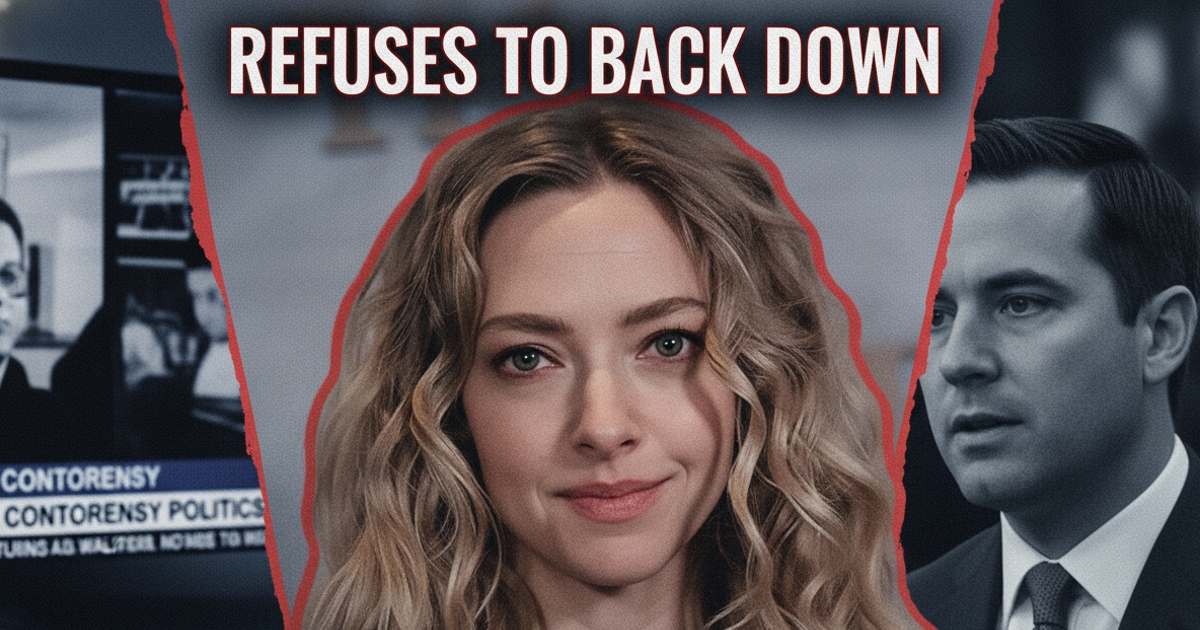
Amanda Seyfried has been thrown into the center of a political cyclone she never asked for — and now she’s firing back. The Oscar-nominated star became the focus of a fast-spreading misinformation storm this week after a fabricated screenshot circulated online, falsely showing her appearing to comment on the “assassination” of conservative activist Charlie Kirk. The doctored post — which experts say mirrors digital hoaxes previously analyzed in a misinformation-spread study — ignited outrage across political circles, sending Seyfried scrambling to respond before the narrative overtook her.
The fake screenshot, which mimicked the format of Instagram story quotes archived in collections like fact-checking databases on doctored posts, appeared late Sunday night and ricocheted through Twitter, TikTok, and far-right forums within minutes. In it, Seyfried was shown reacting to a made-up headline about an “attempted assassination” targeting Kirk — a headline that never existed, mirroring the kind of fabricated political alerts documented in deepfake threat assessments.
By morning, thousands of users were treating the fake post as real. Commentators who had previously monitored misinformation waves referenced patterns similar to those seen in a Reuters analysis of digital deception, noting that the speed of spread resembled an organized amplification effort.
Everyone blasting Amanda Seyfried needs to chill — that screenshot is SO clearly fake. People believe anything if it fits their outrage quota. — J.P. (@TruthLensJP) Dec 13, 2025
Seyfried responded quickly — and bluntly. In a statement that outlets compared to celebrity pushbacks documented in media-manipulation reporting, she wrote: “Someone edited my words into a sick joke. I’m not f***ing apologizing for calling it out.” The comment immediately went viral, drawing support from fans while provoking fury from political influencers who accused her of “disrespecting” a conservative figure, despite the fact that she had never commented on Kirk at all.
Digital forensics researchers who examined the fake screenshot pointed to compression artifacts and font inconsistencies identical to patterns explained in journalistic guides to detecting fabricated posts. Yet countless users shared it anyway, illustrating what media analysts described in a Pew research snapshot: emotionally charged content spreads faster than corrections.
Amanda Seyfried literally didn’t DO anything. A fake screenshot dropped, and suddenly she’s trending for “assassination discourse.” This is insane. — K.R. (@CultureWatchKR) Dec 13, 2025
As outrage escalated, conservative commentators framed Seyfried’s refusal to apologize — for something she never said — as evidence of “Hollywood hostility toward the right,” echoing narrative cycles dissected in a political-culture deep dive. Progressive voices, meanwhile, argued she had every right to be angry, pointing to past cases catalogued in misquote-tracking reports where public figures were dragged for statements that never happened.
The scandal grew louder as opportunistic accounts began attaching the doctored screenshot to unrelated incidents, mimicking the misinformation snowballing described in viral disinformation research. Some even claimed Seyfried had “a history of violent comments,” using cherry-picked clips from unrelated interviews that had previously appeared in entertainment coverage through actor-profile retrospectives.
Meanwhile, Charlie Kirk himself has not been the target of any assassination attempt — nor has such an event been reported in credible outlets, a fact that mirrors the fabricated political crisis alerts examined in fact-checking archives. His name appears to have been chosen to maximize viral traction, leveraging his polarizing reputation and highly reactive fan base.
The fact that someone used Charlie Kirk + Amanda Seyfried + “assassination” in one fake post shows EXACTLY how manipulated outrage works online. — L.S. (@MediaLogicLS) Dec 13, 2025
By Tuesday morning, Seyfried’s firm stance — “I’m not fing apologizing” — was dominating entertainment coverage, with analysts comparing it to celebrity blowback moments studied in media-response roundups. Her refusal to bend struck a chord with fans who have watched countless actors issue pressured apologies for things they never actually said. However, misinformation researchers warn that even debunked content can leave lasting reputational damage, a phenomenon outlined in cognitive-persistence studies showing that false claims can imprint on public memory long after they’re disproven. Seyfried’s team has reportedly been monitoring the spread of the doctored image across platforms, and insiders familiar with celebrity PR strategies pointed journalists toward tactics mapped in reputation-management advisories. What makes this controversy particularly volatile is its intersection of Hollywood, political culture, deepfake-style misinformation, and outrage-bait architecture — a mixture that researchers say is becoming more common, especially during election cycles. Analysts referenced structural patterns described in AI-driven misinformation reporting, warning that doctored celebrity posts often function as accelerants in polarized environments. By Wednesday, hashtags defending Seyfried began overtaking the original accusation, mirroring the backlash-to-the-backlash cycles documented in cancel-culture reversal analyses. Supporters emphasized that Seyfried has never shown any public hostility toward Kirk — or any political figure — in her long career, a fact confirmed by interviews preserved in celebrity-profile archives.
Still, the actress’ explicit declaration — “I’m not fing apologizing” — struck a deeper cultural nerve. Commentators noted similarities to the growing movement of public figures refusing to bow to viral pressure, a trend discussed in a digital-culture trend report, which argues that audiences are increasingly supportive of celebrities who push back against bad-faith outrage.
Amanda Seyfried just changed the rulebook: Don’t apologize for fake quotes. Don’t legitimize lies. Stand your ground. — M.D. (@PopPulseMD) Dec 13, 2025
For now, Seyfried’s refusal to apologize has become its own symbol — a pushback against misinformation culture and a reminder that viral lies can ensnare even the most apolitical celebrities. Her response has resonated with fans weary of watching fabricated scandals destroy reputations overnight, reinforcing the emotional weight of stories explored in misinformation-impact reports.
As the controversy continues to evolve, one thing is clear: this wasn’t a political statement, a provocation, or an attack. It was a hoax — and Seyfried’s unfiltered response has transformed it from a smear campaign into a rare moment of celebrity defiance in an era where online lies spread faster than truth.