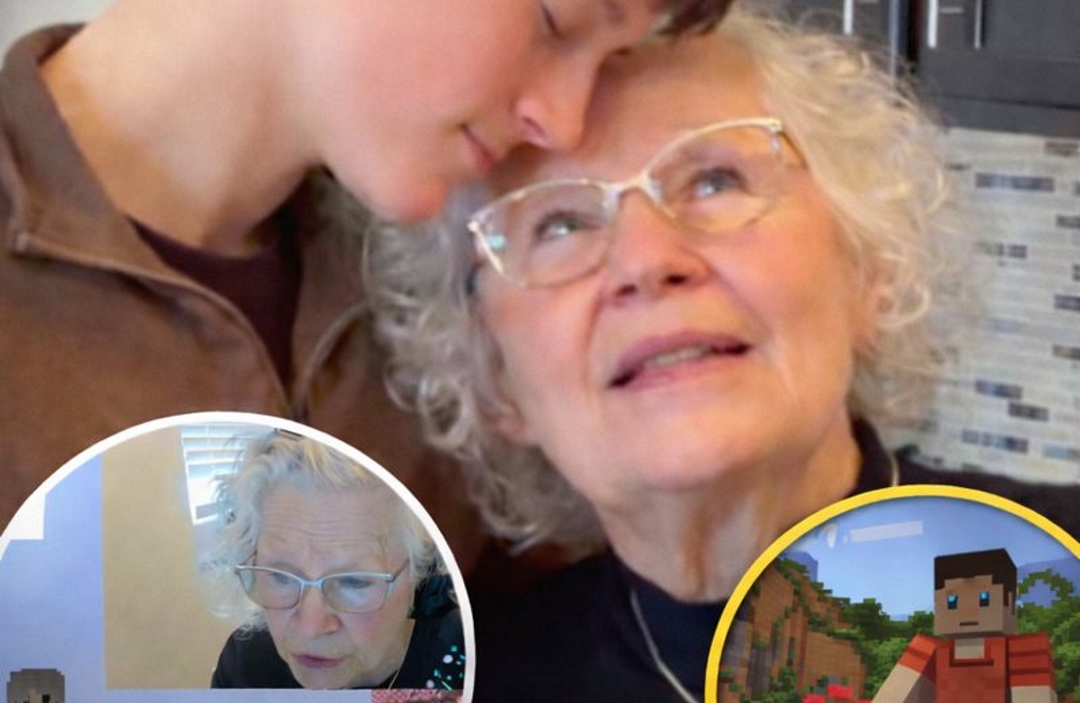
At first glance, the image looks like a quiet family moment: a teenage boy resting his forehead against his grandmother’s, her eyes soft, steady, and full of care. But behind that stillness is a story that has quietly shaken the internet — not because it’s flashy, but because it’s deeply human.
At 81 years old, this grandmother had never touched a video game controller. She didn’t grow up with consoles, avatars, or digital worlds. What she did grow up with was responsibility — and when her grandson began slipping into isolation, grief, and emotional shutdown, she did the only thing that made sense to her.
She followed him.
Her grandson, like millions of kids, found refuge in Minecraft. The blocky universe became a place where he could control something when real life felt unmanageable. Family members noticed he stopped talking as much, stopped engaging, stopped letting people in. According to relatives, Minecraft wasn’t just a game — it was where he went to survive.
So his grandmother asked a question few expected: “Can you show me?”
What started as curiosity turned into commitment. She learned how to move, how to build, how to navigate pixelated terrain. She sat through confusion, frustration, and embarrassment, documented in stories about intergenerational gaming that show just how foreign this world can feel at first.
But she didn’t quit.
Inside the game, something changed. Her grandson began explaining things again. He laughed. He invited her into worlds he had built alone. For the first time in months, he wasn’t shutting someone out — he was letting her in.
Psychologists say this kind of shared digital space can be powerful. Research into connection through play shows that games can act as emotional bridges, especially for young people struggling to verbalize pain.
The story might have ended there, quietly meaningful and private. But it didn’t.
A short clip of the grandmother learning Minecraft was shared online. Then another. Soon, screenshots of her avatar — simple, earnest, unmistakably new — began circulating. The internet, often cruel and impatient, responded in an unexpected way.
An 81-year-old grandma learning Minecraft to connect with her grandson is the most important thing I’ve seen all week. — PixelHeart (@PixelHeart) March 2026
People didn’t mock her. They thanked her.
Comments poured in from gamers who said they wished someone had tried that hard for them. From parents who realized they’d dismissed their kids’ online worlds too easily. From grandparents who wondered if it wasn’t too late to learn something new after all.
One viral thread linked her story to broader conversations about mental health and gaming, pushing back against the idea that games are purely escapist or harmful.
The grandmother herself seemed surprised by the reaction. In interviews, she downplayed her role, saying she just wanted her grandson back. She didn’t see herself as inspirational — just present.
That may be why the story landed so hard.
In a culture obsessed with quick fixes and expert advice, her approach was painfully simple. She didn’t try to pull him out of his world. She stepped into it.
Experts on aging and cognition also pointed out another layer. Learning complex games later in life has been linked to improved memory, focus, and emotional resilience, as outlined in studies on cognitive engagement in seniors. Without realizing it, she was helping herself too.
Today, the two still play together. Sometimes they build. Sometimes they just walk through virtual landscapes in silence. That, she says, is enough.
She didn’t “save” him by changing him. She saved him by staying. That’s the lesson. — QuietStories (@QuietStories) March 2026
The image now circulating online captures more than a grandmother and her grandson. It captures a truth the internet rarely slows down enough to notice: connection doesn’t require fluency. It requires effort.
At 81, she didn’t learn Minecraft to be cool. She learned it to love — and somehow, that was more than enough.