
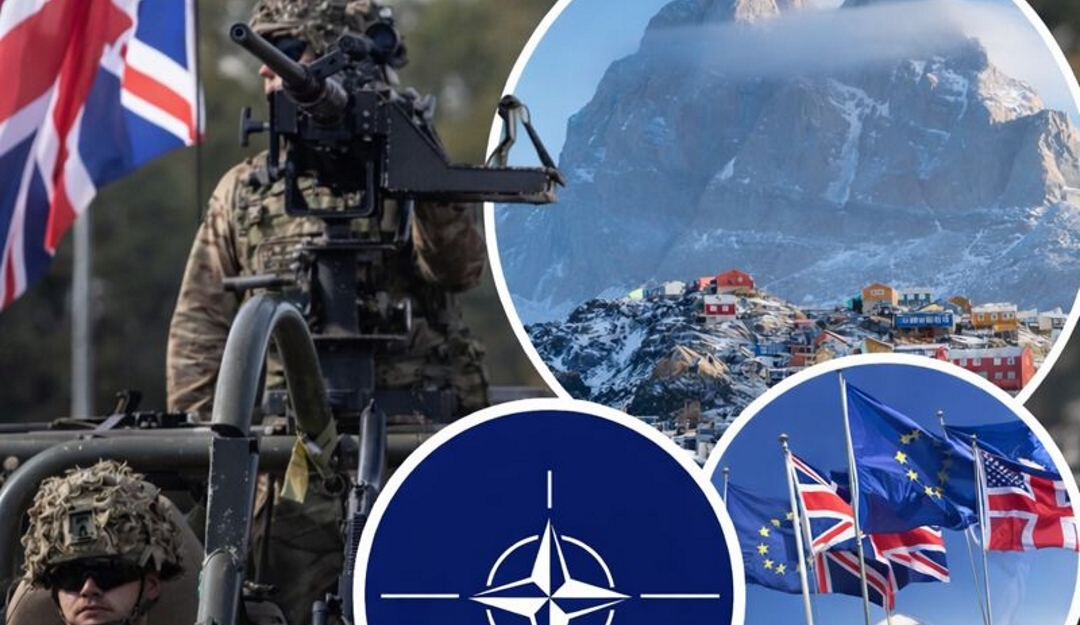
The image feels almost cinematic at first glance. Armored vehicles, soldiers under cold skies, flags snapping in Arctic wind. But behind the visuals is a shift that diplomats and generals alike admit has been building for years. Greenland, long treated as remote and symbolic, is suddenly at the center of Europe’s military anxiety.
Great Britain is now openly urging European allies to expand NATO’s military footprint on the vast Arctic island, arguing that the region’s strategic importance has outgrown its historically light defense presence. What once sounded like contingency planning is increasingly being framed as necessity, driven by climate change, new shipping routes, and intensifying global power competition.
British defense officials have warned in private briefings that Greenland’s geography — positioned between North America, Europe, and the Arctic Ocean — makes it impossible to ignore as ice melts and access expands. According to people familiar with the discussions, London believes the alliance must move faster than it did in the Baltic or Black Sea regions, where military posture lagged geopolitical reality.
Much of the urgency stems from the Arctic itself changing. Shrinking ice has opened corridors once considered impractical, a development outlined in recent climate modeling research that defense planners now study closely. As polar routes become viable for both commercial and military transit, control of surrounding territory has taken on new weight.
Greenland, while part of the Kingdom of Denmark, hosts critical infrastructure already — most notably the U.S.-operated Thule Air Base. But British officials argue that existing arrangements are outdated. They want a broader NATO posture that includes enhanced radar systems, expanded joint exercises, and a rotational troop presence involving multiple European states.
Behind closed doors, some allies have been cautious. Denmark remains sensitive to any move that could be perceived as militarizing the island without full local consent. Greenlandic leaders, who have pushed for greater autonomy in recent years, are wary of becoming a pawn in a great-power chess game. Still, European security officials privately acknowledge that strategic competition in the Arctic has already arrived.
Russia’s growing Arctic military infrastructure looms large in the conversation. From airfields to missile systems, Moscow has steadily expanded its northern capabilities. China, too, has labeled itself a “near-Arctic state,” investing in research stations and signaling long-term ambitions. British defense analysts say ignoring these moves would repeat mistakes made elsewhere.
The Arctic is no longer a frozen buffer. It’s becoming a frontline, whether Europe likes it or not. — Dr. Jack Watling (@Jack_Watling) March 2026
The push from London also reflects a broader recalibration of Britain’s post-Brexit defense identity. Officials see leadership on Arctic security as a way to reinforce relevance within NATO, especially as European allies reassess their own vulnerabilities. One briefing note referenced recent defense assessments warning that under-protected regions invite miscalculation.
Critics argue the plan risks escalation. Environmental groups fear military expansion could damage fragile ecosystems. Others warn that an increased NATO footprint might provoke exactly the confrontation it seeks to deter. But proponents counter that deterrence fails when it is invisible, particularly in regions where surveillance gaps remain wide.
Even within NATO, the conversation is evolving. Officials now speak openly about the Arctic as a single strategic theater rather than a collection of national zones. That shift alone marks a departure from decades of thinking, when the region was treated as peripheral compared to Eastern Europe or the Middle East.
Greenland isn’t remote anymore — it’s central to missile defense, early warning, and future shipping lanes. — NATO Watch (@NATO_Watch) March 2026
For Greenland itself, the attention is both empowering and unsettling. Investment promises accompany security talks, but so do concerns about sovereignty and long-term consequences. Analysts point to earlier geopolitical flashpoints as examples of how quickly strategic interest can reshape local realities.
What is clear is that the Arctic’s era of strategic neglect is over. Britain’s call to expand NATO’s presence may be controversial, but it reflects a growing consensus that the world’s coldest regions are heating up politically. As ice retreats, power politics advance — and Greenland now stands squarely in their path.