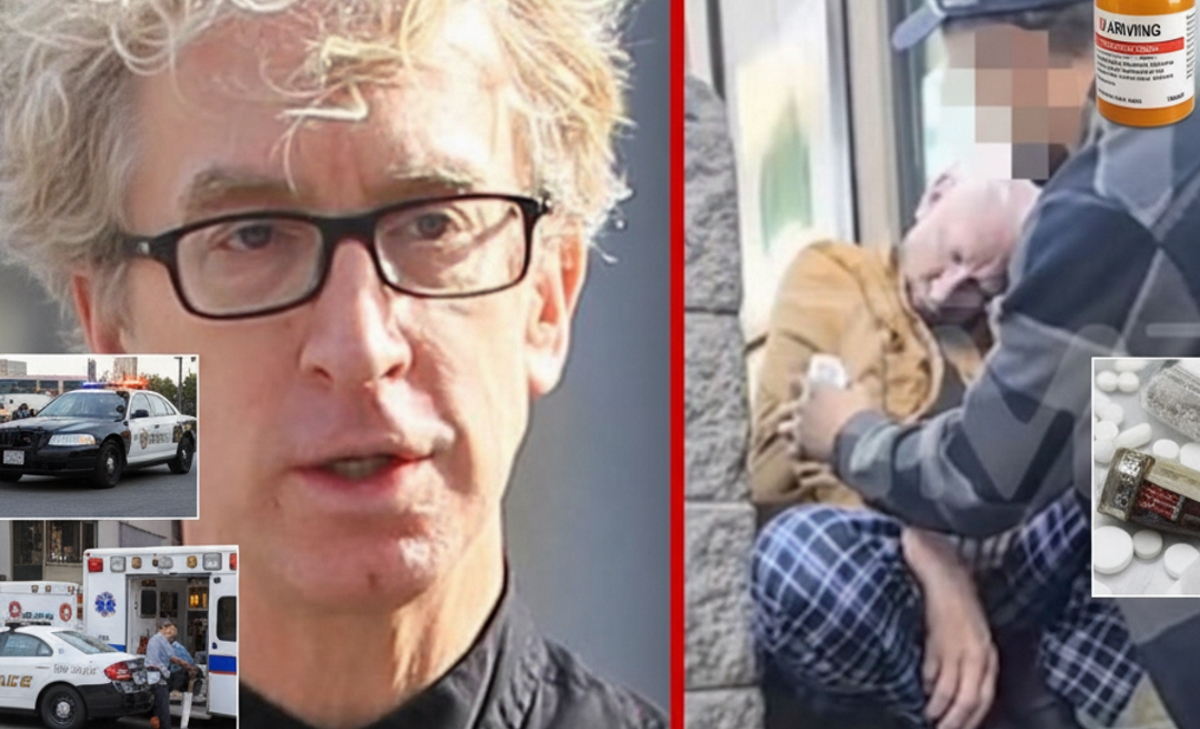
The sun was still high over Hollywood when bystanders noticed a motionless figure on a concrete staircase — a man slumped sideways, glasses crooked, chest barely rising. Moments later, someone recognized him: comedian Andy Dick, a performer once known for frantic energy and sharp improv timing, now lying unresponsive as witnesses begged him to breathe, a scene first captured in a raw street report circulating online.
Within seconds, panic washed across the sidewalk. A woman yelled for someone to check his pulse, while another dug frantically through a backpack for Narcan, the opioid-reversal spray that has become a quiet lifeline in cities across America. Their urgency echoed warnings described in a national health bulletin detailing how opioid-related collapses frequently hit without warning, often in the middle of the day.
One witness administered the spray as others shouted Dick’s name. The moment, according to early accounts summarized in an international recap, felt suspended in time — a man fighting for consciousness, strangers fighting to keep him here.
Just walked past Andy Dick being revived with Narcan in Hollywood. Wild, heartbreaking, and way too real. — M.M. (@MetroWitnessLA) Dec 9, 2025
Minutes later, firefighters from LAFD arrived, confirming to reporters — including those citing a follow-up investigation — that Dick regained consciousness on the ground. Police officers stepped in quickly as crowds formed, some filming, others shielding him from cameras. For insiders familiar with his struggles, the scene resembled a painful replay of warnings described inside a long-form timeline chronicling years of spiraling behavior.
Despite first responders urging him to accept medical transport, Dick refused treatment, insisting he was “fine,” a response consistent with patterns mentioned in a clinical overview explaining how individuals in crisis often underestimate the severity of overdose episodes.
Later that evening, Dick contacted TMZ to confirm he was alive. But he offered no explanation — no details, no clarity, only relief, a reaction echoed in a brief health update that said his voice sounded strained and shaken.
For longtime fans, the incident triggered familiar dread. Dick’s public battles with addiction and erratic behavior span decades, chronicled heavily throughout a detailed entertainment analysis outlining his arrests, rehab attempts, and spiraling personal relationships.
His 2022 sexual-battery conviction — extensively referenced in a legal breakdown — required him to register as a sex offender and marked a steep turning point. After that case, his behavior grew increasingly unpredictable, with further arrests reported inside a California police report describing charges linked to public intoxication and failure to comply with registration rules.
Friends close to the actor have, over the years, expressed fear that the chaos around him would escalate into something irreversible. A former collaborator, speaking in an interview archived by a Hollywood career retrospective, described him as “brilliant, impossible, and in constant danger of self-destruction.”
Even during periods of apparent stability, moments of relapse have resurfaced — a phenomenon widely documented in a national medical study exploring how opioid relapse patterns often emerge suddenly, without visible warning signs.
Seeing Andy Dick like that is rough. Fame doesn’t protect you from addiction. I hope he gets help. — K.S. (@LAreportKS) Dec 9, 2025
Witnesses say Tuesday’s overdose felt different — not chaotic, but eerily quiet. Bystanders reported the kind of stillness described in passages about opioid collapses inside a federal health summary: slow breathing, pale skin, limp limbs. That stillness broke only when Narcan took effect, forcing his body back toward consciousness.
The broader public response has been conflicted — sympathy mixed with exhaustion, concern mixed with criticism. Some argue that Hollywood circles enabled Dick’s decline, echoing themes discussed inside a studio-industry editorial about how fame can shield destructive behavior for years.
Others point to the opioid epidemic itself — a crisis ravaging cities far beyond Los Angeles, highlighted in a national investigative report explaining how overdose fatalities are no longer confined to specific demographics but cutting across age, income, and profession.
Some online reactions turned sharply critical, accusing the public of ignoring earlier warnings and enabling a cycle of collapse and revival. A thread summarizing that frustration in a public forum debate described the overdose as “years in the making.”
People laugh at Andy Dick, but addiction is deadly serious. He’s lucky someone had Narcan. — A.R. (@StreetNewsAR) Dec 9, 2025
Yet others noted that strangers acted faster than many of the people who once depended on him professionally — an irony similar to observations made in a cultural critique about the entertainment industry’s tendency to distance itself from troubled stars only after public collapse becomes impossible to ignore.
As questions linger, police have confirmed there is no criminal investigation at this time. Officials reiterated protocols consistent with details outlined in a public LAPD reference guide, stating that non-fatal overdoses are treated as medical emergencies rather than criminal matters unless evidence suggests otherwise.
What investigators did confirm — through updates reflected in a regional news briefing — is that Dick was conscious, speaking softly, and able to stand by the time authorities finished their assessment.
But despite the relative calm, those who saw him lying on the steps say the visual will stay with them. One witness later described the moment in a recap amplified in a cultural digest, saying “he looked gone — I thought we were watching someone die.”
Just hope Andy Dick realizes he got a second chance today. Not everyone gets that. — J.L. (@CivicObserverJL) Dec 9, 2025
For now, Dick has offered no plan for treatment, rehabilitation, or follow-up care. His representatives have remained silent. But those at the scene say the overdose was disturbingly severe — the kind authorities warn about inside a national addiction-support guideline outlining how rapidly opioid-related emergencies can escalate without immediate intervention.
Hollywood has long been a city of reinvention, but rarely does reinvention come with a reminder this stark: that even the most recognizable performers can collapse in total public view, dependent on the mercy and speed of strangers who carry Narcan in their backpacks because they know how often this city forces them to use it.