
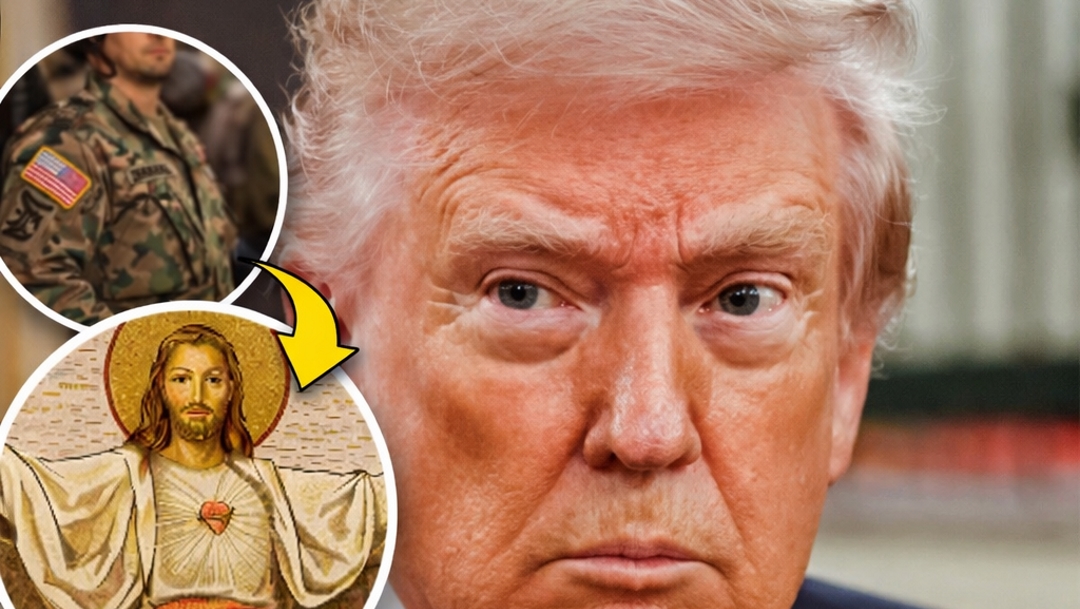
A recent statement attributed to a U.S. military figure has stirred intense debate online after comments surfaced suggesting former President Donald Trump had been “chosen by Jesus” to confront Iran. The remark quickly spread across social media, igniting discussions that blend politics, religion, and international relations — three forces that have often collided throughout American history.
The comment, which circulated widely after being referenced in several political discussions, reflects a long-running phenomenon in American political culture: the use of religious language to frame geopolitical conflicts. For supporters, such statements can symbolize moral conviction or spiritual interpretation of world events. For critics, they raise concerns about mixing religious prophecy with government decision-making.
The United States has always had a complicated relationship between faith and politics. While the Constitution establishes a separation between church and state, religious rhetoric has frequently appeared in political speeches, particularly during times of international tension.
During the Cold War, for example, American leaders often framed the ideological struggle with the Soviet Union in moral or spiritual terms. Presidents referenced divine guidance, national destiny, and moral responsibility when discussing global conflict.
The same dynamic has occasionally appeared in discussions about the Middle East.
For decades, tensions between the United States and Iran have remained one of the most volatile geopolitical relationships in the world. Disagreements over Iran’s nuclear ambitions, economic sanctions, and regional influence have fueled repeated diplomatic crises between the two nations.
Those tensions escalated significantly during Trump’s presidency.
In 2018, the United States withdrew from the Joint Comprehensive Plan of Action — the international agreement designed to limit Iran’s nuclear program. The move triggered a new wave of economic sanctions and further strained relations between Washington and Tehran.
The conflict reached one of its most dramatic moments in January 2020 when a U.S. drone strike killed Iranian General Qassem Soleimani in Baghdad. The strike prompted immediate retaliation from Iran, which launched missile attacks on bases housing American troops in Iraq.
Although the confrontation stopped short of full-scale war, it underscored how fragile the situation had become.
Against that backdrop, religious interpretations of the conflict have occasionally surfaced in political discourse. Some religious leaders and commentators view global events through a prophetic or theological lens, interpreting geopolitical developments as part of a broader spiritual narrative.
Such interpretations are not unique to any one political movement or country.
Throughout history, religious symbolism has often been used by leaders and commentators to frame conflicts as struggles between good and evil or between competing moral visions of the world. In the United States, these themes sometimes appear in political messaging aimed at audiences that place strong emphasis on faith.
However, experts say that while religious language can resonate with certain communities, it also carries risks when applied to international diplomacy.
Foreign policy analysts warn that framing geopolitical disputes in apocalyptic or prophetic terms can complicate efforts to pursue diplomatic solutions. When conflicts are portrayed as inevitable or divinely mandated, compromise may appear politically or morally unacceptable to some audiences.
That tension helps explain why the recent comments have generated such strong reactions.
Supporters of Trump have often described his foreign policy approach toward Iran as firm and necessary, arguing that strong deterrence is essential to prevent further escalation in the region. Critics, meanwhile, contend that aggressive rhetoric and religious framing can heighten already dangerous tensions.
The debate also reflects a broader question that continues to shape American politics: how much influence religious beliefs should have in shaping government policy.
For some voters, faith plays a central role in political identity and national values. For others, the separation of religion and state remains a fundamental principle that should guide public leadership.
As discussions about Iran, security, and global stability continue, the intersection of faith and politics is likely to remain part of the conversation.
And as recent reactions show, even a single comment linking religion and foreign policy can quickly ignite debate across the country.