
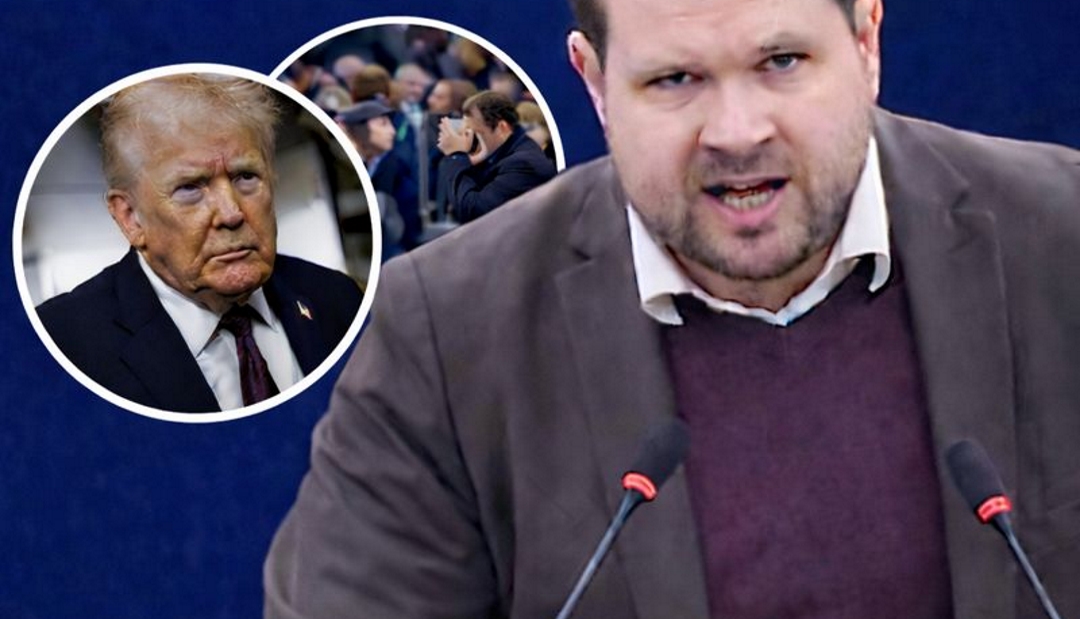
The moment unfolded fast and stunned the room. A Danish politician, standing at the podium inside a European parliamentary chamber, launched into a heated condemnation of Donald Trump’s past comments about Greenland — only to be abruptly cut off mid-sentence as officials moved to shut down the exchange.
The image captures the intensity perfectly: a clenched fist, a raised voice, and the unmistakable look of someone who knew they had crossed a line — and chose to cross it anyway. What followed has rippled far beyond Denmark, reigniting an already sensitive debate about sovereignty, diplomacy, and how far European leaders are willing to go in pushing back against American power.
At the center of the clash was Trump’s long-standing fixation on Greenland, the autonomous Danish territory rich in minerals and strategically positioned in the Arctic. His suggestion, floated publicly years ago, that the United States should acquire Greenland was initially dismissed as unserious. But for many in Denmark, it never stopped being alarming.
During the debate, the lawmaker reportedly abandoned diplomatic language altogether, delivering a blunt, emotionally charged rebuke aimed directly at Trump. Parliamentary officials intervened almost immediately, citing rules around decorum and language, a move that only amplified attention on what had been said moments earlier.
Within hours, clips and transcripts began circulating online, alongside renewed analysis of why Greenland has become such a flashpoint. As outlined in a deep dive into Arctic strategy, the island has taken on outsized importance as climate change opens new shipping routes and access to rare earth minerals.
Danish officials were quick to distance themselves from the tone of the remarks, while still defending the underlying message. Greenland, they emphasized, is not for sale, not negotiable, and not a bargaining chip in global power games. The episode exposed just how raw the issue remains, even years after Trump first raised it.
The anger in that chamber wasn’t spontaneous. Greenland has been a simmering issue since 2019 — this was just the pressure valve blowing. — Arctic Watch (@ArcticWatchEU) February 2026
Political analysts note that what made the exchange so explosive wasn’t just the language, but the setting. European parliamentary debates are typically restrained, governed by rigid norms. When someone breaks that mold, it signals a deeper frustration that polite phrasing can no longer contain.
That frustration has been building as U.S.–Europe relations continue to strain under the weight of security concerns, trade disputes, and diverging views on global leadership. Greenland, in that sense, has become symbolic — a stand-in for fears about encroachment, influence, and respect.
Some commentators argue the interruption did more harm than good. By cutting the speaker off, critics say, officials inadvertently validated the sense that uncomfortable truths are being suppressed. Others counter that allowing the speech to continue would have undermined institutional norms entirely.
As discussed in an analysis of shifting Arctic power, Greenland’s value is no longer hypothetical. U.S. military installations already exist there, and China has shown growing interest in the region’s resources. Against that backdrop, rhetorical restraint is increasingly difficult to maintain.
Greenland isn’t just land — it’s leverage. And today proved how emotional that reality has become. — EU Politics Now (@EUPoliticsNow) February 2026
What’s striking is how quickly the incident resonated with audiences outside Europe. In the U.S., reactions split sharply along political lines. Some praised the bluntness as overdue honesty, while others saw it as disrespectful and counterproductive. The debate, much like the Arctic itself, is frozen on the surface but turbulent underneath.
For Denmark, the episode may serve as a warning that Greenland will remain a pressure point — one that tests alliances and tempers alike. And for Trump, whose shadow looms large over the exchange despite not being present, it’s another reminder that his words continue to reverberate internationally.
In the end, the speech may have been cut short, but the message landed. Greenland is not a punchline. And patience, at least in some corners of Europe, is wearing thin.