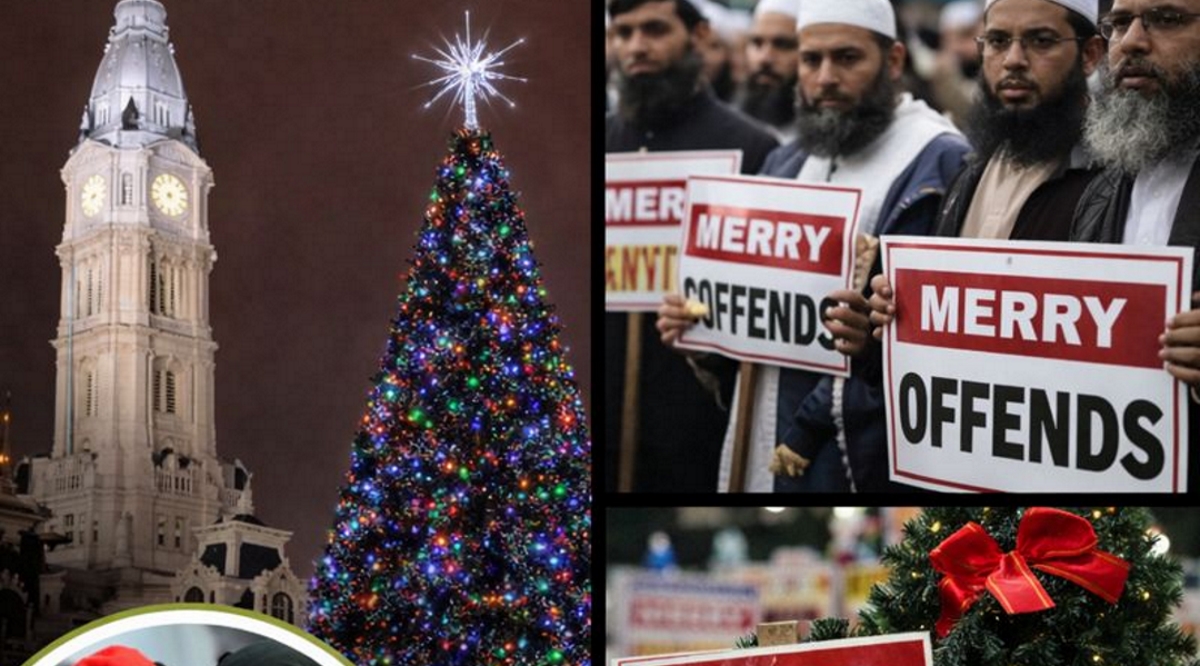
A new cultural flashpoint has erupted after reports surfaced that some Muslim voices and interfaith advocates have called for the term “Christmas tree” to be replaced with “holiday tree” in certain public spaces, citing religious sensitivity and inclusivity. The proposal, limited in scope but loud in reaction, has reignited a familiar national argument over tradition, accommodation, and what shared public culture should look like.
The push did not originate from a single national organization or religious authority. Instead, it emerged from local discussions in a handful of communities and school settings where officials were already grappling with how to represent multiple faiths during the end-of-year season. In those contexts, proponents argued that neutral language helps avoid privileging one religion over others in government-funded or shared civic spaces.
Supporters of the change emphasized that the request was not about erasing Christmas, but about naming conventions in settings meant to serve diverse populations. Similar language debates have played out before, particularly around seasonal greetings and decorations, a history often revisited in older examples people tend to forget when controversies resurface.
Still, the reaction was swift and intense. Critics accused those making the request of attempting to water down a Christian tradition, framing the debate as yet another instance of cultural overreach. Social media amplified the backlash, with some commentators portraying the proposal as a broader attempt to secularize Christmas entirely.
Muslim community leaders pushed back on that characterization, noting that many Muslims already participate in seasonal celebrations in non-religious ways while maintaining their own faith practices. They stressed that the discussion was about public institutions, not private homes or churches, a distinction often blurred during online debates.
Interfaith advocates echoed that point, arguing that neutral language in public spaces does not prevent anyone from celebrating religious holidays privately or communally. They pointed to guidance discussed in research that rarely trends on how pluralistic societies navigate shared traditions.
Calling something a holiday tree doesn’t cancel Christmas. It just acknowledges not everyone celebrates it. — Interfaith organizer (@SharedSpaces) Dec 2025
Opponents remain unconvinced. Many argue that Christmas has long functioned as both a religious and cultural holiday in the United States, and that changing terminology represents a concession that only flows in one direction. They warn that constant adjustments risk alienating people who feel their traditions are being treated as optional or expendable.
The controversy also highlights how quickly localized conversations can be nationalized. What began as a narrow discussion in specific settings ballooned into a broader cultural dispute once framed as a sweeping demand, a pattern examined in analysis of how culture wars spread through media ecosystems.
Muslim scholars pointed out that Islamic teachings do not require others to alter their religious language. They emphasized that participation in interfaith dialogue is often about coexistence rather than conformity. In many cases, they said, Muslim families are more concerned with ensuring their own holidays are respected than with renaming those of others.
At the same time, public institutions face genuine challenges. Schools, city halls, and libraries are often tasked with balancing representation while avoiding the appearance of endorsing a specific faith. Some administrators have adopted neutral language as a precaution, citing legal and inclusivity concerns, an approach described in guidance that doesn’t always make headlines.
This debate says more about anxiety than about trees. — Cultural commentator (@PublicSquare) Dec 2025
Polling suggests Americans are divided on these questions, often depending on how the issue is framed. When asked about inclusivity in public spaces, many support neutral language. When asked about preserving tradition, many express concern about losing cultural continuity. That tension is reflected in survey results that complicate simple narratives.
Some Christian leaders urged calm, noting that faith traditions are resilient and not threatened by terminology used outside religious settings. Others, however, warned that repeated concessions could gradually marginalize religious expression in the public sphere.
For many Muslims watching the backlash, the intensity has been surprising. Several community members said the debate has reinforced a sense that even modest requests for consideration can be interpreted as hostile acts, deepening mistrust rather than fostering understanding.
As with many cultural disputes, the loudest voices may not represent the majority. Most Americans continue to navigate the holiday season in ways that blend tradition, culture, and personal belief without incident. Yet moments like this reveal how fragile consensus can feel in a diverse society.
Whether the term “holiday tree” gains traction or fades as another seasonal controversy remains to be seen. What is clear is that the argument touches something deeper than decorations. It exposes unresolved questions about belonging, visibility, and how a pluralistic country shares public space.
In the end, the debate may say less about trees and more about trust — trust that honoring one tradition does not require diminishing another, and that coexistence does not have to come at the expense of identity.