
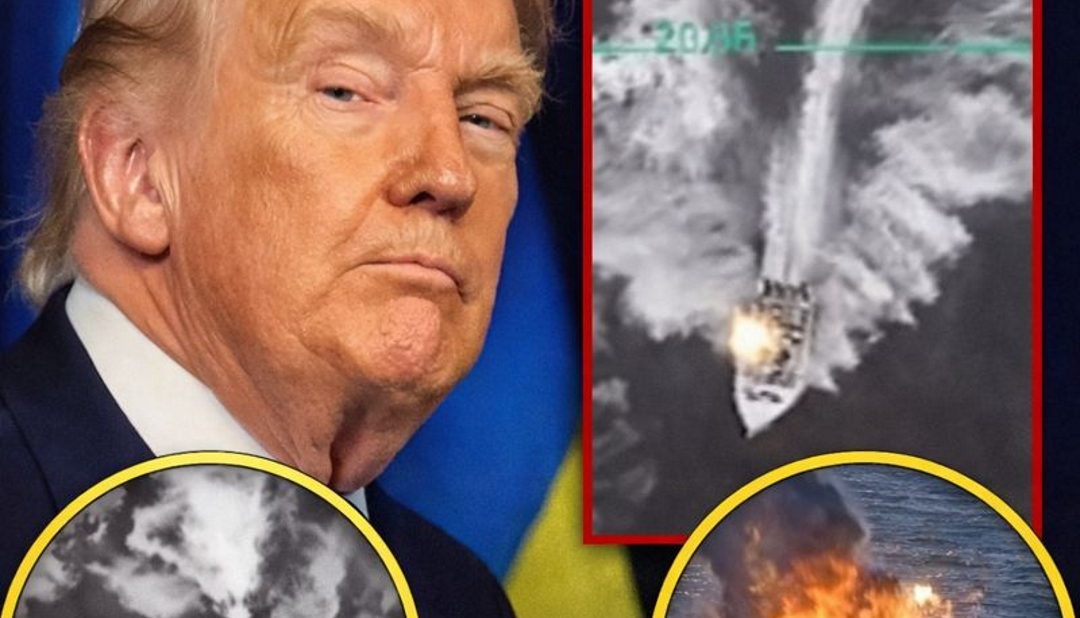
A grainy, high-contrast video began circulating online showing what appears to be a boat erupting into flames after being struck from above, the impact captured from an aerial perspective that resembles military targeting footage. Within hours, the clip was being widely discussed not just for its violent imagery, but for who amplified it.
The video was shared by :contentReference[oaicite:0]{index=0}, quickly igniting alarm among analysts, journalists, and social media users who questioned both the source of the footage and the intent behind its promotion. The imagery itself is stark: a vessel cutting through open water, a sudden flash, and an explosion that engulfs the boat in fire.
What exactly the video shows remains unclear. There is no verified information identifying the location, the date, or the parties involved. Despite that uncertainty, the clip’s presentation — complete with crosshair-style overlays and telemetry-like markings — has fueled speculation that it depicts a real-world military strike rather than a simulation or archival clip.
Defense observers were quick to caution against jumping to conclusions, pointing out that similar visuals are frequently recycled from unrelated conflicts, training footage, or even video games. Still, the decision to circulate such imagery carried weight, especially given the broader geopolitical climate and ongoing conflicts that dominate global headlines.
Some users traced earlier versions of the clip to obscure accounts that regularly post dramatic war footage, often without context. Others noted similarities to publicly available strike videos analyzed in open-source investigations, where misleading framing has previously distorted public understanding of real events.
The reaction online was swift and polarized. Supporters argued that the video underscored the reality of modern warfare and the need for strength. Critics accused the post of recklessness, warning that sharing violent, unverified footage risks inflaming tensions and spreading misinformation.
We have no confirmation where this video is from, yet it’s being framed as something much bigger. Context matters. — Conflict Watch (@ConflictWatchX) May 7, 2024
National security experts emphasized that imagery resembling aerial strikes carries symbolic power, particularly when detached from facts. A single clip can spark rumors, trigger diplomatic reactions, or be weaponized in information warfare — a phenomenon extensively documented in research on modern influence campaigns.
The concerns grew louder because the video was not accompanied by explanation or clarification. Without context, viewers were left to interpret the footage on their own, leading to wildly different narratives about what it showed and why it mattered.
Some analysts suggested the clip may have originated from footage released years ago during naval strike demonstrations, similar to material archived in defense reporting libraries. Others argued it could be edited content, stitched together to maximize shock value rather than inform.
The incident also reignited debate about the responsibility of high-profile figures when sharing violent content. Platforms routinely moderate graphic material, yet posts by influential accounts often travel faster than fact-checks can keep up. That imbalance has been highlighted repeatedly in discussions about misinformation dynamics in the digital age.
Sharing unverified strike footage without context is how misinformation spreads — regardless of intent. — Media Ethics (@MediaEthicsNow) May 7, 2024
As the clip continued to circulate, journalists pressed for answers about its origin. No official military sources have confirmed that the footage represents a recent or specific incident. In the absence of verification, many newsrooms declined to republish the video itself, opting instead to report on the reaction it generated.
The episode highlights how easily violent imagery can leap from obscurity into the mainstream when amplified by powerful voices. In a media environment already saturated with conflict footage, the line between documentation and provocation grows increasingly thin.
For now, the video remains an unanswered question — a few seconds of destruction floating free of time, place, and explanation. What lingers is not certainty, but unease, as viewers are left to wonder what they saw, and why they were meant to see it.