
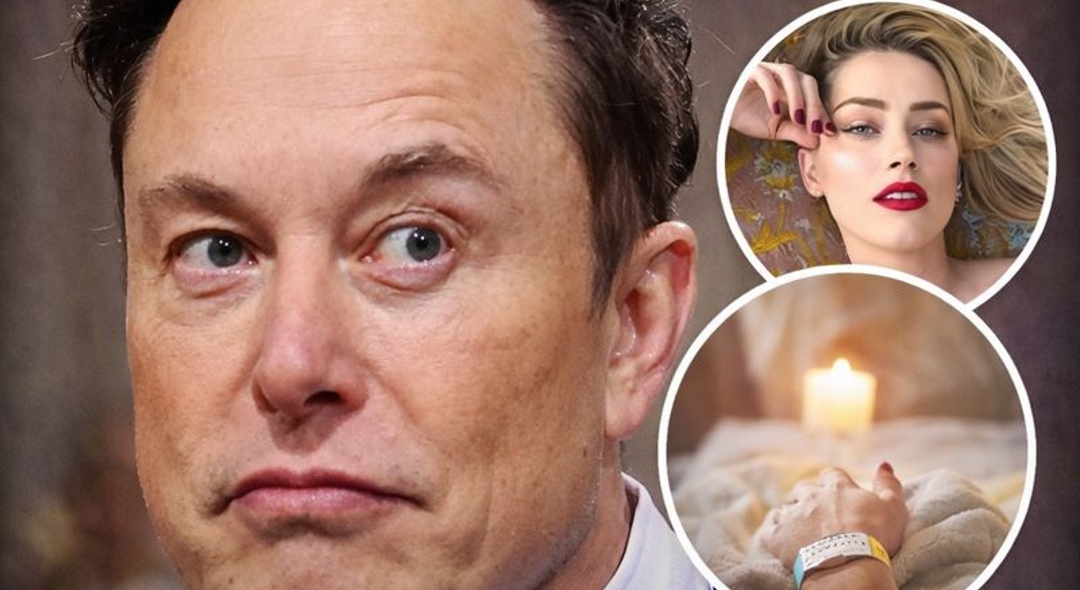
Elon Musk is facing renewed backlash online after users accused him of sharing a private image connected to Amber Heard, igniting another round of heated debate about consent, privacy, and power in the digital age. The controversy erupted quickly, spreading across social platforms as critics questioned why a high-profile billionaire would amplify deeply personal material tied to a former partner.
The image in question, which circulated rapidly after being posted, was described by many users as intimate and not intended for public consumption. While Musk did not explicitly explain the context behind the image, the lack of clarity only intensified the reaction, with many arguing that public figures have a heightened responsibility when it comes to sharing sensitive material.
Within hours, social media was flooded with condemnation. Some users accused Musk of violating boundaries, while others framed the post as an example of how powerful men can control narratives long after relationships end. Privacy advocates warned that even resharing disputed or “already leaked” material can compound harm, particularly when the subject has been at the center of years of public scrutiny.
Amber Heard, whose name has remained tightly linked to highly public legal battles and public judgment, did not immediately comment on the image. Supporters argued that her silence should not be interpreted as consent or approval, emphasizing that the absence of a response does not diminish the seriousness of sharing private imagery without clear permission.
Criticism was not limited to Musk’s detractors. Some longtime followers expressed discomfort, saying the post crossed a line regardless of personal opinions about Heard or her past controversies. Others questioned whether Musk’s history of provocative online behavior has blurred his sense of what should remain private versus public spectacle.
This is far from the first time Musk’s social media activity has triggered backlash. As the owner of X, formerly Twitter, he has frequently positioned himself as a champion of free expression, often arguing that open discourse requires tolerating discomfort. But critics countered that free speech does not equate to freedom from accountability, especially when posts involve private individuals rather than abstract ideas.
The situation also reignited broader discussions about revenge porn laws and digital ethics. Legal experts pointed out that many jurisdictions treat the non-consensual sharing of intimate images as a serious offense, regardless of who posts them or how influential they are. Even when legal consequences are unclear, reputational and ethical fallout can be swift.
In past interviews, Heard has spoken about the long-term emotional toll of having her personal life dissected online, describing how viral moments can linger indefinitely. Coverage examining how scrutiny continues to follow her years after high-profile trials has highlighted the difficulty of reclaiming privacy once it has been eroded, as explored in analysis of her post-trial public life.
Musk’s supporters pushed back against the backlash, arguing that the image had already circulated elsewhere and that singling him out was selective outrage. Some framed the criticism as politically motivated or rooted in dislike for Musk rather than genuine concern for privacy. Still, even among defenders, there was acknowledgment that the optics were poor.
What made the reaction particularly intense was the imbalance of power involved. Musk is one of the most influential figures in the world, commanding a platform that reaches hundreds of millions. When someone with that reach shares sensitive content, the scale of exposure multiplies instantly, leaving little room for nuance or correction.
Media scholars noted that celebrity scandals increasingly operate as feedback loops. One post triggers outrage, outrage fuels coverage, and coverage cements the moment into public memory, often with little regard for the long-term consequences for those involved. In this case, critics argued, the cycle once again placed Heard’s body and privacy at the center of a spectacle she did not initiate.
The backlash also reopened questions about platform governance. As owner of X, Musk occupies a dual role as both user and rule-maker, leading some to question how moderation standards apply when the platform’s most powerful account is the one under scrutiny. Calls for clearer enforcement of policies around intimate imagery grew louder as the controversy spread.
So far, Musk has not issued a formal apology or detailed explanation, allowing speculation to fill the vacuum. Communication experts noted that silence can sometimes escalate backlash, especially when audiences expect accountability or clarification from someone accustomed to speaking freely online.
For many observers, the incident was less about Musk or Heard individually and more about a recurring pattern in internet culture: deeply personal moments becoming ammunition in public battles. As one commentator put it, outrage may fade, but the images and their impact often do not.
As debates over digital consent continue, the episode serves as another reminder that online actions, particularly by those with immense influence, can have consequences far beyond a single post. Reporting on the growing criticism has underscored how quickly public sentiment can turn when privacy lines appear to be crossed, as detailed in coverage of the backlash surrounding the post.
Whether the controversy will prompt reflection or simply become another fleeting storm in Musk’s long history of online disputes remains unclear. What is certain is that questions about consent, power, and responsibility in the digital age are not going away — and each new incident adds fuel to a conversation that is growing louder, not quieter.