
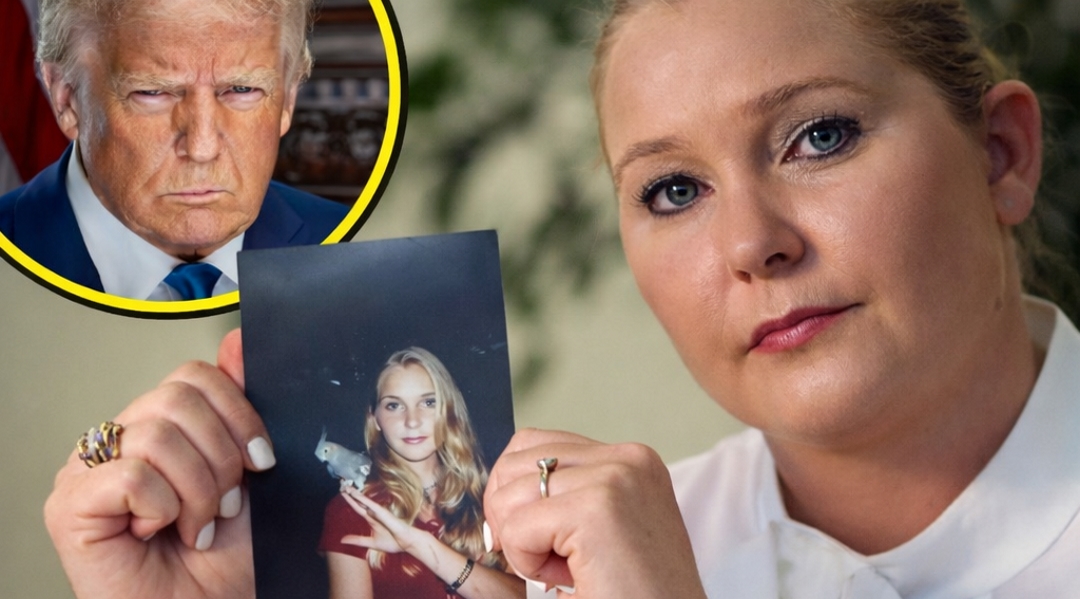
A woman who has publicly identified herself as a victim of Jeffrey Epstein is now alleging that undisclosed recordings exist that could have major political consequences for Donald Trump. The claim, made during a recent interview, immediately sparked fierce debate across social media and cable news panels, though no evidence has been produced to support the assertion.
The accuser said she believes there are “secret tapes” connected to Epstein’s network that could implicate powerful figures. She did not provide proof of their existence, nor did she specify who may be in possession of such recordings. Still, the suggestion alone was enough to reignite long-running speculation about what materials federal investigators seized during the 2019 raids on Epstein’s properties.
Authorities recovered hard drives, computers, and storage devices when Epstein was arrested on federal sex trafficking charges in July 2019. According to reporting at the time, including coverage by NBC News detailing what investigators found during the Manhattan raid, agents removed a significant amount of electronic equipment and physical documents from his residence. However, officials have never publicly confirmed the existence of hidden tapes tied to specific political figures.
Trump’s name has surfaced in public discussions of Epstein largely because the two were socially acquainted in the 1990s and early 2000s. Photographs and video footage from that era show them at shared events. Trump has repeatedly stated that he distanced himself from Epstein years before the financier’s arrest, and he has denied any wrongdoing related to Epstein’s crimes.
The accuser’s comments come at a time when Epstein’s legacy continues to cast a long shadow over American politics. His death in a federal jail in August 2019 was officially ruled a suicide, yet the circumstances surrounding it have fueled persistent conspiracy theories. Coverage from The Associated Press reviewing the official findings into Epstein’s death highlights how multiple investigations concluded there was no evidence of foul play, despite widespread public suspicion.
Legal experts caution that allegations alone do not constitute evidence. For any such recordings to have legal consequences, they would need to be authenticated, verified, and shown to contain incriminating material. Without that, the claims remain speculative.
Trump allies moved quickly to dismiss the allegation as politically motivated. Several former administration officials argued that if such material existed and contained actionable evidence, it would likely have surfaced during prior investigations. They emphasized that federal prosecutors, congressional committees, and journalists have spent years examining every possible connection between Epstein and prominent public figures.
At the same time, critics argue that the public has never seen the full scope of the evidence collected from Epstein’s properties. They point out that many documents remain sealed in court proceedings tied to civil lawsuits and criminal cases involving his associates. That gap in public knowledge leaves room for continued speculation.
The mention of potential impeachment adds another layer of political drama. Under the Constitution, impeachment requires a majority vote in the House of Representatives and a two-thirds vote in the Senate for removal. It is a political process rather than a criminal one, meaning it depends heavily on the balance of power in Congress and the prevailing political climate.
Trump has already faced impeachment twice during his presidency, though he was acquitted by the Senate on both occasions. Any new effort would require substantial evidence and political consensus, both of which appear distant in the current environment.
The broader issue is how unverified claims can shape public discourse. In the digital age, allegations spread rapidly, often outpacing fact-checking efforts. Even when claims lack documentation, they can influence public perception and deepen partisan divides.
For survivors of Epstein’s abuse, the situation remains deeply personal. Many have expressed frustration that powerful individuals have not faced more scrutiny. Others have warned against turning their experiences into political weapons. The pain of those directly harmed by Epstein is often overshadowed by the high-profile names associated with him.
Legal analysts say that if credible evidence of undisclosed recordings were to emerge, the matter would likely fall to federal investigators or a special counsel. Any findings would need to meet strict evidentiary standards before influencing impeachment discussions or criminal proceedings.
As of now, there is no public confirmation that such tapes exist, nor has any federal agency announced new findings tied to the allegation. The Department of Justice has not indicated that additional charges related to Epstein’s network are forthcoming in connection to Trump.
In Washington, the story underscores how Epstein’s crimes continue to reverberate years after his death. The combination of sealed court documents, incomplete public records, and high-profile associations ensures that speculation remains part of the conversation.
Whether this latest claim gains traction will likely depend on whether substantiating evidence surfaces. Without that, it joins a long list of allegations that swirl around one of the most controversial chapters in recent American history.
For now, the political consequences remain hypothetical. The legal bar for impeachment is high, and the evidentiary threshold for criminal prosecution is even higher. Until verifiable proof emerges, the allegation stands as a claim — powerful in rhetoric, but untested in court.