
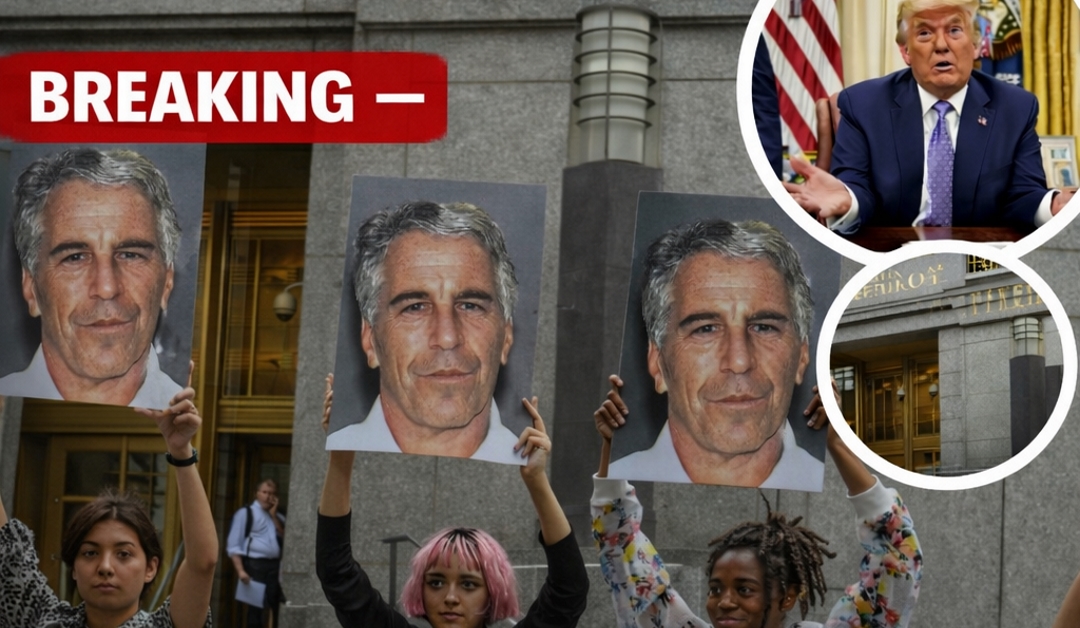
An alleged victim of Jeffrey Epstein has claimed that recordings exist involving Donald Trump that, if made public, would be politically devastating — a statement that has reignited controversy surrounding the late financier’s network and the powerful figures once associated with him.
The accuser made the remarks during a recent interview, asserting that tapes connected to Epstein’s circle contain material involving the former president. No recordings have been publicly produced, and no court has verified the existence of such tapes.
Still, the claim alone was enough to spark renewed debate online and in political circles.
Jeffrey Epstein, who was arrested in 2019 on federal sex trafficking charges involving minors, cultivated relationships with numerous high-profile individuals over decades. His case has remained a focal point of public scrutiny since his death in federal custody later that year. The official indictment outlining the charges against him was published by the U.S. Attorney’s Office for the Southern District of New York, detailing allegations of a trafficking scheme spanning years.
Trump has acknowledged knowing Epstein socially in the 1990s and early 2000s but has repeatedly denied any involvement in criminal activity related to Epstein’s conduct. He has also stated that he distanced himself from Epstein long before the financier’s arrest.
The accuser did not present physical evidence during the interview, nor did she specify where the alleged recordings are currently located. Her comments centered on the belief that Epstein maintained extensive documentation of influential figures, suggesting such materials could have been used as leverage.
Legal analysts caution that extraordinary claims require verifiable proof. In the absence of authenticated recordings or court filings referencing such material, the allegation remains unsubstantiated.
Epstein’s connections to prominent figures across politics, finance, and entertainment have long fueled speculation about undisclosed evidence. Over the years, portions of court documents and deposition transcripts have been unsealed, but many records remain partially redacted due to privacy and legal considerations.
Federal authorities have not publicly confirmed the existence of tapes implicating Trump in wrongdoing. Court filings in the criminal case against Epstein did not charge Trump with any offense.
After Epstein’s death — ruled a suicide by the New York City medical examiner — public skepticism intensified, prompting internal reviews. The U.S. Department of Justice later reported significant procedural failures within the detention facility but found no evidence contradicting the medical determination.
Political observers note that allegations tied to the Epstein case often resurface during election cycles or periods of heightened public attention. Claims involving hidden recordings or undisclosed files have circulated widely on social media, though few have been substantiated in court.
Trump representatives have dismissed the latest assertion as baseless and politically motivated. They emphasize that multiple investigations have not produced evidence of criminal conduct by the former president in connection with Epstein’s trafficking case.
Advocates for Epstein’s victims argue that transparency remains critical. They contend that full disclosure of relevant documents could help restore public trust and clarify lingering questions about the scope of Epstein’s network.
However, legal experts stress that the judicial system operates on documented evidence, not speculation. Without verified recordings or corroborating testimony presented in a court of law, the allegation remains an unproven claim.
The Epstein saga continues to cast a long shadow over American politics. Years after his arrest and death, the case remains intertwined with debates about accountability, transparency, and the responsibilities of public figures.
For now, no recordings have been publicly released, and no formal charges against Trump have emerged from the Epstein prosecution. Whether the accuser’s claim leads to further investigation or fades into the broader swirl of controversy remains uncertain.
What is clear is that any credible evidence — if it exists — would be subject to intense legal scrutiny. Until such material is presented and authenticated, the allegation stands as part of an ongoing, unresolved chapter in one of the most scrutinized criminal cases of the last decade.