
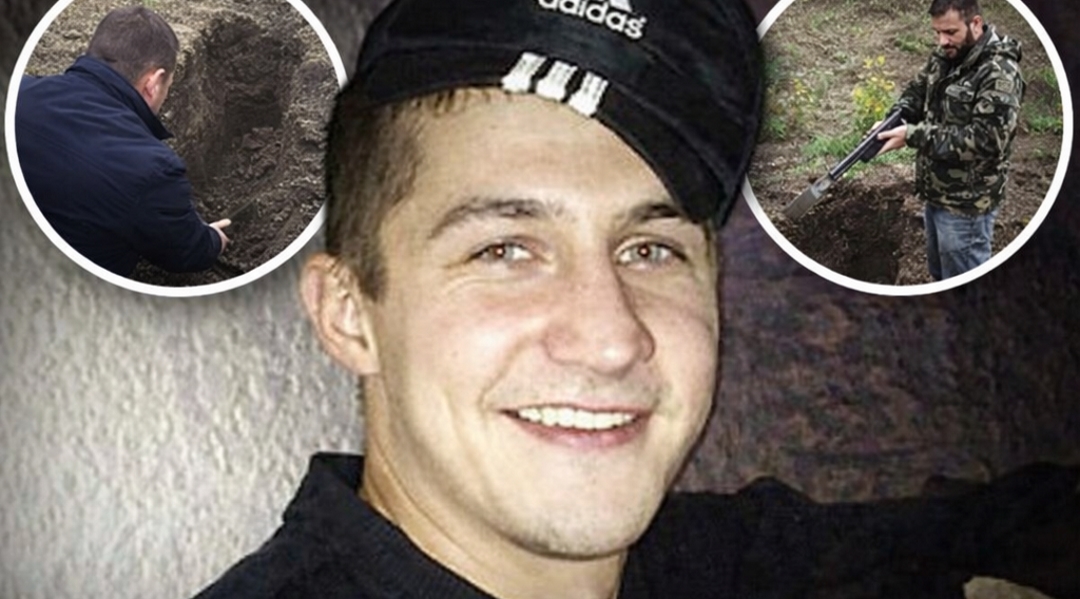
It began like the kind of friendship people don’t question. A familiar face in the kitchen. A man who knew the family routines, the neighborhood rhythms, the small details that make someone feel safe enough to stop watching the door. In some communities, that kind of closeness is treated like proof of character—until one moment comes along and turns every memory into something poisonous.
According to reports from Russia, a father became convinced a family friend had abused his young daughter, and what happened next has been described as one of the most chilling vigilante episodes in recent years. The allegations, the shock, and the father’s response—forcing the man into the woods and making him dig a grave—have split public opinion into angry camps, each arguing about justice, revenge, and what society does when it believes the system will never feel “enough.”
The case has circulated widely because it contains the kind of details that people can’t stop picturing. Not just the violence, but the intimacy of betrayal: a friend trusted around children, a home that should have been the safest place in the world, and a father who says he discovered something that made him feel like the ground beneath his family had cracked open.
One of the hardest parts to read, even in the most restrained accounts, is the idea that the father believed there was evidence—something seen or heard—that convinced him the worst had happened. The story’s public versions vary in specifics, but the central narrative stays the same: the father confronted the friend, forced him out to a remote area, and made him dig what looked like his own burial site.
From there, the account turns into a legal and moral maze. Reports have described the friend’s death as a suicide that was allegedly coerced, rather than a direct killing, a distinction that dramatically changes how the law treats the father. In coverage describing the community reaction, public support for the father was portrayed as intense and emotional, with people framing him as someone who did what the justice system would never do fast enough.
That kind of public support is not unusual in cases that involve allegations of child abuse. The anger is primal. People feel protective, even if they don’t know the victims, because the crime touches a universal fear: that danger can enter through familiarity. It’s why these stories ignite faster than most news cycles, and why the comments under them become a battlefield within minutes.
But the support comes with a darker shadow: the unspoken permission it can create. When a crowd celebrates revenge, it can start to sound like instruction. It can normalize the idea that the courtroom is optional, that punishment is a private decision, that fear and rage can replace evidence and due process. Even people who understand the father’s grief can still recoil at what it means if that kind of response becomes a model.
What makes the debate even more volatile is the way the story is often framed online—less as a tragedy and more as a satisfying narrative arc. Stranger harms child. Father becomes executioner. Evil is erased. The end. But real life rarely lands cleanly like that, especially when courts have to determine what happened, how it happened, and what is provable versus what is believed.
In some reports, authorities initially treated the father as a murder suspect before later leaning toward a charge related to coercion or involvement in a suicide, depending on the findings. The difference matters, because it changes the sentence, the public story, and the moral label attached. It also shapes whether the case is remembered as a brutal act of vigilantism or a disturbing example of coercion driven by rage.
There’s another complication that sits underneath the headlines: the daughter at the center of the allegations. In any case like this, the most important person is also the most protected, meaning the public will never fully know what she experienced, what she said, or how her life was altered. That silence is necessary. But it also creates an information vacuum that gets filled with speculation, and speculation is where stories like this become even more dangerous.
Some of the online retellings turn graphic. Some become exaggerated. Some are posted for shock value, stripped of empathy. That’s one reason the case keeps resurfacing: it’s easy for people to share the “grave” detail without grappling with the fact that there is a child who has to live with whatever happened long after strangers stop arguing about the father’s sentence.
The legal question—what should happen to a parent who believes they are avenging their child—collides with a deeper emotional truth: some pain is so raw it feels like it has nowhere to go. The justice system moves slowly. Investigations can feel cold. Court language can sound clinical, like it’s trying to flatten trauma into paperwork. In that gap, rage grows. And rage is the one feeling that can trick someone into believing they are restoring order when they may be destroying what’s left.
At the same time, it’s not hard to understand why the public response becomes sympathetic. The idea of betrayal by a trusted adult hits like a nightmare. People imagine the helplessness, the guilt, the self-blame, the way a parent might replay every moment they allowed that friend close. They imagine the father’s mind spiraling into a single thought: if I don’t act, who will.
That’s why this story has been repeated so often in tabloids and social feeds. In one widely shared account of the incident, the emotional framing leans heavily into the father’s fury and the grotesque symbolism of forcing a grave to be dug, a detail that feels designed to haunt anyone who reads it.
But beyond the symbolism is the bleak reality: nothing about what happened restores the child’s safety in the way people want to believe. If the allegations are true, the damage is not undone by punishment, no matter how severe. And if the law decides the father crossed a line, the family may find itself living inside a second kind of trauma—one shaped by courts, prison time, stigma, and the permanent weight of a moment that can’t be taken back.
This is why the story divides people so sharply. Some see a father who became the instrument of consequence when society fails. Others see a terrifying breakdown of order that risks encouraging more violence, more mistakes, more bloodshed driven by certainty that may not be proven. And almost everyone, no matter what side they argue, is reacting to the same core fear: that evil can hide behind a friendly smile until the day it doesn’t.
In the end, the headline detail—the grave—sticks because it’s visceral. But the deeper horror is what it represents: trust shattered, a child’s innocence threatened, and a father so consumed by rage and grief that the world narrowed to one terrible act. It’s a story people will keep sharing because it feels like a warning. The real question is what kind of warning it becomes.