
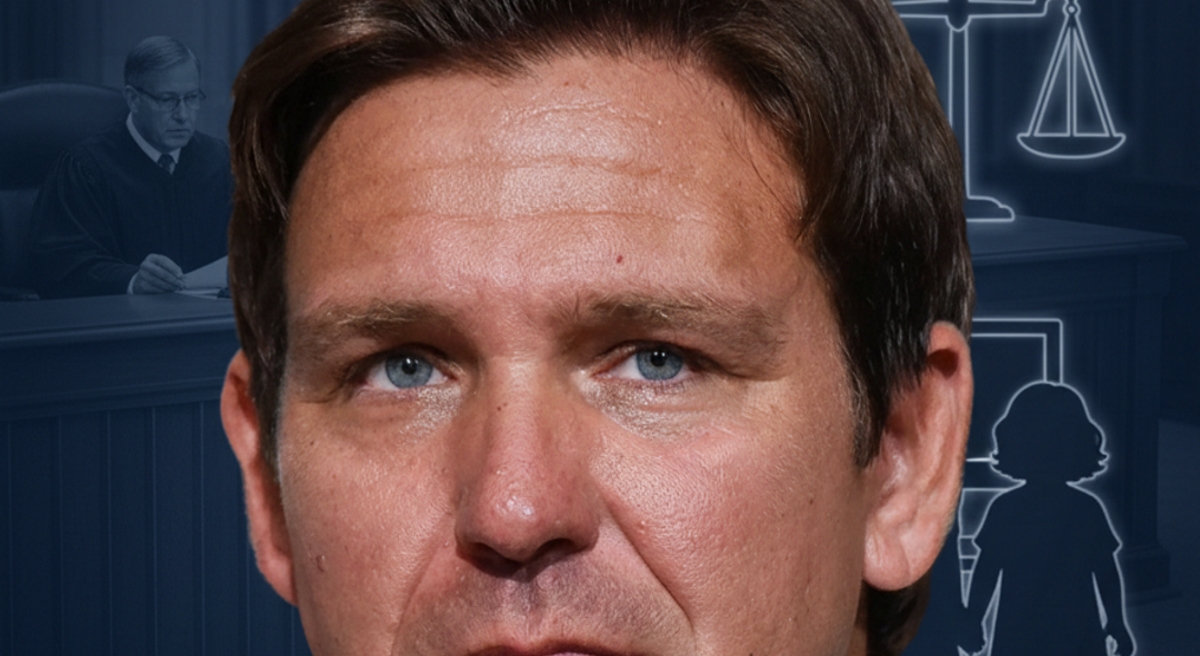
Florida Governor Ron DeSantis has signed a law that allows the death penalty for adults convicted of sexually assaulting children under the age of 12, a move that has immediately placed the state on a collision course with long-standing U.S. Supreme Court precedent and reignited one of the most emotionally charged debates in American criminal justice. The legislation, which passed overwhelmingly through Florida’s Republican-controlled legislature, was framed by supporters as a response to what they describe as irreparable harm inflicted on victims, a rationale outlined in early national reporting on the bill’s passage as it moved rapidly toward DeSantis’ desk.
Under the new statute, prosecutors may seek capital punishment for offenders convicted of child sexual assault even when the crime does not result in death, directly contradicting the Supreme Court’s 2008 ruling in Kennedy v. Louisiana, which barred the death penalty for non-homicide offenses involving children. Florida lawmakers were explicit about the challenge, signaling their intent to provoke a legal test that could reopen the issue before a more conservative Supreme Court, a strategy legal analysts discussed in coverage examining the constitutional gamble behind the law.
DeSantis, signing the bill without hesitation, argued that crimes against children represent a category so severe that states should be free to impose the harshest possible punishment. His position echoed language used during legislative debate, where sponsors claimed the Court’s earlier ruling failed to account for the lifelong trauma experienced by victims, arguments summarized in a detailed breakdown of the bill’s supporters and their reasoning.
Florida lawmakers want to force the Supreme Court to revisit whether child rape can be punished by death. This is a direct challenge to Kennedy v. Louisiana. — Steve Vladeck (@steve_vladeck) May 2023
Critics responded with alarm, warning that the law undermines constitutional protections and risks unintended consequences. Civil-rights groups argued that expanding capital punishment to non-homicide crimes could discourage reporting, particularly in cases involving family members, a concern highlighted by advocates interviewed in analysis of potential ripple effects following the law’s signing.
Legal scholars were quick to note that the statute is almost certain to be challenged in court. Until the Supreme Court overturns or modifies its 2008 decision, Florida judges would be bound to block any execution under the law, a procedural reality explained in expert commentary on how the issue could return to the justices. Supporters of the law see that inevitability not as a flaw, but as the point.
This statute is designed to get to SCOTUS. Florida lawmakers are daring the Court to reverse itself. — Leah Litman (@LeahLitman) May 2023
The political context surrounding the bill is impossible to ignore. DeSantis, positioning himself as a national figure within the Republican Party, has consistently embraced policies that test federal authority and appeal to voters who favor aggressive law-and-order approaches. Observers pointed out that the death-penalty expansion fits squarely within that strategy, a pattern traced in political analysis of DeSantis’ broader agenda as governor.
Florida already maintains one of the largest death rows in the United States, and the new law arrives amid other changes to capital punishment procedures, including a reduction in the number of jurors required to recommend death sentences. Together, these shifts have prompted renewed scrutiny of the state’s justice system, especially when viewed alongside data examined in research on Florida’s evolving capital framework and its national implications.
Supporters of the law argue that extraordinary crimes demand extraordinary penalties, insisting that the state has a moral obligation to use every available tool to protect children. They cite public outrage in high-profile abuse cases and claim the law reflects the will of voters, sentiments echoed by lawmakers quoted in coverage highlighting conservative support for the measure.
Florida just authorized the death penalty for child rape, daring SCOTUS to reverse Kennedy v. Louisiana. This will be one of the biggest death penalty cases in years. — Mark Joseph Stern (@mjs_DC) May 2023
Opponents counter that the emotional intensity surrounding such crimes should not override constitutional limits, warning that expanding capital punishment risks eroding safeguards meant to prevent wrongful convictions. They point to studies showing higher error rates in cases involving severe penalties, research discussed in long-running examinations of innocence and capital punishment that fuel skepticism toward any expansion.
As the law takes effect, its practical impact remains uncertain. No executions can proceed under the statute unless the Supreme Court revisits and overturns its prior ruling, a development that would reshape death-penalty law nationwide. Until then, Florida’s move stands as both a political statement and a legal provocation, signaling that one of the country’s most divisive punishment debates is far from settled.