
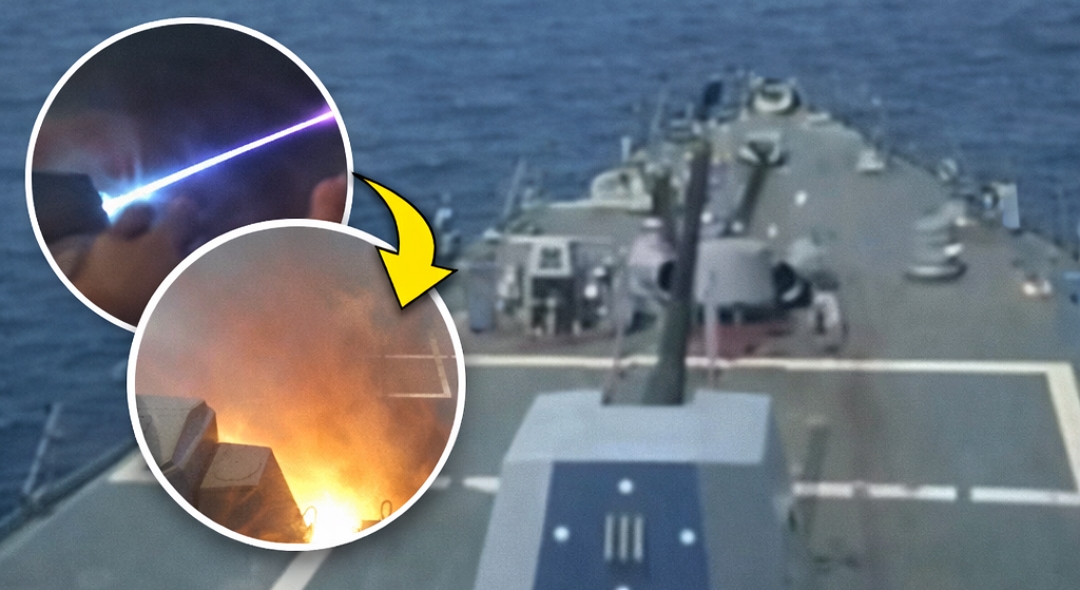
In recent days, a short clip circulating online has reignited public fascination with one of the most futuristic technologies in modern military development: laser weapons. The footage, showing a naval vessel firing what appears to be a concentrated beam of light toward a distant target, has quickly spread across social media platforms, drawing millions of views and sparking intense discussion about the next era of warfare.
Many viewers initially assumed the video captured a dramatic moment during a recent conflict involving Iran. But defense analysts say the reality is more complicated. While the clip shows a real system being tested, experts caution that much of the speculation online goes far beyond what the video actually confirms.
Still, the technology itself is very real — and it has been quietly advancing for years.
Laser-based weapons have long been a goal of military research programs in the United States and around the world. Unlike traditional missiles or artillery, directed-energy systems fire concentrated beams of energy capable of disabling drones, sensors, or small vessels almost instantly. The appeal is obvious: the weapons travel at the speed of light, require no conventional ammunition, and can potentially operate with lower long-term costs once installed on ships or vehicles.
For the U.S. Navy, the technology has moved from theory to testing over the past decade.
One of the most widely known systems is the Laser Weapon System, often referred to as LaWS, which has been mounted on naval vessels for evaluation in real-world conditions. In demonstration videos released by the Pentagon in previous years, the system can be seen locking onto small drone targets before disabling them in seconds.
The principle behind the weapon is surprisingly straightforward.
Rather than launching a projectile, the system concentrates intense energy into a narrow beam. When that beam strikes a target — particularly delicate components such as sensors, engines, or fuel systems — the heat generated can quickly cause failure. For smaller targets like unmanned aircraft, the effect can be immediate.
Supporters of directed-energy weapons argue the technology could transform battlefield defense, especially against drones.
The rapid expansion of inexpensive unmanned aerial vehicles has changed modern warfare. In conflicts across the Middle East, Eastern Europe, and elsewhere, relatively cheap drones have proven capable of damaging expensive military equipment. Laser systems offer a potential countermeasure because they can engage targets quickly without the need for traditional missile interceptors.
But the technology still faces limitations.
Environmental conditions such as fog, dust, or heavy rain can weaken the beam’s effectiveness. Power generation aboard ships or vehicles also remains a challenge, since sustained laser firing requires enormous amounts of energy.
Because of these factors, most experts say directed-energy weapons will complement existing defense systems rather than replace them entirely.
That context helps explain why the viral video has sparked such strong reactions online. For many viewers, the idea of a weapon firing a visible beam of light evokes science fiction more than modern military engineering. Yet defense researchers say the concept has been under development since the Cold War.
The difference today is that the technology is finally approaching practical use.
The Pentagon and other defense agencies continue to invest heavily in directed-energy research. Beyond naval applications, similar systems are being explored for use on ground vehicles and aircraft. Some prototypes are designed to protect bases from incoming rockets or artillery shells by neutralizing them mid-flight.
Despite the dramatic imagery, analysts emphasize that viral clips rarely capture the full story behind military testing.
“Short videos can make it look like a sudden breakthrough,” one defense researcher noted. “In reality, these programs involve decades of gradual development.”
For now, the viral footage serves as a glimpse into a future that is steadily approaching — one in which beams of light may become an increasingly common tool in military defense systems.
Whether or not the clip itself represents a recent operational moment, it has succeeded in reminding millions of viewers that the technology once imagined in science fiction is slowly becoming part of the real world.