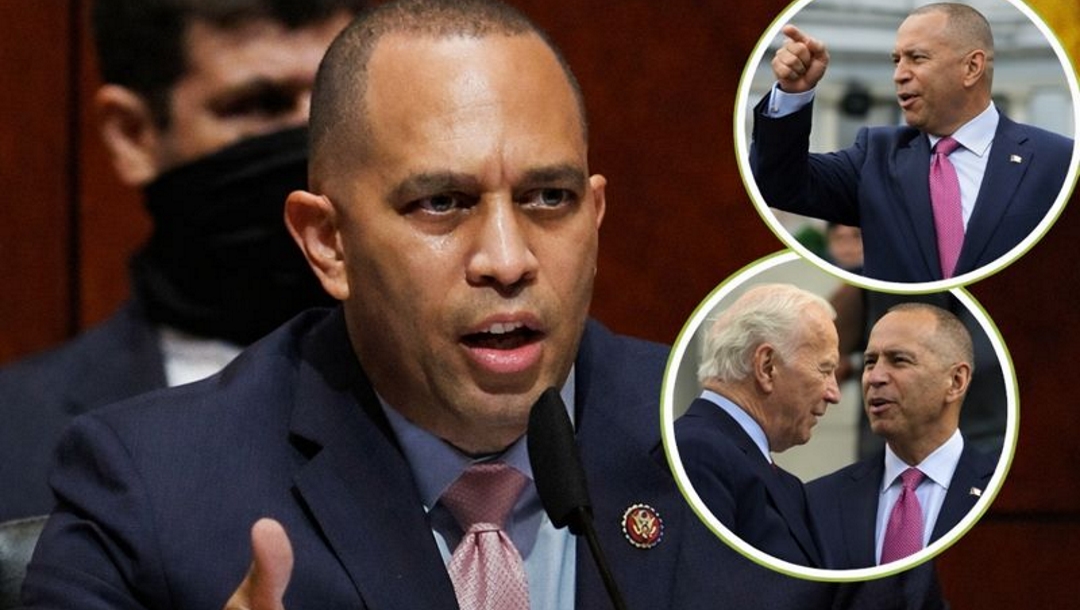
The comment landed with the kind of weight that instantly shifts a political conversation. During a public appearance, House Minority Leader Hakeem Jeffries suggested that America may be ready once again for a Black president — and that the idea of a 2028 run isn’t something he’s ruling out.
The remark wasn’t delivered as a formal announcement, but it didn’t sound accidental either. Jeffries framed it as a reflection on the country’s political trajectory, race, and generational change, leaving just enough ambiguity to ignite speculation across Washington and social media.
Within hours, clips of the moment began circulating widely, prompting both excitement and skepticism. Supporters pointed to Jeffries’ rise through Democratic leadership and his ability to unify factions, while critics questioned whether the statement was premature or strategically timed.
Jeffries has long been viewed as a bridge figure — younger than many party elders, media-savvy, and disciplined in his messaging. Since taking over House Democratic leadership, he’s been careful to project steadiness, a contrast some observers have noted in profiles of his leadership style that emphasize patience over flash.
Still, invoking the presidency changes the stakes. His comment inevitably drew comparisons to Barack Obama’s rise, though Jeffries has not positioned himself as a successor in tone or policy. Instead, allies say his approach reflects lessons learned from the last decade of political turbulence, including how cultural backlash and identity politics intersect with electoral reality.
Some Democratic strategists argue the timing makes sense. With voters increasingly fatigued by familiar faces, there’s growing interest in leaders who represent a generational shift. Analysts discussing the party’s long-term bench have repeatedly mentioned Jeffries as someone quietly building national credibility.
Others are more cautious. Jeffries has never run statewide, let alone nationally, and the Democratic field in 2028 could be crowded with governors, senators, and cabinet veterans. A single comment, they argue, doesn’t erase the logistical and political hurdles of a presidential campaign.
The reaction online reflected that divide.
Hakeem Jeffries floating 2028 isn’t random. It’s a signal — to donors, to voters, to the party. Whether he runs or not, he wants to be in the conversation. — Capitol Watch (@CapitolWatchHQ) May 2024
Race, inevitably, became a focal point of the discussion. Jeffries’ statement about America being “ready” reopened broader debates about how much progress has truly been made since Obama left office. Some commentators cited shifts in voter demographics and turnout patterns, while others pointed to persistent polarization as evidence the country remains deeply divided.
Jeffries himself has largely avoided framing his career around identity alone. His public record emphasizes voting rights, economic opportunity, and institutional stability — themes he often returns to in speeches and interviews highlighted in recent national coverage.
That restraint is part of what makes the comment notable. Coming from a leader known for discipline, even a hypothetical nod toward 2028 reads as intentional. It suggests confidence not just in himself, but in how he believes the electorate may evolve over the next four years.
Republican voices, meanwhile, seized on the statement as evidence Democrats are already looking past the next election cycle. Conservative pundits questioned Jeffries’ readiness for executive leadership, while others dismissed the idea outright as political theater.
Yet history shows that presidential narratives often begin this way — not with declarations, but with carefully placed sentences that test reaction and gauge appetite. Political historians frequently note how early speculation can shape donor interest and media framing long before a campaign exists, a dynamic explored in analyses of modern presidential launches.
For now, Jeffries remains focused on leading House Democrats through a turbulent Congress. No exploratory committee, no staff reshuffle, no policy rollout has followed the remark. But the message is out there, and it’s not easily forgotten.
Jeffries didn’t announce anything — but he didn’t shut it down either. That’s how serious political conversations usually start. — Election Insight (@ElectionInsight) May 2024
Whether the moment proves to be a footnote or the opening line of a future campaign will depend on events still unfolding. What’s clear is that Jeffries has signaled belief in both his country and his own place within its political future — and in Washington, that alone is enough to move the needle.