
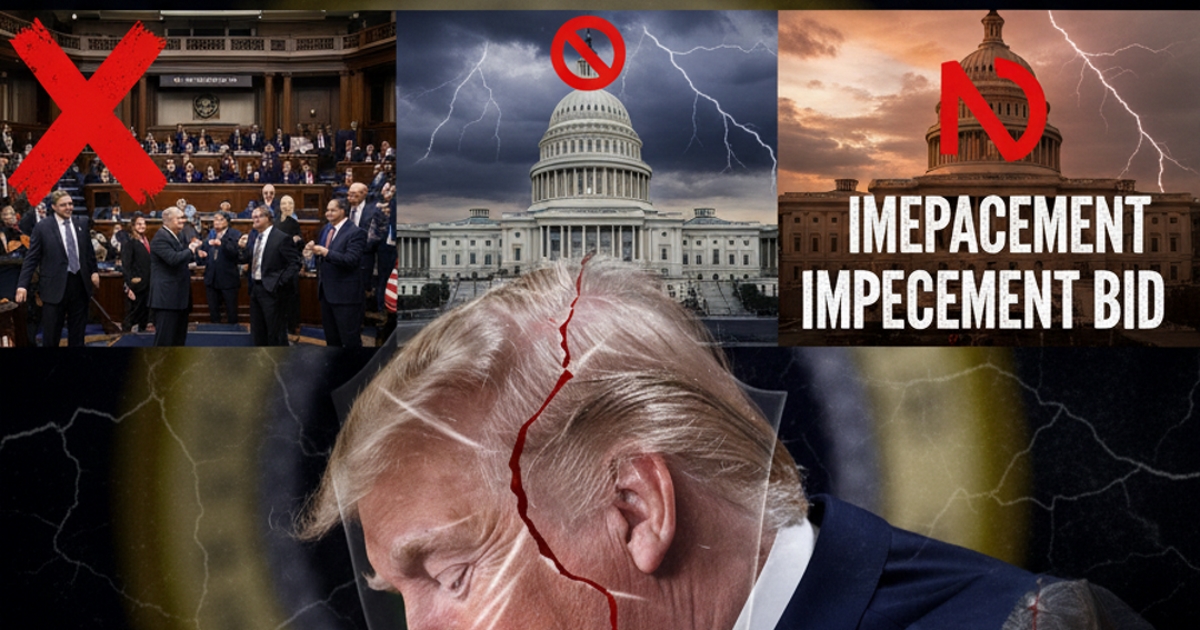
The U.S. House of Representatives was forced into damage-control mode this week after a viral online rumor exploded across social platforms, falsely claiming that Rep. Al Green had launched a second impeachment attempt against former President Donald Trump — a claim that spiraled so quickly that political analysts compared its trajectory to the misinformation patterns mapped in a major rumor-dynamics study documenting how fast unverified narratives can overwhelm public understanding in moments of political tension.
The rumor began with a single doctored screenshot purporting to show a privileged impeachment resolution filed by Green, mirroring the sort of procedural filings archived inside the House’s legislative calendar. But no such filing appears in congressional records — a fact quickly confirmed by reporters cross-checking the claim using the authenticated notices listed through Congress.gov’s official bill tracking system. Still, the screenshot spread like wildfire, amplified by political influencers who tied it to frustrations already simmering in public discourse.
Within an hour, thousands of users were citing the false impeachment bid as proof of an escalating institutional war, a narrative that echoed previous partisan clashes analyzed in a Pew deep-dive on polarization. The rumor intensified after several fringe accounts repurposed an unrelated House vote graphic and combined it with language cut from a real Associated Press story archived in AP’s impeachment-era reporting, creating a visual mashup that looked superficially credible to casual viewers.
That “Al Green impeachment vote” screenshot is fake — literally NOTHING on the House floor today came close. Check official records, not memes. — A.M. (@CivicsNerdAM) Dec 13, 2025
The false rumor gained even more traction after several accounts invoked language from older impeachment debates described inside a New York Times impeachment timeline, blending historical context with modern speculation. Political strategists noted that the mixture of outdated information and real-sounding legal terminology mimicked the misinformation architecture outlined in a Reuters analysis of AI-amplified political rumor cycles.
To contain the chaos, House communications staff issued clarifications referencing the public docket available through the House document repository, reiterating that no impeachment articles were filed, considered, or scheduled. But the clarification was soon drowned out by partisan influencers treating the rumor as fact. Several posts claimed the vote had been “suppressed,” despite no such vote existing — a rhetorical technique eerily consistent with patterns discussed in a media-trust and internet deception report.
People jumped from “rumor” to “why did Democrats block it??” without checking ANY source. The speed of misinformation now is terrifying. — J.S. (@PolicyWatchJS) Dec 13, 2025
The frenzy hit a second wave when political commentators connected the rumor to Green’s real 2019 impeachment push, which was recorded in congressional history and referenced inside a CNN congressional report. Though unrelated, the old vote tally circulated again, misleading many into thinking it reflected a new action. Reporters described the confusion as a “timeline collapse,” where past events are weaponized to lend legitimacy to current falsehoods.
The rumor’s traction ignited a wider debate about the tools used to detect fake political claims. Digital forensics specialists pointed to telltale irregularities in the screenshot’s metadata and font behavior, patterns that match the manipulated images documented in Poynter’s guide to identifying forged screenshots. Yet despite clear evidence of tampering, the narrative continued to spread — a reflection of the psychological forces discussed in a cognitive-persistence study explaining why debunking often lags behind belief-formation.
The wild part? People weren’t just sharing the fake impeachment rumor — they were debating the VOTE COUNT of something that never happened. — L.R. (@TruthTrackerLR) Dec 13, 2025
Democratic aides, speaking anonymously to reporters, voiced concern that the rumor had been amplified strategically by actors familiar with the outrage mechanics described in a Vox examination of political outrage cycles. Some staffers pointed to coordinated timing across certain accounts — activity that mirrored the influence-mapping models analyzed in Brookings’ research on digital influence operations.
The manufactured impeachment narrative also collided with real congressional tensions. Policy analysts noted that the rumor surfaced amid heated debates over funding deadlines tracked inside Politico’s legislative standoff coverage, creating a chaotic information environment where audiences expected high-stakes developments. In such climates, experts say, false claims flourish because they feel emotionally “possible,” a phenomenon detailed in a psychology report on crisis-driven belief formation.
The rumor hit at the exact moment Congress was already in meltdown mode over budget negotiations. People assume the wildest things are true. — E.D. (@HillInsiderED) Dec 13, 2025
Republicans responded to the chaos with a mix of mockery and opportunism. Several conservative commentators framed the rumor as evidence of “Democratic instability,” despite its complete lack of basis in official proceedings. Meanwhile, progressive activists accused right-leaning influencers of willfully amplifying the false claim, pointing to the engagement-bait tactics described in a Washington Post analysis of political engagement loops.
As the narrative spread, many Americans found themselves confused about what had actually happened inside the House chamber. Civic educators and watchdog groups posted tutorials directing users to official sources, including the bill registry updated in the House Clerk’s public database. The episode reignited calls for digital literacy initiatives modeled on the fact-checking programs outlined in an NBC News education report, arguing that the public must become better equipped to verify claims before sharing them.
By evening, the rumor had fully collapsed under scrutiny — but not before shaping hours of online debate, partisan conflict, and speculative commentary. What emerged from the wreckage was not an impeachment proceeding, but a vivid demonstration of how quickly the modern information ecosystem can manufacture political crises out of thin air, especially when familiar names, emotionally charged narratives, and fabricated procedural claims merge into something that feels true even when it isn’t.