
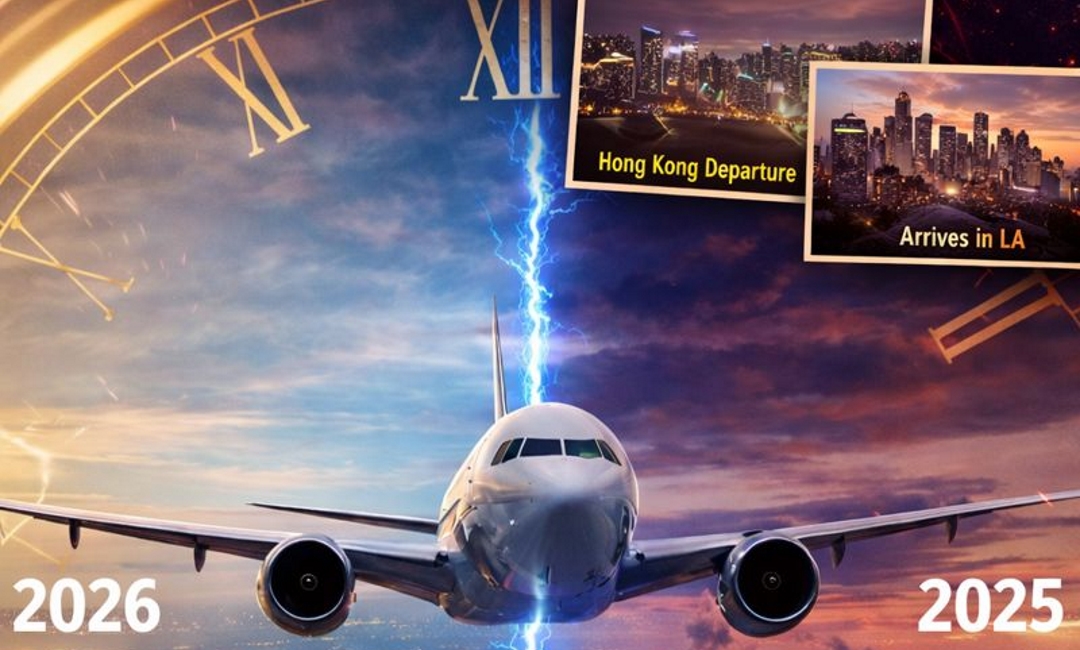
The image looks like science fiction: a commercial jet slicing through lightning, a clock face cracked down the middle, and a claim that feels impossible at first glance. A plane departs Hong Kong in 2026 — and somehow lands in Los Angeles in 2025.
Within hours of the image circulating, social media lit up with stunned reactions, jokes about time travel, and more than a few genuinely confused travelers wondering whether physics had finally broken.
The story traces back to a real phenomenon that happens far more often than most people realize. Flights crossing the International Date Line regularly “arrive earlier” than when they depart — at least according to the calendar.
In this case, the route from Hong Kong to Los Angeles crosses west-to-east, effectively moving backward one calendar day. Add time zones, flight duration, and departure timing, and you get a result that looks surreal when stripped of context.
But the image — and the way it was framed — did the rest.
Online posts simplified the explanation into a single shocking line, triggering millions of reactions. Many users admitted they knew about time zones in theory, but had never seen the effect presented this dramatically.
Some aviation enthusiasts quickly stepped in, pointing readers toward basic flight timing rules and how airlines calculate arrival dates.
Still, the conversation didn’t stay technical for long.
Once the idea of “time travel” entered the chat, speculation exploded. Screenshots circulated showing departure boards, booking apps, and old tickets that appeared to confirm similar cases.
One widely shared post referenced how the International Date Line works, but even that explanation struggled to compete with the visual drama of the image.
What made this instance stand out wasn’t that it happened — it was how clearly it looked like a paradox. Departing in a future year and arriving in a past one taps directly into how humans intuitively understand time.
We think of time as linear. Aviation reminds us it’s not.
Commercial pilots have joked for decades about “time traveling” on long-haul routes. Some have even celebrated New Year’s Eve twice in the same shift.
But for passengers, especially casual travelers, the experience can be genuinely disorienting. Sleep deprivation, jet lag, and calendar changes combine into something that feels wrong on a gut level.
That discomfort is exactly why the image went viral.
Psychologists studying viral content note that posts triggering “cognitive dissonance” — moments where reality clashes with expectation — spread faster than straightforward explanations. Articles on why the brain reacts to paradoxes help explain the reaction.
It wasn’t just confusion. It was fascination.
Some users began sharing personal stories of landing “before they left,” while others posted mock boarding passes claiming to beat deadlines or birthdays.
I know this isn’t real time travel but my brain absolutely refuses to accept landing in a year that already happened.— SkyLogic (@SkyLogic_) January 2026
Others leaned fully into the absurdity, joking about fixing past mistakes or warning their earlier selves.
Airlines, meanwhile, quietly deal with this confusion all the time. Booking systems, immigration records, and hotel check-ins all have safeguards to prevent errors caused by date-line crossings.
Without those systems, chaos would be routine.
Aviation analysts emphasized that nothing about the flight violated physics, causality, or time itself. The only thing broken was expectation.
Still, the story tapped into a broader cultural moment. Between rapid technological change, AI breakthroughs, and constant global disruption, people are primed to believe reality is bending faster than they can keep up.
That’s why even a mundane explanation struggled to land.
It’s wild how something totally normal can feel impossible just because we don’t think about time zones every day.— DataDrift (@DataDrift_) January 2026
In the end, no laws of time were broken. No wormholes opened. No passengers stepped into the past.
But for a moment, millions of people were reminded that time — especially when viewed from 35,000 feet — doesn’t behave the way we think it does.
And sometimes, that realization is just as unsettling as the idea of time travel itself.