
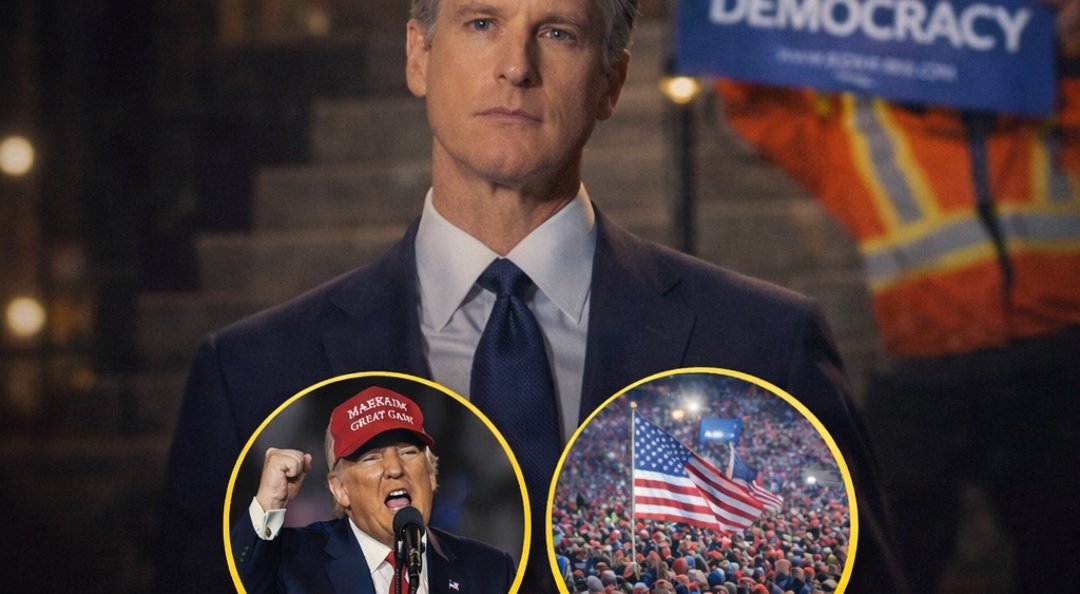
It is no longer 2024. It is 2026, and the political argument has not cooled — it has sharpened.
Standing before reporters this week, California Governor Gavin Newsom revived a line that has followed Donald Trump for years: he does not represent the majority of Americans. But this time, the context is different. The country has moved through another election cycle, multiple court battles, and a reshaped Congress. The stakes feel heavier, and the numbers are being dissected more aggressively than ever.
Newsom’s argument centers on approval and national sentiment rather than partisan loyalty. While Trump continues to command intense support from his base, national surveys throughout 2025 and into 2026 have shown approval ratings that remain deeply polarized. According to Gallup’s presidential approval tracking archive, Trump’s overall job approval has historically struggled to cross the 50 percent threshold, even during politically favorable moments.
That statistical ceiling is what Newsom is leaning into. His message is simple but strategic: intensity is not the same as majority support. Loud backing at rallies and on social media does not automatically translate into broad national consensus.
The argument carries renewed relevance in 2026 because the electorate has shifted again. Voter registration patterns in suburban districts, turnout changes among younger Americans, and demographic transitions in Sun Belt states have reshaped the political map. At the same time, Trump’s grip on Republican primary voters remains strong — a dynamic that creates a split between party dominance and national majority standing.
Critics of Newsom counter that majority sentiment is not determined by approval surveys alone. Elections are decided by turnout and the Electoral College, not raw national polling. Official results from recent federal elections, documented in Federal Election Commission reporting, show how vote distribution — not just total votes — shapes political outcomes. That structural reality continues to define American governance.
Still, the “majority” debate has become symbolic in 2026. It now represents a broader philosophical fight over who truly speaks for the country. Is it the candidate who dominates their party? Or the coalition that reflects a statistical plurality across regions and demographics?
Newsom’s language suggests he believes the latter is decisive. He has framed Trump’s political strength as concentrated rather than expansive. In other words, powerful but not wide-reaching enough to claim national consensus.
The timing of the renewed message is not accidental. With midterm tensions simmering and policy fights unfolding in Congress, both parties are testing narratives ahead of the next presidential cycle. Democrats want to reinforce the idea that Trump’s movement, while energized, does not mirror the broader electorate. Republicans argue the opposite — that institutional barriers, media framing, and electoral mechanics distort public will.
What makes 2026 distinct is the cumulative fatigue factor. After years of legal disputes, investigations, and polarizing rhetoric, voter exhaustion has become part of the equation. Political strategists across the spectrum acknowledge that enthusiasm gaps can determine outcomes more than persuasion alone.
For Newsom, framing Trump as outside the majority serves two purposes. First, it reassures moderates and independents that they are not isolated in their skepticism. Second, it attempts to chip away at the perception of inevitability that often surrounds Trump’s candidacy.
Perception matters in modern politics as much as arithmetic. Trump’s rallies and media presence project dominance. But polling averages and national approval snapshots tell a more complicated story. The tension between visible enthusiasm and measurable majority support is at the core of this dispute.
Republican leaders dismiss the framing as selective. They argue that the country remains closely divided and that labeling Trump as outside the majority ignores electoral realities. After all, a candidate does not need 60 percent support to win; they need a pathway through the system as it exists.
Yet the phrase “majority of Americans” resonates emotionally. It speaks to legitimacy. It implies moral weight. And in a hyperpolarized environment, legitimacy can shape turnout, donor confidence, and campaign momentum.
There is also a generational dimension emerging in 2026. Younger voters are aging into greater political influence, while older blocs remain reliable participants. How those demographic curves intersect will heavily influence whether Newsom’s argument gains traction or fades into partisan noise.
Beyond numbers, the cultural divide remains stark. For many Trump supporters, he represents disruption, defiance, and resistance to establishment politics. For many opponents, he symbolizes instability and institutional strain. Both narratives coexist, and neither fully captures the entire electorate.
That coexistence is why the “majority” claim is contested terrain. It is less about a single data point and more about defining the national mood. Are Americans leaning toward continuity or confrontation? Toward consolidation or upheaval?
In 2026, the answer is still unsettled. Approval ratings fluctuate. Economic conditions shift. Global events intrude on domestic politics. The electorate recalibrates in real time.
What is clear is that the battle over representation has become as strategic as any policy debate. Newsom’s statement is not merely commentary; it is positioning. Trump’s response — direct or indirect — will shape the next phase of this evolving narrative.
The argument over who represents the majority will ultimately be decided at the ballot box, not in press conferences. But as campaign infrastructure builds toward the next national vote, that framing may influence how voters see their own alignment.
In 2026, the country remains divided, energized, and uncertain. And the word “majority” has become one of the most powerful — and disputed — terms in American politics.