
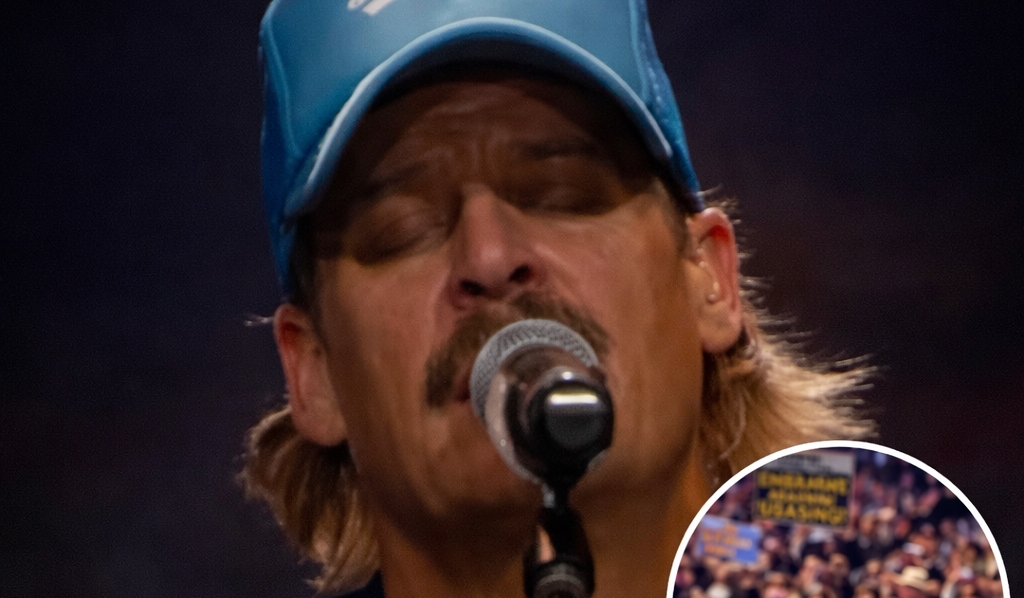
What was meant to be a defiant, chest-thumping musical moment at Turning Point USA’s high-profile halftime show has instead ignited a fresh wave of online ridicule and accusations that Kid Rock didn’t sing live at all.
Within minutes of the performance airing online, clips began circulating across social media showing moments where the vocals appeared suspiciously detached from the microphone. Viewers quickly pointed to mismatched mouth movements, abrupt audio continuity, and a lack of natural vocal fluctuation that many associate with pre-recorded tracks.
The backlash spread rapidly, fueled by the fact that the event itself was promoted as a raw, authentic counterculture spectacle — the exact opposite of polished pop performances often criticized by conservative commentators.
Multiple users posted slowed-down video comparisons, freezing frames where Kid Rock’s lips appeared closed while the vocals continued uninterrupted. Others highlighted moments where the microphone was pulled away without any audible drop in volume, a detail that immediately raised red flags among concertgoers familiar with live sound dynamics.
Turning Point USA had billed the halftime show as a centerpiece attraction, leaning heavily on Kid Rock’s reputation as an unapologetic live performer. That framing only intensified the reaction when doubts emerged about whether the performance was actually live at all.
Critics were quick to point out the irony. For years, Kid Rock has positioned himself as a vocal opponent of what he describes as “fake” entertainment culture, often mocking artists accused of using backing tracks or vocal assistance. The accusation that he may have done the same struck many as deeply contradictory.
Social media commentary quickly moved from technical critique to outright mockery. Some labeled the performance “painfully staged,” while others called it a “karaoke-level production masquerading as authenticity.” A number of posts compared the show unfavorably to previous Turning Point USA musical segments, arguing that this one lacked both energy and credibility.
Music professionals weighed in as well. Several sound engineers noted that while backing tracks are common at large-scale events, the issue wasn’t their use — it was the apparent lack of transparency. When an artist known for live grit appears to rely heavily on pre-recorded vocals, expectations clash with reality.
The controversy also reignited debate over Turning Point USA’s broader media strategy. The organization has increasingly leaned into spectacle-driven events designed to go viral, blending politics, pop culture, and outrage. Critics argue that the halftime show felt less like a concert and more like a manufactured moment engineered for social media clips.
Supporters pushed back, insisting that partial backing tracks are standard in outdoor performances and accusing critics of nitpicking. They argued that production limitations, crowd noise, and broadcast compression can create the illusion of lip-syncing even during live vocals.
However, that defense did little to slow the momentum of criticism. Hashtags referencing the performance trended briefly, with users sharing side-by-side comparisons of Kid Rock’s past live shows and the Turning Point USA appearance.
Notably, neither Kid Rock nor Turning Point USA immediately addressed the accusations. The silence only fueled speculation, as fans and critics alike waited to see whether the claims would be denied, clarified, or ignored altogether.
The incident also drew comparisons to past halftime show controversies, where artists faced scrutiny for perceived inauthenticity. In many of those cases, transparency — or lack thereof — determined whether the backlash faded or intensified.
As the clips continued circulating, mainstream outlets began reporting on the accusations, further amplifying the story beyond political circles. Coverage emphasized the disconnect between the event’s messaging and the optics of the performance itself.
For Kid Rock, the moment represents an unexpected reputational stumble at a time when his public image is tightly intertwined with ideological branding. For Turning Point USA, it raises questions about how spectacle-driven programming can backfire when authenticity is called into question.
Whether the performance was fully lip-synced, partially assisted, or simply victim to technical quirks may ultimately matter less than perception. In the digital age, perception often hardens faster than explanations can catch up.
As of now, the debate remains unresolved, with supporters and critics locked in familiar online trenches. What’s clear is that the halftime show achieved one thing undeniably: attention — though not in the way it was likely intended.
More coverage on the controversy can be found via industry reporting on the performance fallout and analysis of the backlash surrounding the event.