
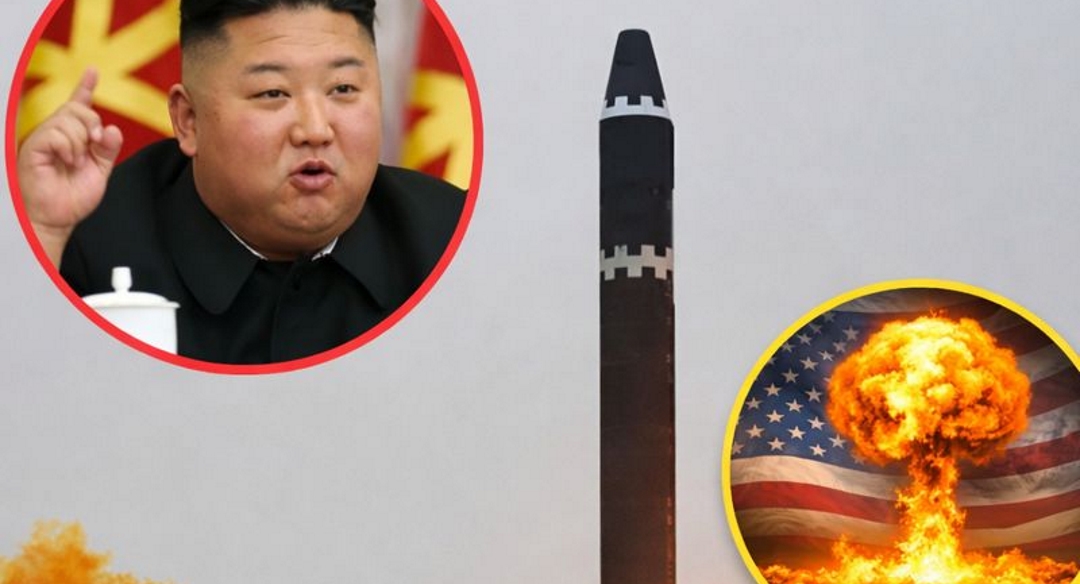
North Korea has once again dragged the world’s attention back to the edge of nuclear anxiety, with Kim Jong-un issuing a blunt warning that explicitly names the United States. The message, delivered alongside images of missile launches and military drills, landed with familiar menace but renewed urgency.
State media framed the warning as a defensive response, but the language was sharper than usual. Kim described North Korea’s nuclear forces as being in a state of constant readiness, warning that any perceived threat to the regime would be met with “overwhelming” retaliation.
The statement followed a series of missile tests that analysts believe are designed to simulate strikes capable of reaching U.S. territory. According to early international coverage, the tests included solid-fuel ballistic missiles, which are harder to detect and faster to deploy than earlier systems.
North Korean state television showed Kim observing the launch in person, flanked by senior military officials. The visuals were carefully choreographed, reinforcing the image of a leader fully in control of an expanding nuclear arsenal.
South Korean and U.S. officials responded cautiously, emphasizing deterrence rather than escalation. Pentagon spokespersons reiterated that America’s security commitments to South Korea and Japan remain “ironclad,” while urging Pyongyang to return to diplomatic channels.
Behind the scenes, intelligence agencies are less calm. Analysts note that North Korea’s rhetoric often spikes during periods of internal pressure, whether economic strain, food shortages, or political signaling toward allies like China and Russia.
One regional expert told reporters that these warnings are not random. They are timed messages meant to shape negotiations, influence elections abroad, or force concessions without firing a single shot.
The nuclear threat also comes amid expanding military cooperation between North Korea and Russia. Western officials have raised concerns that weapons technology and resources may be flowing in exchange for support in Ukraine, a dynamic explored in recent global reporting.
Kim’s speech included references to new missile platforms, including submarine-launched systems and mobile launch vehicles. While details were vague, the implication was clear: North Korea wants Washington to believe that its nuclear reach is no longer theoretical.
Online, reactions were swift and divided. Some dismissed the warning as routine saber-rattling, while others pointed to the steady technical progress behind the bluster.
North Korea’s rhetoric sounds familiar, but the technology behind it keeps advancing. That’s what makes this warning different. — Asia Security Watch (@AsiaSecWatch) February 2026
U.S. defense officials have acknowledged that North Korea now likely possesses missiles capable of reaching parts of the continental United States, though accuracy and reliability remain open questions. Still, the threshold Kim is pushing toward grows thinner with every test.
The Biden administration has so far avoided direct engagement with Kim, relying instead on sanctions, military drills, and diplomatic pressure through allies. Critics argue this approach has allowed Pyongyang to advance its capabilities largely unchecked.
Others counter that talks without leverage would only legitimize North Korea’s nuclear status, something Washington has long refused to do. The stalemate leaves the region locked in a cycle of threats and responses, each one slightly louder than the last.
A separate regional analysis noted that Kim’s warnings are increasingly framed not just as deterrence, but as justification for preemptive action if North Korea believes an attack is imminent.
That shift in tone has alarmed neighboring countries. Japan has accelerated missile defense planning, while South Korea continues joint drills with U.S. forces despite North Korean claims that such exercises are rehearsals for invasion.
China, meanwhile, has urged restraint on all sides, calling for dialogue while quietly opposing harsher sanctions that could destabilize the region. Beijing’s balancing act reflects its fear of both a nuclear-armed North Korea and a collapsed one.
Every missile test is a reminder that this isn’t just rhetoric. North Korea is building real leverage, and the clock keeps ticking. — Global Affairs Desk (@GlobalAffairsHQ) February 2026
For now, Kim Jong-un’s warning stands as another chapter in a long, dangerous standoff. No missiles are flying toward the U.S. tonight, but the message was unmistakable: North Korea wants to be seen, feared, and taken seriously as a nuclear power.
Whether that strategy leads back to negotiations or pushes the region closer to miscalculation remains the unanswered question hanging over the Pacific.