
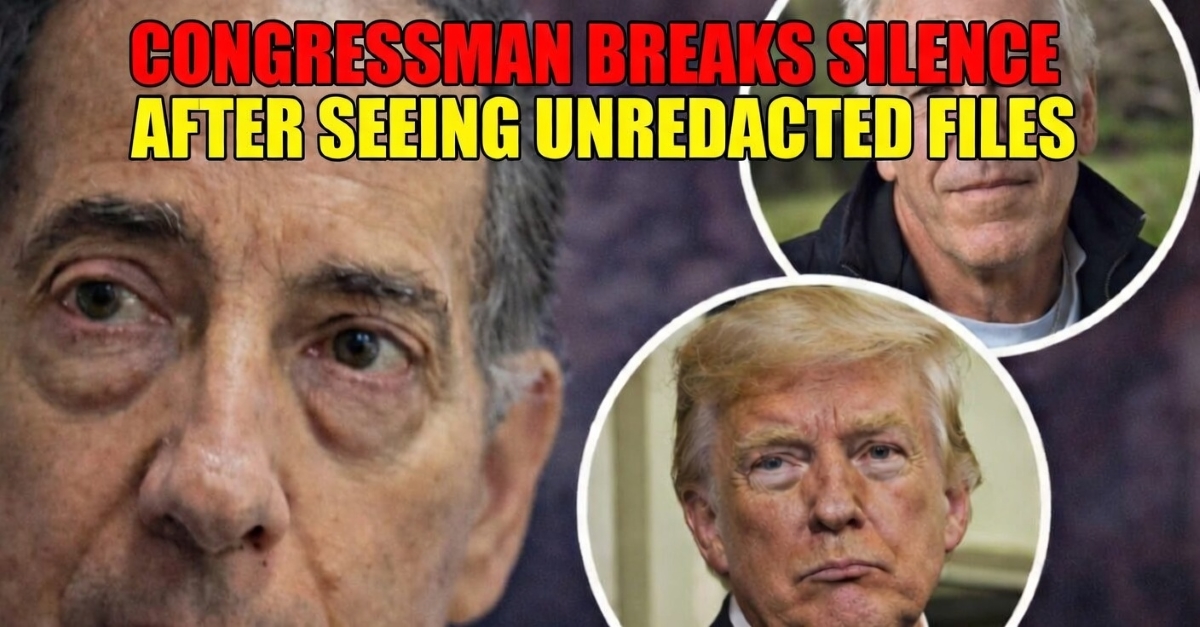
A member of Congress says that after reviewing unredacted materials connected to Jeffrey Epstein, Donald Trump’s name appears numerous times throughout the documents — a claim that is already fueling political debate and renewed scrutiny of the late financier’s records.
The congressman did not publicly release the documents he referenced, nor did he provide specific page counts or context for the alleged references. Still, his remarks have quickly circulated across political circles and social media.
Epstein, who was arrested in 2019 on federal charges of sex trafficking minors, maintained connections with a wide array of influential figures over decades. The indictment outlining the criminal allegations against him was made public by the U.S. Attorney’s Office for the Southern District of New York, detailing accusations of a trafficking scheme spanning years.
Trump has acknowledged knowing Epstein socially during the 1990s and early 2000s but has consistently denied any involvement in criminal conduct tied to Epstein’s case. He has also stated that he severed ties with Epstein long before the financier’s arrest.
Legal experts note that the presence of a name in documents does not automatically indicate wrongdoing. High-profile figures may appear in contact lists, flight logs, correspondence, or deposition transcripts without being accused of criminal behavior.
The congressman’s statement reportedly refers to unredacted files that have not been broadly released to the public. Portions of Epstein-related court documents have been unsealed over time, but many remain partially redacted to protect victims’ identities and sensitive investigative details.
Following Epstein’s death in federal custody in August 2019 — officially ruled a suicide — the case remained under intense public scrutiny. A review conducted by the U.S. Department of Justice identified procedural failures at the detention facility but did not uncover evidence contradicting the medical examiner’s findings.
Since then, periodic releases of court documents and civil case filings have reignited interest in the network of individuals who interacted with Epstein.
The congressman did not clarify whether the repeated references to Trump’s name were tied to specific allegations, business dealings, social interactions, or other documented communications. Without access to the full context of the materials, analysts caution against drawing conclusions.
Representatives for Trump have dismissed similar claims in the past, stating that no investigation into Epstein’s criminal case resulted in charges against him.
Political observers say the timing of such statements often shapes their impact. With national elections and ongoing legal battles dominating headlines, references to Epstein-related documents can quickly become part of larger partisan narratives.
Advocates for victims of Epstein’s abuse continue to call for full transparency, arguing that comprehensive disclosure of documents — with appropriate protections for survivors — is essential to restoring public trust.
At the same time, constitutional scholars emphasize that accusations or document mentions must be evaluated within the framework of due process. Appearances of a name in records alone do not equate to criminal liability.
The Epstein case remains one of the most closely examined federal prosecutions in recent history, in part because of the powerful individuals who crossed paths with him. As additional documents surface over time, public debate often intensifies before legal clarity emerges.
For now, the congressman’s claim stands as an assertion without publicly released supporting documentation. No new charges related to Epstein’s case have been filed against Trump.
Whether further disclosures will provide additional context remains uncertain. Until verified documents are made available for independent review, the scope and significance of the references cited by the lawmaker cannot be fully assessed.
In a case that continues to generate headlines years after Epstein’s arrest and death, questions surrounding unsealed records and political accountability remain unresolved — and closely watched.