
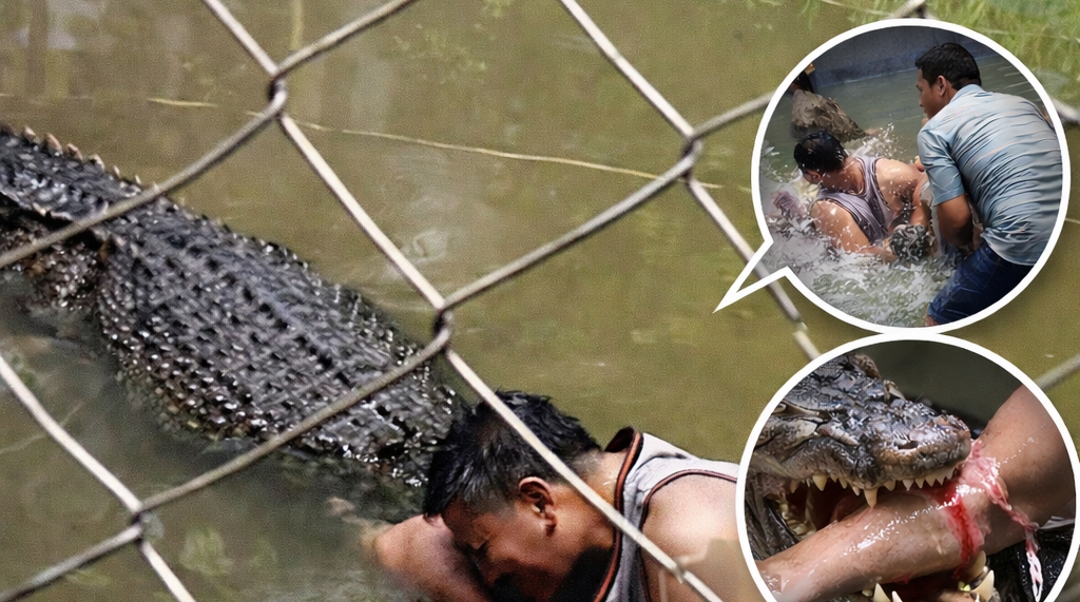
At first, onlookers thought it was a joke.
Visitors at a small wildlife park gathered along a fenced enclosure watched as a man slipped past a barrier and stepped into shallow, murky water where several crocodiles rested motionless in the heat. Phones were already out. Someone laughed. Another voice shouted for him to come back.
He didn’t.
According to witnesses, the man appeared to be trying to stage a dramatic photo. He waded several feet into the enclosure, crouching low near one of the reptiles as friends outside the fence called out instructions. For a moment, nothing happened. The crocodile nearest him remained still, its armored back barely shifting in the water.
Then the surface broke.
“It was like a switch flipped,” said one woman who had been standing just a few yards away. “One second it looked calm. The next second the water exploded.”
Crocodiles are ambush predators, capable of explosive bursts of speed over short distances. Wildlife experts say their stillness is often misunderstood as docility. In reality, they can accelerate with startling force, particularly in confined environments where escape routes are limited.
Witnesses described a sudden lunge, followed by screams from the crowd. Several people rushed toward the enclosure’s edge as the man struggled in the water. A park staff member reportedly ran from a nearby building, shouting for others to step back.
Video recorded by visitors shows chaos unfolding in seconds — splashing water, frantic movement and people yelling instructions no one could hear clearly.
Emergency responders were called immediately. Authorities later confirmed that the man suffered serious injuries but was pulled from the enclosure by staff before the situation became fatal. He was transported to a local hospital, where he remains in recovery.
Officials say the investigation is ongoing.
What is not under dispute is how quickly events escalated.
Wildlife professionals note that crocodiles can exert extraordinary bite force and are capable of performing a “death roll,” a maneuver designed to destabilize prey. Even trained handlers maintain strict distance protocols and protective measures when working around them.
“The misconception is that if an animal isn’t moving, it’s safe,” said one zoologist familiar with reptile behavior. “That’s exactly when they’re most dangerous.”
The park released a statement emphasizing that the man bypassed multiple warning signs and safety barriers. Management said the enclosure is designed to prevent precisely this kind of intrusion, but no physical system is foolproof against deliberate trespassing.
For those who witnessed the scene, the emotional aftermath lingers.
“I can’t get the sound out of my head,” another visitor said quietly. “The screaming. It changed in an instant.”
Incidents like this have become more frequent in the age of social media, where extreme photos and videos often attract attention online. Experts say the desire for dramatic content can blur judgment, particularly when animals are involved.
Wildlife advocates warn that such behavior not only endangers individuals but also puts animals at risk. In some cases, when a captive animal injures a person who entered illegally, authorities face difficult decisions about the animal’s future — even if it was simply acting on instinct.
“This isn’t about a bad animal,” the zoologist added. “It’s about human choices.”
Crocodiles, which have existed for more than 200 million years, are highly adapted predators. Their sensory systems detect subtle vibrations in water, allowing them to respond faster than most people realize. What appears to be a stagnant pond is, biologically speaking, a field of coiled energy.
The broader conversation now centers on accountability.
Authorities are reviewing surveillance footage and interviewing witnesses to determine whether charges will be filed. Trespassing in restricted wildlife enclosures typically carries legal consequences, particularly when public safety resources are required.
Meanwhile, the park has increased security around the exhibit and added additional signage reinforcing the risks.
For many who were there, the lesson feels painfully clear.
“It wasn’t worth a picture,” one witness said. “Nothing is.”
What began as a moment of bravado turned into a sobering reminder of how thin the line can be between spectacle and tragedy — and how quickly nature reasserts its rules when they are ignored.