
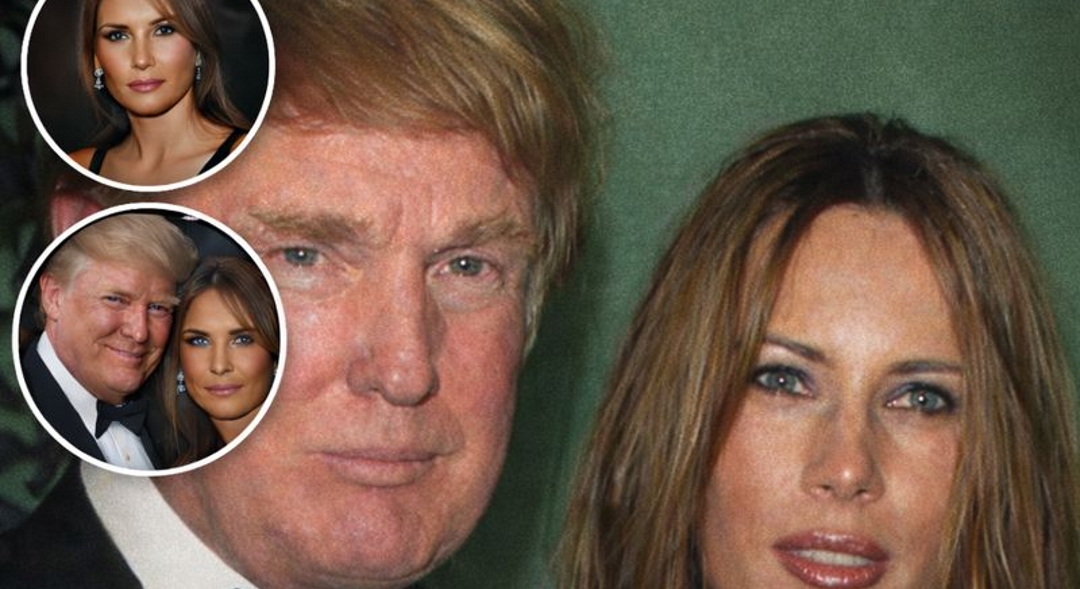
The photo looks like a time capsule: a young model in a glossy, late-’90s room, standing beside an older, already-famous businessman whose name would eventually swallow the country’s oxygen. For years, that image has floated around as a kind of shorthand for a relationship people still argue about—how it started, what it meant, and what it cost both of them to keep it alive in public.
When Melania first stepped into Donald Trump’s orbit, the number that followed them everywhere wasn’t a poll rating or a balance sheet. It was the age gap. He was 52. She was 28. And the reaction—then and now—has always carried a mix of suspicion, fascination, and the kind of judgment that pretends it’s just “asking questions” while already deciding the answer.
What makes the conversation flare up again isn’t just the math. It’s the way Melania has described those early moments, because her words don’t arrive wrapped in apology. They land bluntly, sometimes coldly, and they refuse to bend toward the kind of public comfort people demand from women in high-profile relationships—especially when the man is older, richer, louder, and already surrounded by rumors.
In a resurfaced 1999 interview, she was pressed on the same insinuations that dogged her from the start—questions that weren’t really questions, more like accusations delivered with a microphone. Her response didn’t try to charm anyone into understanding her. She dismissed the idea that a relationship can be reduced to status symbols, insisting that you can’t connect with “things,” you can’t hold them, you can’t build a real life out of them, a tone captured in the ABC clip that keeps circling back online.
That’s the part that still jolts people: she didn’t act like someone trying to win the jury. She acted like someone who didn’t recognize the jury’s authority. And for a public trained to expect either coyness or confession, that refusal can read as confidence, calculation, defiance—or all three at once, depending on what the viewer wants to see.
The age gap, of course, was never just about birthdays. It was about power. It was about proximity to a man who could reshape her life with a single phone call, and the assumption that no woman that young would choose that spotlight unless she was chasing something. But Melania’s public posture has often been: you don’t know me, and you don’t get to write my motives for me.
That same posture shows up again in how she later framed the very beginning, especially in the way she describes feeling drawn in despite the difference. In a memoir excerpt reported in a memoir write-up, she recalls noticing he was older but still feeling an immediate connection—language that can sound almost annoyingly simple, like she’s refusing to offer a more dramatic reason because she doesn’t believe she owes one.
That’s where the renewed “shock” often comes from online. People don’t just fixate on the gap; they fixate on the absence of a dramatic defense. The internet loves a scandal with a clear villain and a clear victim, and Melania has always been difficult to place neatly into either box. She rarely performs the version of herself that outsiders want—either the starry-eyed romantic or the trapped, suffering spouse.
For critics, that composure is proof of something darker: that she entered the relationship with a ledger in her head, that she understood the transaction and accepted it. For defenders, the same composure reads like steel—like a woman who refused to let strangers humiliate her into shrinking. And hovering above both interpretations is the uncomfortable truth that people often talk about her as if she isn’t fully human, as if she’s a symbol first and a person second.
Even the way the relationship began has always carried a jagged edge, because the origin story is messy. They met in New York’s fashion-and-nightlife circuit, and accounts of that night have long included an awkward detail: he wasn’t alone. That detail gets repeated because it feeds the larger narrative that nothing about the Trump world arrives clean, quiet, or simple.
The age-gap debate also tends to flatten time. It treats Melania at 28 as if she were a teenager, ignoring that she had already been working, traveling, and surviving in an industry that forces you to grow up fast. That doesn’t erase the imbalance—money and fame warp everything they touch—but it does complicate the cheap, lazy line that she “must have been manipulated” or “must have been using him.” Real life is almost never that tidy.
And yet, the shock persists because the public conversation about older-man/younger-woman relationships is rarely honest. People pretend the outrage is about ethics, when much of it is about discomfort—discomfort with a woman appearing unbothered by judgment, discomfort with the possibility that she made a choice others wouldn’t make, discomfort with not being able to punish her with shame.
What’s also changed is the context around the quote. In 1999, it was gossip TV and tabloid chatter. Now, it’s an era where every clip is ripped, captioned, and weaponized within minutes. A sentence from decades ago can be made to look like a confession, a flex, or a threat, depending on how it’s framed on someone’s feed.
That’s why the reaction online often feels less like surprise and more like ritual. People share it to prove something they already believe: that she’s calculating, that she’s honest, that she’s trapped, that she’s cold, that she’s smarter than the world gave her credit for. The same few seconds of video become a mirror, and everyone sees what they came to see.
Underneath it all, the most unsettling part is how familiar the scrutiny feels. A couple can live together for decades, build a family, endure public humiliation, survive scandal after scandal—and still be reduced to a number and a motive. The age gap becomes the only “real” detail anyone needs, the only evidence that matters, the only story worth telling.
But the reason the quote keeps resurfacing isn’t just because it’s spicy or blunt. It’s because it exposes something raw about the culture watching her: the hunger to drag a woman into a confession booth, the insistence that she must explain herself in a way that satisfies strangers, and the anger that follows when she simply… doesn’t.