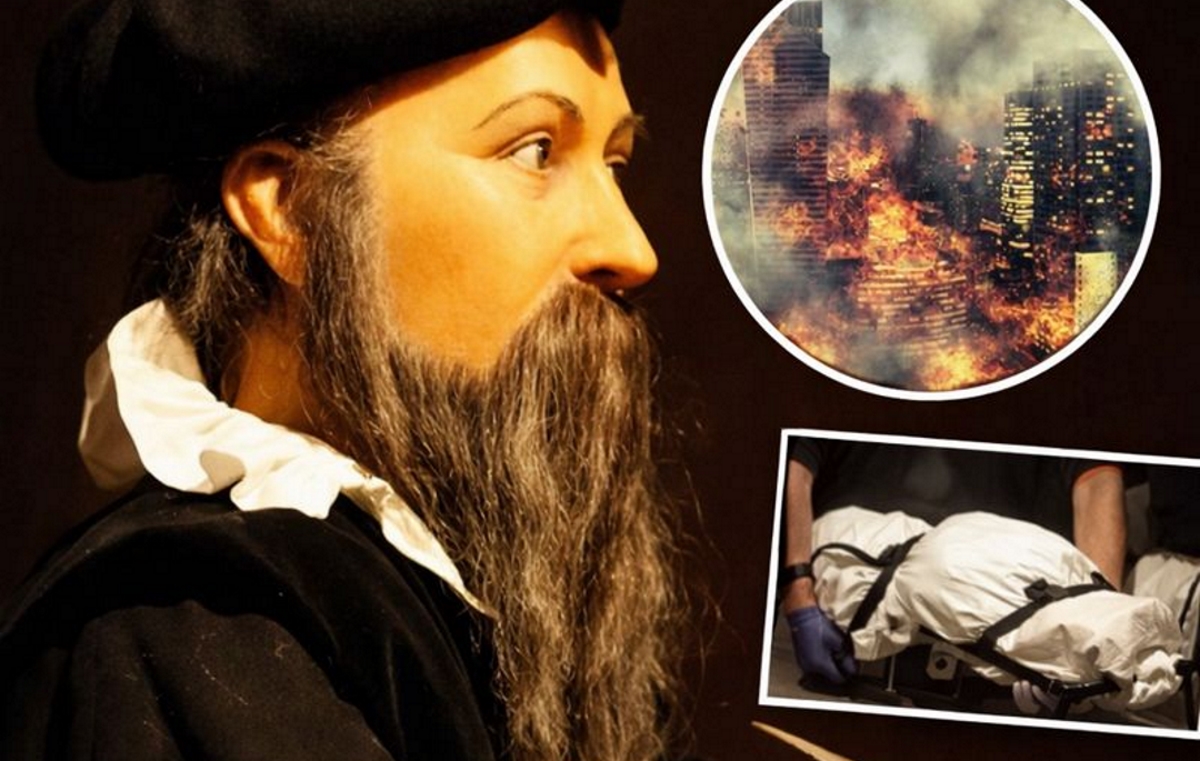
Centuries after his death, Nostradamus is once again being dragged into the present, as readers of his cryptic prophecies claim several verses point toward a deeply unsettling year ahead. According to interpretations gaining traction online, 2026 could mark a convergence of catastrophe, political upheaval, and the death of a globally recognizable celebrity.
Michel de Nostredame, writing in the 1500s, never offered clear dates or names. Instead, his quatrains relied on symbolism, fractured language, and deliberate ambiguity. That vagueness is exactly why moments of global tension tend to resurrect his work — and why some believe 2026 stands out more clearly than most.
One passage repeatedly cited references “the great one falling before the crowd,” a line some interpreters say points to a high-profile figure whose influence spans culture, wealth, or power. The phrase has reignited debate about whether Nostradamus foresaw the death of a modern celebrity whose life is lived under constant public scrutiny.
Similar interpretations have surfaced before, but believers argue the current context makes this different. With celebrity culture more centralized than ever, the loss of a single figure can trigger mass reaction, market shifts, and cultural shockwaves. Analysts familiar with longstanding interpretations note that Nostradamus often framed death as symbolic collapse, not just physical loss.
The second prediction stirring concern involves large-scale conflict. One quatrain describes “fires from the sky” and “iron beasts crossing the seas,” imagery that modern readers often link to aerial warfare and naval escalation. Some believe this points to a significant military confrontation that expands beyond regional borders.
These interpretations have gained renewed attention amid rising geopolitical instability. Researchers who track prophecy trends point out that similar verses are often cited during periods of global tension, particularly when technology reshapes how war is fought. Comparisons have been drawn to historical prophecy cycles where fear amplifies interpretation.
The third event predicted for 2026 is perhaps the most abstract, but also the most ominous. A passage referencing “the shaking of the great markets” and “hunger among the prosperous” has been interpreted as a severe economic disruption. Supporters of this reading suggest a financial crash or supply-chain collapse that affects even wealthy nations.
Economists dismiss prophetic claims, but acknowledge that instability is cyclical. The reason Nostradamus predictions persist, experts argue, is because vague language easily maps onto recurring human crises. That pattern is explored in psychological breakdowns of why people return to apocalyptic forecasts.
Online, discussion of the 2026 predictions has exploded. Videos analyzing the quatrains rack up millions of views, while comment sections spiral into speculation about which celebrity, which war, and which economy might be involved.
Nostradamus predicting a major celebrity death in 2026 is eerie when you look at how fragile fame really is right now.— Culture Watch (@culturewatch) March 2025
Others push back hard, warning against fear-driven interpretations. Historians stress that Nostradamus wrote during an era plagued by plague, war, and famine, meaning his imagery reflects a world constantly on the brink. When modern readers overlay current events, meaning naturally emerges — whether intended or not.
Every generation thinks Nostradamus predicted *their* apocalypse. That’s the trick of vague prophecy.— History Debunked (@histdebunked) March 2025
Still, believers argue that coincidence alone cannot explain how often his verses seem to align with real-world events. They point to past claims that Nostradamus foresaw major fires, assassinations, and global conflicts — interpretations that surged after the fact.
Skeptics counter that retrofitting prophecy is not prediction, but pattern recognition fueled by hindsight. Once an event occurs, language is bent until it fits, a phenomenon well documented in cognitive bias research.
What makes the 2026 predictions especially potent is the emotional climate in which they’re circulating. Economic anxiety, constant news alerts, and celebrity overexposure create a backdrop where ominous forecasts feel more plausible than they might otherwise.
Whether Nostradamus truly foresaw anything beyond his own turbulent era remains unanswered. What is clear is that his words continue to function as a mirror, reflecting modern fears back at us in poetic form.
As 2026 approaches, interpretations will only multiply. Names will be guessed, timelines drawn, and meanings stretched. History suggests that when the year arrives, something will happen — something always does — and many will claim the prophecy was fulfilled.
In the end, Nostradamus may not be predicting the future so much as reminding humanity of a constant truth: uncertainty is eternal, and fear is remarkably adaptable.