
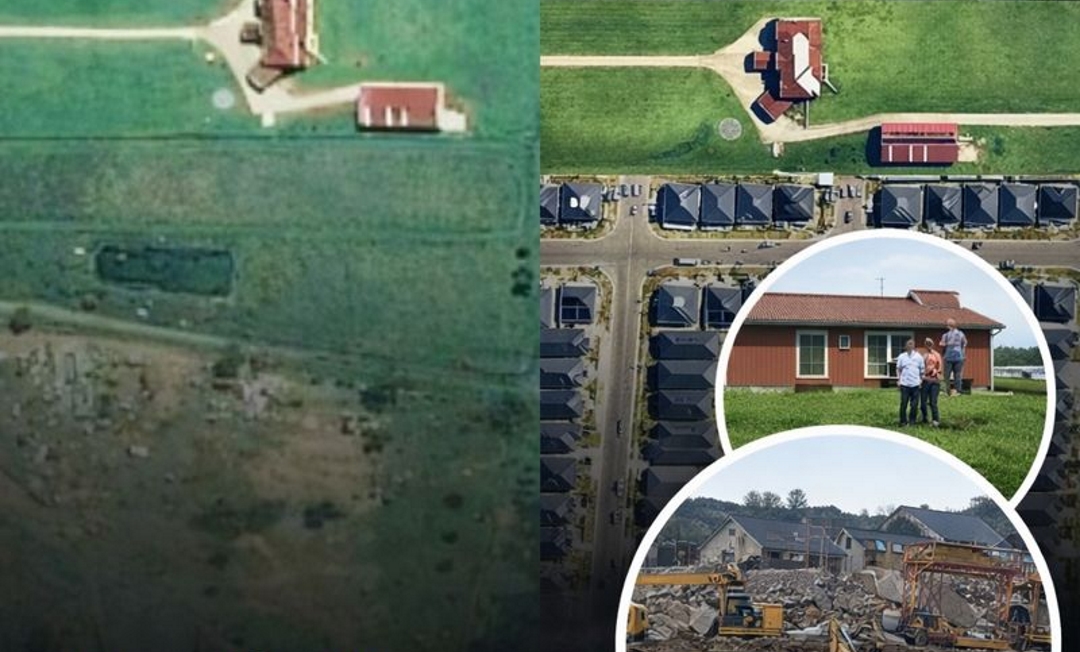
From above, it looks almost unreal. A single family home sits untouched, surrounded on all sides by towering new developments, glass balconies, and freshly paved roads. Where rows of identical buildings now rise, this one house remains — not abandoned, not derelict, but deliberately defiant.
The homeowners were offered what many would consider life-changing money. Developers approached them repeatedly over the years, each offer climbing higher than the last. Cash deals. Relocation packages. Promises of “no hassle.” Every time, the answer was the same: no.
What makes the story resonate isn’t just stubbornness. It’s what the house represents — a rare refusal to bend in an era where nearly everything has a price.
The surrounding neighborhood transformed rapidly. What was once a modest residential area became prime real estate almost overnight, driven by population growth and aggressive redevelopment. One by one, neighbors sold. Bulldozers followed. The family stayed.
Developers reportedly offered sums several times higher than the home’s original value. According to people familiar with the negotiations, the final proposal included a payout that could have funded multiple properties elsewhere, a deal similar to other high-profile holdout cases that drew global attention.
But the owners say the house isn’t an asset — it’s a life. Built decades ago, it holds generations of memories: births, losses, celebrations, and ordinary mornings that never make headlines. Walking away, they said, would mean erasing something money can’t replace.
Urban planners note that holdout properties are becoming increasingly rare as development accelerates. In many cities, zoning pressure and eminent domain leave homeowners with few options. That’s why cases like this spark fascination, similar to documented standoffs where residents resist transformation.
The home’s isolation now feels symbolic. Surrounded by steel and glass, it looks smaller than it once did, but somehow louder. Photos of the property have gone viral, with people calling it “the last stand” and “a middle finger to corporate development.”
That one house refusing to sell while everything around it gets built? That’s not stubbornness — that’s principle.— Urban Lens (@UrbanLens) April 2025
Others see it differently. Critics argue that holding out slows progress, disrupts planning, and inflates costs for everyone else. They say cities must grow, and sentimental resistance only delays the inevitable.
The homeowners reject that framing. They point out that development didn’t need to erase them — it chose to build around them instead. The fact that construction continued without their consent, they argue, proves their refusal didn’t block growth at all.
Legal experts say the family was able to stay because zoning laws protected single-family residences in that specific pocket. Without that protection, the outcome might have been very different. Similar protections have been debated in recent housing policy discussions.
Life inside the house has changed dramatically. Natural light is reduced. Traffic noise is constant. Privacy is limited. Still, the family insists staying was worth the cost.
“We didn’t stay because it was easy,” one family member said. “We stayed because leaving would’ve meant giving up who we are.”
Architects note that the visual contrast between old and new creates a powerful narrative. The home doesn’t just resist development — it exposes it. The scale difference highlights how quickly urban identity can be overwritten.
Similar images have emerged around the world, from China to Australia to the U.S., often referred to as “nail houses.” In many cases, owners eventually give in. This one hasn’t.
Property analysts say the value of the house may now be higher than ever, not because of square footage, but because of symbolism. Its refusal has turned it into a landmark of sorts, echoing economic breakdowns of scarcity and leverage.
Developers built an entire future around them — and that family still said no. Respect.— Housing Watch (@HousingWatch) April 2025
The family has no plans to sell. They say they’ve stopped answering calls and letters altogether. For them, the decision was made long ago.
Whether the house stands for another decade or eventually disappears, its message has already landed. Not everything is negotiable. Not every story ends in a transaction.
In a skyline built on deals and deadlines, one small house remains — quietly reminding everyone that progress doesn’t always get the final word.