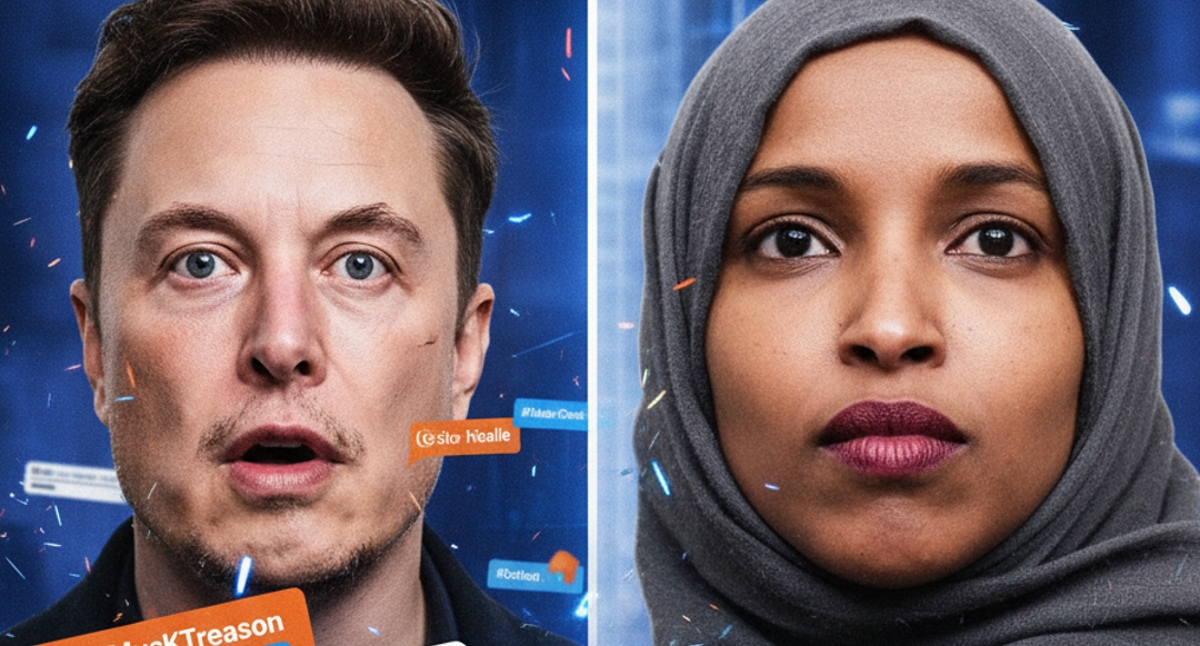
What began as a single explosive screenshot spiraled into a national frenzy overnight as thousands of users circulated a viral claim that Elon Musk had accused Rep. Ilhan Omar of “treason” over U.S. policy toward Somalia — a claim Musk has not made on record, but one that spread fast enough to force fact-checkers, lawmakers, and even congressional staffers to respond. The rumor detonated across X just after midnight, gaining traction in the same algorithmic surge documented in a major Brookings study on viral misinformation, and quickly reshaping the political conversation before dawn.
The frenzy began when a screenshot — formatted to resemble a Musk reply on X — began circulating in political circles, echoing earlier deepfake-style hoaxes analyzed in New York Times reporting on fabricated political posts. The image appeared to show Musk responding to a user who criticized Omar’s comments on Somalia’s security crisis, falsely claiming Musk had written: “This is treason. She should be removed from Congress.” No such post appears anywhere on Musk’s timeline or in deletion archives monitored through independent tracking tools.
But once the screenshot caught momentum, truth no longer mattered. The narrative accelerated with the exact velocity described in a Reuters analysis on AI-amplified misinformation, where fabricated political statements outperform corrections by orders of magnitude.
People are sharing a FAKE Musk post accusing Ilhan Omar of treason. No such tweet exists. Verify before sharing. — CivicCheck (@CivicCheckNow) Dec 15, 2025
The rumor caught fire partly because it collided with an already tense geopolitical moment. Omar, who previously warned about foreign influence and humanitarian instability in East Africa — positions documented in her congressional record — had recently commented on U.S.-Somalia relations in an interview referenced by regional news coverage. Opportunistic accounts seized the chance to frame her remarks as unpatriotic, echoing strategies mapped in Vox’s breakdown of political outrage cycles.
Within hours, the fake screenshot triggered partisan reactions from both sides. Some users treated it as confirmation of their existing beliefs, while others demanded Musk clarify the situation publicly. Analysts comparing the outbreak to earlier misinformation waves cited patterns consistent with a Pew study on the psychology of political rumor acceptance.
So Musk “accused Omar of treason”? No he didn’t. A fake screenshot went viral and half the internet ran with it. — MediaForensics (@ForensicsLab) Dec 15, 2025
Attempts to correct the record were drowned out by anti-Omar posts fueling the narrative. Commentators revived years-old controversies involving Omar’s foreign policy positions, many previously dissected in NBC News reporting on political backlash, reframing them as justification for the misleading “treason” claim. The result was an online battlefield packed with recycled grievances, weaponized misinformation, and emotionally charged falsehoods.
Meanwhile, supporters of Omar criticized the rumor as xenophobic and dangerous, noting parallels to prior coordinated smear campaigns tracked in Washington Post analyses of targeted misinformation attacks. Some warned the situation could escalate offline, referencing earlier cases where fake political quotes led to harassment or threats, such as those summarized in a Reuters investigation into rising threats against lawmakers.
These kinds of fake “treason” accusations aren’t harmless. This stuff puts real people in danger. — DefendTruth (@FactGuardian) Dec 15, 2025
The rumor also prompted experts to revisit the legal meaning of “treason,” a term frequently misused online. Constitutional scholars pointed back to definitions outlined in the National Constitution Center’s overview of treason law, emphasizing that foreign policy disagreements or diaspora advocacy are not remotely treasonous acts. But nuance rarely survives the velocity of social media.
While Musk did not engage with the viral claim, analysts said any response — denial or otherwise — could risk amplifying the hoax further. They compared the dilemma to earlier misinformation storms where public figures avoided feeding the narrative, a strategy outlined in Nieman Lab’s reporting on the backfire effect.
Inside Washington, the situation sparked whispers about digital vulnerability. Staffers familiar with Omar’s office said they were tracking the spread of the fake screenshot closely, noting its resemblance to earlier targeted disinformation campaigns catalogued through Brookings’ influence-operations research. Some aides warned the viral claim could resurface in political attack ads, a tactic observed repeatedly in the past two election cycles.
Others framed the episode as a broader warning about the fragility of truth in digital politics — a reality detailed in Lawfare’s analysis of manipulated public discourse, which notes that fabricated accusations often lodge in public memory even after proven false.
When a fake Musk post reaches millions before anyone checks if it exists, the system isn’t just broken — it’s weaponized. — InfoSecWatchdog (@ISWatchdog) Dec 15, 2025
The fallout now centers on two questions: how the false accusation gained such momentum, and what it means for the future of political discourse as AI-generated screenshots become indistinguishable from real ones. Policy researchers argue the incident underscores the urgency of media literacy reforms similar to those described in NBC News’ reporting on digital-literacy efforts.
For Omar’s team, the priority is containing damage before the hoax becomes a long-term narrative. For Musk, the silence appears deliberate — a refusal to validate or refute a claim he never made. For Washington, the episode feels like a preview of an election season defined not by what politicians say, but by what the internet decides they said.