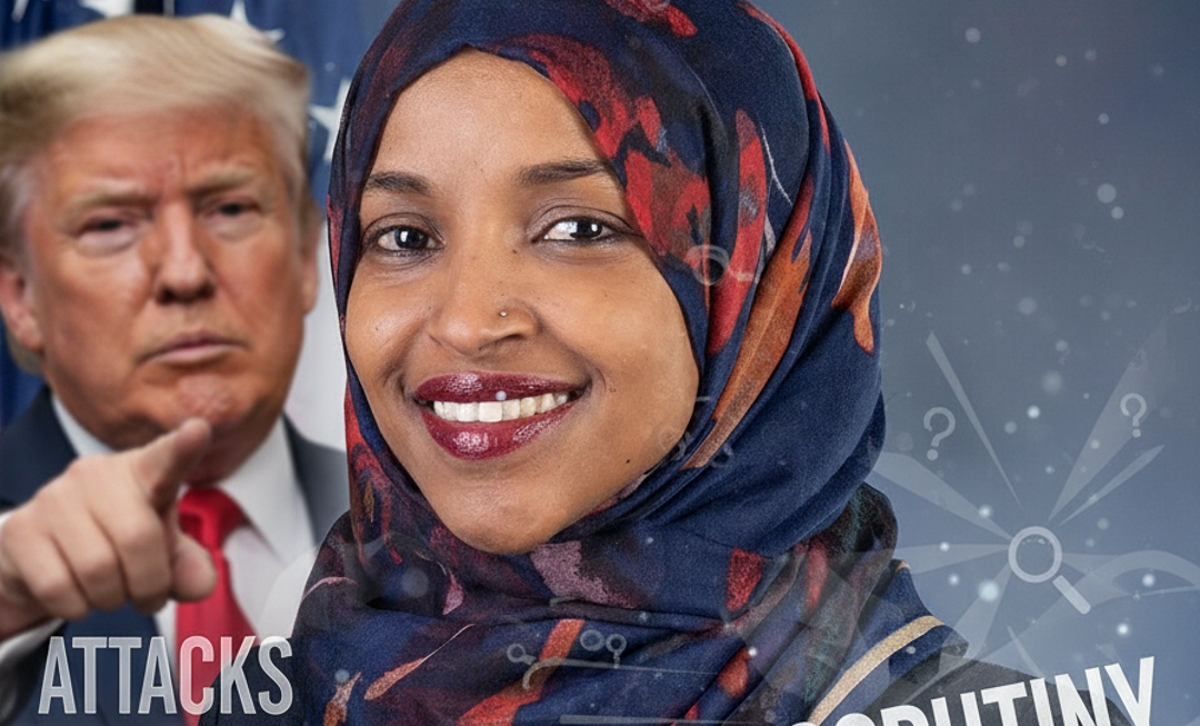
A wave of viral posts swept across social media overnight claiming that Rep. Ilhan Omar accused Donald Trump of using attacks on Somali immigrants to “deflect attention” from scrutiny surrounding his political and legal troubles. The claim — circulating without a verified interview, transcript, or official statement — still triggered an explosive national debate, spreading with the same velocity described in a Brookings analysis of viral misinformation and drawing millions of engagements before fact-checkers even weighed in.
The controversy erupted shortly after Trump delivered remarks criticizing “dangerous refugee policies” and referencing Minnesota’s Somali community, comments that echoed themes previously examined in NBC News coverage of Trump’s immigration rhetoric. Within hours, screenshots and out-of-context clips began circulating on X, claiming Omar had issued a fiery response accusing Trump of weaponizing Somali immigrants as a distraction from his own mounting scrutiny.
No official record of Omar making that statement exists — but that didn’t slow the wildfire. Analysts say the speed of the rumor aligns closely with patterns of fabricated political quotes identified in a Reuters investigation into AI-generated misinformation, where false statements often travel far faster than authentic reporting.
People are sharing a FAKE quote claiming Omar said Trump is “deflecting scrutiny with Somali attacks.” There is ZERO record of her saying this. — CivicCheck (@CivicCheckNow) Dec 15, 2025
The rumor became especially potent because Omar has a long history of speaking about U.S.–Somali relations and diaspora issues, positions documented in her congressional record and explored in coverage of her foreign-policy commentary. That familiarity made the claim feel plausible to many — a phenomenon political psychologists described in a Pew Research report on rumor acceptance, where users often believe fabricated quotes if they align with a public figure’s known views.
The narrative then collided with an already volatile political climate. Trump’s recent rallies, which included renewed attacks on immigration policy, were widely dissected in New York Times reporting on election-year messaging, making any alleged Omar response a lightning rod. The viral quote — true or not — became the centerpiece of a polarizing national argument.
Whether she said it or not, this is EXACTLY the debate America is having: Are Trump’s immigrant attacks real policy or political distraction? — PoliticalFocus (@PolFocus) Dec 15, 2025
Fact-checkers scrambled to contain the fallout. Early assessments referenced databases maintained by FactCheck.org and quote-verification tools used in Snopes investigations, none of which showed evidence Omar ever made the “deflection” accusation. But the correction cycle lagged far behind, mirroring the delay described in Nieman Lab’s research on rumor backfire effects, where the truth often can’t keep pace with the initial lie.
The rumor’s explosive reach prompted renewed scrutiny of how fabricated political content spreads. Media theorists noted similarities to earlier misinformation storms analyzed through Washington Post reporting on digital manipulation, where emotionally charged statements attributed to women of color generate disproportionate engagement — and disproportionate hostility.
This “quote” is fake. But the hate it unleashed toward Somali Americans is very real — and very dangerous. — DefendTruth (@FactGuardian) Dec 15, 2025
Omar’s real comments on Somalia — drawn from past interviews summarized in a Vox foreign-policy explainer — focus on diplomacy, counterterrorism partnerships, and diaspora contributions. None resemble the viral “deflection” quote. Still, the rumor resonated because it tapped into existing political tensions surrounding immigration narratives popular in Trump-aligned media, many of which were analyzed in MSNBC’s coverage of Trump’s messaging playbook.
The misinformation wave escalated further when partisan influencers repackaged the fake statement into attack videos, echoing campaign-style editing tactics previously documented in Reuters investigations into political video manipulation. Some even paired the quote with unrelated footage of Omar speaking at earlier hearings, creating the illusion of confirmation.
As the fake quote spread, supporters of Trump seized on the narrative as validation of their belief that Omar represents “anti-American sentiment,” a theme rooted in years of culture-war clashes chronicled in NBC News timelines of Omar’s political controversies. But critics countered that the uproar exposes how quickly misinformation targeting minority communities can escalate — especially when tied to immigration rhetoric already under national scrutiny.
Researchers tracking online extremism pointed to trends catalogued in ADL reports on coordinated harassment campaigns, warning that false accusations connecting Omar to Somalia often become entry points for xenophobic narratives targeting Somali-American communities more broadly.
This is how it starts: A fake Omar quote → mass outrage → targeted harassment toward Somali communities. We’ve seen this spiral before. — CommunityShield (@CommShieldUSA) Dec 15, 2025
The speed of the rumor reflects a larger vulnerability in today’s information ecosystem. AI-generated screenshots, mislabeled video clips, and fabricated quotes now move through networks faster than journalists can debunk them — a threat highlighted in The Guardian’s warning about deepfake-driven elections. Experts say this episode is a preview of the chaos expected in the coming campaign cycle.
Inside Congress, aides familiar with Omar’s office say they immediately recognized the quote as inauthentic. Still, they expressed concern that the rumor might reappear in political ads or talking points — a pattern observed repeatedly in cases tracked by ProPublica’s investigations into recycled misinformation.
Meanwhile, Minnesota officials monitoring community sentiment said the viral accusation added fuel to existing anxieties within Somali-American neighborhoods — a chilling effect comparable to those described in MinnPost reporting on politically driven harassment. Leaders warned that the spread of false narratives can quickly translate into real-world threats.
By midday, the online debate had shifted from whether Omar said the words to a broader question: Why are fabricated political quotes so easy to believe when they involve marginalized public figures? Media researchers referenced long-standing stereotypes about loyalty and identity, themes dissected in BBC coverage of racialized political attacks, noting that these dynamics often make minority lawmakers uniquely vulnerable to weaponized misinformation.