
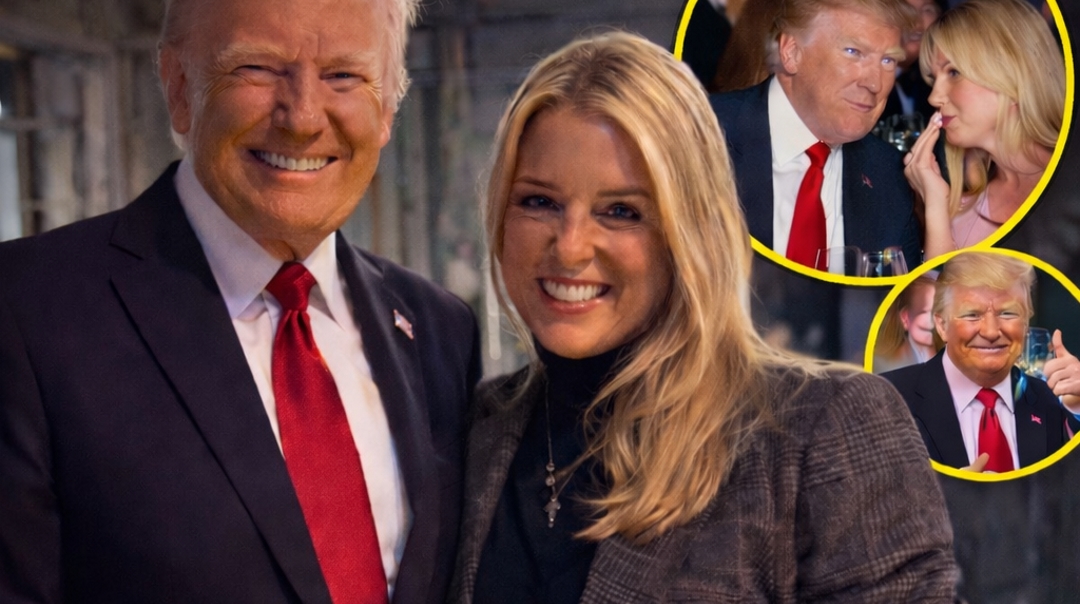
Pam Bondi stepped into the spotlight this week with a blunt declaration that immediately reignited one of the country’s most combustible political arguments. “There’s no evidence Donald Trump committed a crime,” she said, adding that his time in office has been “the most transparent presidency” Americans have ever seen. The comment was delivered without hesitation, but the reaction was anything but calm.
Bondi, a longtime Trump ally and former Florida attorney general, framed her defense as a response to what she described as years of politically motivated investigations. Supporters quickly amplified her words, arguing that repeated probes have failed to produce definitive criminal convictions tied directly to Trump himself. Critics, however, pushed back hard, pointing to the long record of investigations, indictments, and court battles that have followed him in and out of office.
The tension surrounding Trump’s legal history is not new. Over the past several years, he has faced multiple investigations and charges at both the state and federal level, including high-profile cases tied to election interference claims and classified documents. A detailed overview of those cases published by Reuters outlines the range of legal challenges he has confronted, some of which are ongoing, while others have stalled or been reshaped by appeals.
Bondi’s argument hinges on a narrow but potent claim: that accusations are not convictions. In her telling, transparency means that investigations have unfolded publicly, in courtrooms and congressional hearings, rather than behind closed doors. She contends that the sheer visibility of the process proves there has been nothing hidden from the American people.
Opponents counter that transparency and accountability are not interchangeable. They argue that a presidency can be highly scrutinized yet still mired in ethical controversy. For them, the number of investigations itself signals deeper institutional concern, not vindication.
The phrase “most transparent presidency” has its own complicated history. Trump frequently described his administration as uniquely open, pointing to press briefings, public statements, and social media posts as proof of accessibility. But watchdog groups often rated his administration poorly on traditional transparency measures, citing conflicts over document disclosures and compliance with oversight requests.
In recent months, the legal and political landscape around Trump has shifted yet again. Court rulings have narrowed some charges while other proceedings continue. Coverage from The Associated Press’s ongoing Trump legal tracker shows how fluid the situation remains, with different cases moving at different speeds depending on jurisdiction and appeals.
Bondi’s remarks appear to be part of a broader strategy to reframe the narrative from defense to offense. Rather than simply rebutting allegations, she is asserting that the investigations themselves prove the system works, and that Trump has emerged without proof of criminal wrongdoing that meets the highest legal standards. It’s a message designed to resonate with voters who believe the former president has been unfairly targeted.
That message lands very differently depending on where one stands politically. To Trump’s base, Bondi’s statement reinforces a familiar storyline of endurance under pressure. To critics, it feels like an attempt to gloss over unresolved questions and the gravity of formal indictments that have already occurred in some jurisdictions.
What complicates the conversation is that legal outcomes do not always align neatly with political judgments. Court cases can hinge on technicalities, procedural rulings, or appellate interpretations that leave broader ethical debates unresolved. Even when charges are dismissed or reduced, public opinion can remain deeply divided.
Bondi’s emphasis on transparency also taps into a wider cultural frustration about trust in institutions. Many Americans on both sides of the aisle believe the justice system is unevenly applied. For some, her statement signals confidence that scrutiny has not produced disqualifying proof. For others, it sounds like an attempt to declare victory before every case has fully played out.
The backdrop to her comments is a 2026 political environment that feels as polarized as ever. Trump remains one of the most recognizable and polarizing figures in modern American politics. Every new statement about his legal exposure or lack thereof reverberates instantly across cable news panels, social platforms, and campaign rallies.
It’s also worth noting that “no evidence” is a phrase that carries legal weight but political ambiguity. Prosecutors must meet a high burden to secure convictions. Public debate, however, often operates on a different threshold, one shaped by perception, values, and partisan loyalty rather than courtroom standards.
Bondi’s defenders argue that after years of investigations, the absence of a final, disqualifying criminal conviction proves their point. Critics respond that ongoing proceedings and past indictments complicate any sweeping claim of vindication. The gap between those interpretations is where much of today’s political heat lives.
Meanwhile, the question of what counts as transparency continues to divide observers. Is it the volume of information released? The willingness to testify? The outcome of oversight requests? Or is it something less tangible, like a perception of candor? Bondi’s framing suggests that visibility alone equals openness, but watchdog organizations have historically measured transparency through compliance with records laws and congressional oversight.
The broader implication of her statement is clear: it’s not only about the legal record, but about the legacy. By labeling Trump’s presidency as the most transparent in history, Bondi is staking a claim about how it should be remembered. That claim is likely to be debated for years, long after the final legal filings are submitted.
In the end, her remarks underline a truth about American politics in 2026: legal proceedings and public narratives often run on parallel tracks. Courtrooms demand proof beyond a reasonable doubt. Voters weigh credibility, character, and conviction in very different ways. Between those two arenas, the argument over evidence, transparency, and accountability continues to unfold in real time.