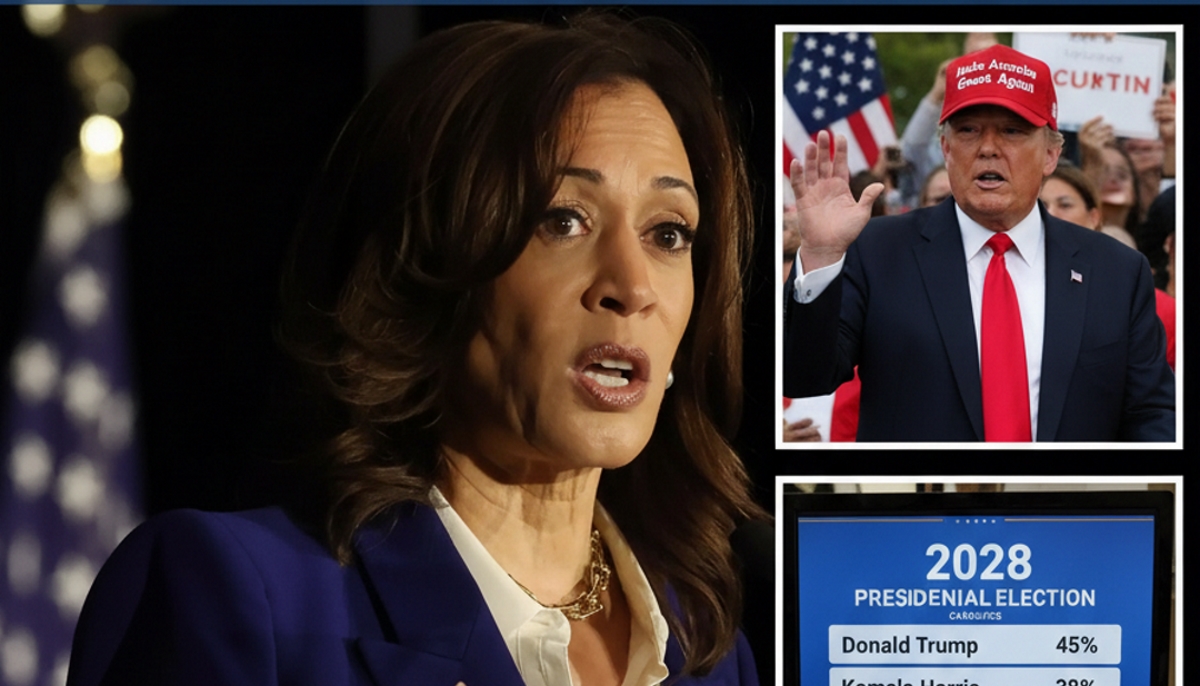
A new set of 2028 presidential odds has sent shockwaves across social media, not because of who topped the list — but because of who didn’t. When users noticed that Donald Trump was listed as more likely to win the presidency than Kamala Harris, despite Trump being constitutionally barred from running again, the reaction was immediate and brutal.
The odds were published on Kalshi, a regulated prediction market that allows users to trade on future political outcomes. Screenshots of the rankings began circulating rapidly, particularly after people realized that Trump — ineligible under the 22nd Amendment — was still being priced higher than the sitting vice president.
According to the snapshot that went viral, Trump was given roughly a six percent chance of winning the 2028 election, while Harris sat closer to three percent. The numbers themselves were less important than what they symbolized: a brutal reflection of public sentiment, frustration, and disbelief.
The moment exploded after being highlighted in a report by UniLAD’s coverage of the reaction, which captured just how stunned people were by the comparison alone.
Kamala Harris having lower odds than someone who literally cannot run again is wild. — Political commentator (@PoliTake) Dec 2025
At first glance, the listing looks absurd. Trump has already served two terms and is constitutionally prohibited from running again, a legal reality spelled out clearly in the amendment ratified in 1951. And yet, his continued presence on the odds board underscores something deeper — his grip on the political imagination hasn’t loosened.
Prediction markets like Kalshi are not polls and not forecasts. They reflect where money is being placed, which often mirrors emotion, speculation, and cultural momentum more than legal feasibility. Kalshi itself has repeatedly emphasized that its numbers represent sentiment, not certainty, a distinction explained in how the platform frames election markets.
Still, that nuance did little to calm reactions online. Many users saw the ranking as an indictment of the Democratic Party rather than a compliment to Trump. Others interpreted it as a referendum on Harris’s political standing more than a literal assessment of eligibility.
Adding to the chaos was the rest of the leaderboard. The top spot belonged to Vice President JD Vance, followed closely by California Governor Gavin Newsom. Other familiar names — including Alexandria Ocasio-Cortez, Pete Buttigieg, Gretchen Whitmer, and Marco Rubio — filled out the rankings in a way that felt more like a cultural mood board than a ballot.
This feels less like an odds list and more like a collective emotional breakdown. — Media analyst (@MediaMindset) Dec 2025
What truly stunned observers was not Trump’s placement, but Harris’s. As the sitting vice president and a theoretically obvious Democratic contender, many expected her to rank far higher. Instead, her position reignited long-running debates about visibility, messaging, and whether she has ever truly been embraced as a future nominee.
Political analysts pointed out that Harris’s odds may reflect broader dissatisfaction rather than direct opposition. Studies cited in recent public opinion research have shown that voter confidence in institutions and leadership remains fragile across party lines, often translating into pessimism about familiar figures.
Others argued that the reaction itself proved the problem. By treating speculative odds as verdicts, critics said, social media once again turned political discourse into spectacle. Numbers divorced from context took on emotional weight, fueling outrage that quickly drowned out explanation.
Yet even skeptics admitted the comparison hit a nerve. Trump’s continued relevance — even in hypothetical, impossible scenarios — highlights how deeply he remains embedded in American political culture. Harris’s lower odds, meanwhile, sparked uncomfortable questions Democrats have struggled to answer for years.
The fact that Trump still looms over every future election tells you everything. — Political historian (@HistoryLens) Dec 2025
Kalshi users and election watchers were quick to remind everyone that four years is an eternity in politics. No candidates have officially declared, alliances will shift, and unexpected figures will emerge. But the viral moment wasn’t about predicting 2028 — it was about exposing the current state of political trust.
In that sense, the odds list acted less like a crystal ball and more like a mirror. What people saw staring back wasn’t a forecast of the future, but a snapshot of disillusionment, anxiety, and unresolved power dynamics that continue to define American politics.
Whether the rankings fade or resurface again, the reaction made one thing unmistakably clear: even hypothetical numbers can ignite real emotions when they collide with a system many Americans already feel disconnected from.