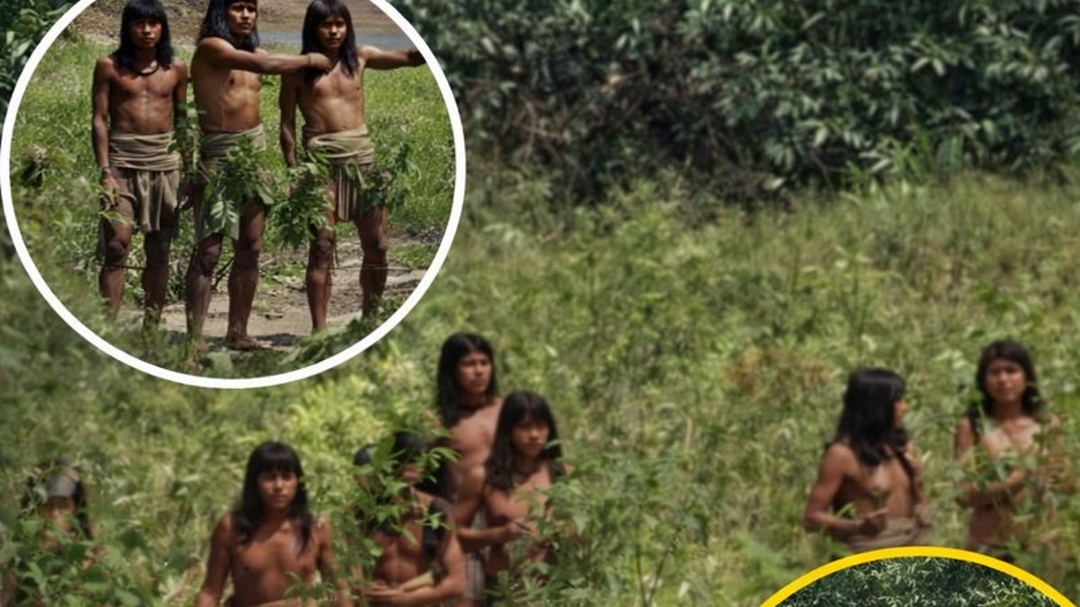
The footage didn’t arrive with fanfare. It surfaced quietly, shared first among researchers and then ricocheted across social media, showing a small group of Indigenous people moving through dense Amazon brush. Barefoot, alert, and clearly uncontacted, they appeared unaware—or deeply wary—of the outside world watching them.
Within hours, the clip exploded online. Viewers weren’t just reacting to the rarity of seeing an uncontacted tribe alive and moving in the modern era. They were fixated on small details that felt wrong, out of place, or disturbingly familiar.
The video appears to show members of the tribe navigating terrain that should be untouched. But sharp-eyed viewers began pointing out what looked like cleared paths, unfamiliar plant arrangements, and even materials that resembled processed fabric rather than traditional bark or fiber.
That’s where alarm bells started ringing.
Anthropologists and Indigenous-rights advocates warn that even subtle signs of outside interference could be catastrophic. Uncontacted tribes have no immunity to common diseases, and history shows that even indirect contact can lead to mass death. A chilling overview of how fragile these populations are appears in longstanding field documentation that experts say people often underestimate.
As the footage spread, speculation filled the vacuum. Some claimed the tribe had already been approached by illegal loggers. Others suspected nearby mining activity. A few even questioned whether the footage itself had been staged or manipulated, though no evidence supports that claim.
What experts agree on is simpler and more troubling: the tribe should not be visible at all.
Uncontacted groups actively avoid detection, often retreating deeper into the forest when they sense danger. The fact that they were filmed at close range suggests either desperation or disruption. According to recent reporting from cultural researchers, increased deforestation has made isolation harder to maintain.
The surrounding environment in the clip adds to the concern. Viewers noticed shelters that looked hastily assembled, not permanent dwellings. Others pointed to what appeared to be defensive body language—grouped movement, frequent glances outward, and children kept tightly within the formation.
To seasoned fieldworkers, those details speak volumes.
“This is not curiosity,” one researcher said anonymously. “This is survival behavior.”
Uncontacted tribes should never be filmed like this. Visibility often means something has already gone terribly wrong. — Amazon Watch (@AmazonWatch) February 2026
Government agencies responsible for protecting Indigenous territories have offered limited comment, emphasizing that investigations are ongoing. Critics argue that response is far too slow, especially given how frequently illegal operations slip through enforcement gaps.
There’s also growing frustration with how the footage is being consumed. While many viewers express concern, others treat it as viral content—zooming in, circling screenshots, and theorizing without understanding the stakes.
Indigenous advocates say that attention itself can be dangerous. Even sharing locations indirectly can guide outsiders to vulnerable groups. That risk is outlined repeatedly in international protection frameworks that stress non-interference above all else.
Yet the images continue to spread.
Some of the “strange details” gaining traction may ultimately have benign explanations rooted in cultural practices unfamiliar to outsiders. But others—especially signs of environmental disturbance—are harder to dismiss.
Satellite data already shows accelerating deforestation near regions believed to host uncontacted tribes. A broader analysis of land encroachment trends can be found in investigative environmental reporting that tracks how quickly protected zones are shrinking.
For those who work closely with these communities, the footage feels less like a discovery and more like a warning. A signal that isolation is cracking under modern pressure.
Every time an uncontacted tribe appears on camera, it’s a sign they may already be in danger. — Indigenous Rights Now (@IndigenousRN) February 2026
The unsettling truth is that once visibility increases, consequences usually follow. Disease, displacement, and violence have wiped out entire tribes in living memory.
This footage, stripped of speculation and viral noise, leaves one question hanging heavily: are we witnessing a rare glimpse of human resilience—or the early stages of another irreversible loss?
For now, the forest remains quiet. But the world is watching, and history suggests that attention alone can be enough to change everything.