
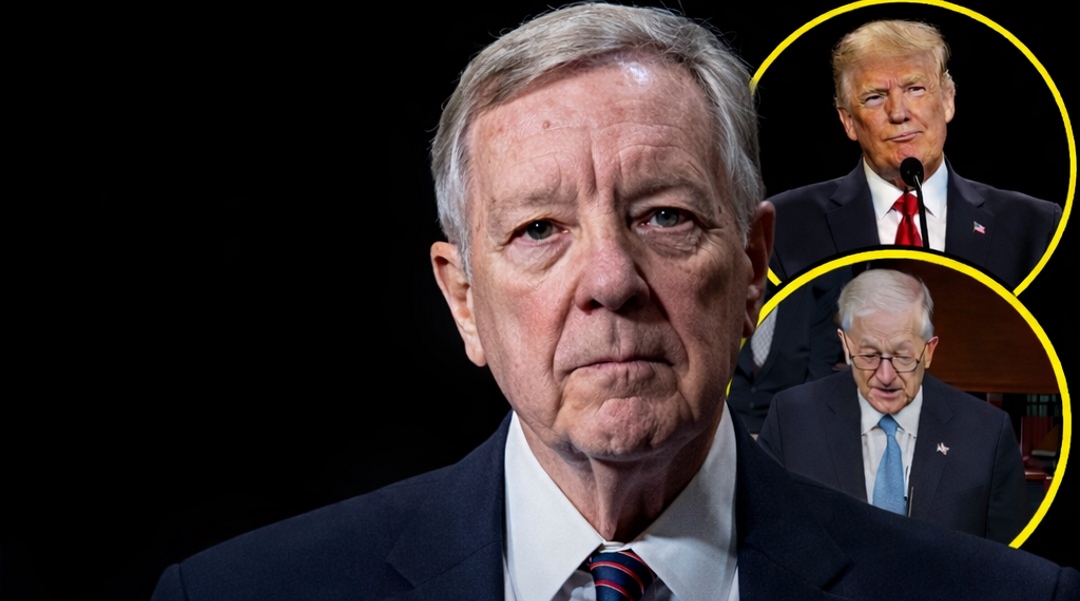
The warning landed like a match in dry grass: a U.S. senator publicly framing Donald Trump’s political “endgame” as power without risk, arguing that the goal isn’t just to win the next election, but to shape the rules so his side “never loses again.”
It’s the kind of language that instantly hardens the room. Supporters hear a familiar attack line, opponents hear a blaring siren, and everyone else is left trying to separate rhetoric from a real-world plan that could actually be carried out.
In the senator’s telling, this isn’t about one campaign cycle or one courtroom fight. It’s about building a system of pressure points — on election administration, on courts, on state officials, on the public’s belief in outcomes — until the idea of a clean loss becomes politically impossible.
That claim hits a nerve because elections don’t just run on ballots. They run on trust, procedure, and thousands of small decisions: who can vote, where they can vote, how results are certified, how challenges are handled, and which officials can be leaned on when the margins are thin.
What the senator is really describing is an ecosystem where control doesn’t need to look like a coup. It can look like “reform,” like “integrity,” like “security,” while quietly centralizing power in the hands of partisan actors who get to decide which votes count and which ones are suspicious by default.
That’s why election rules are so fiercely fought over in state legislatures. The senator’s argument is that if you can tilt the machinery — through laws, litigation, and relentless narrative warfare — you don’t need to persuade more people, you just need to make the battlefield more favorable every time.
None of that requires secret tapes or shadowy committees. It requires daylight politics: drafting bills, pressuring election officials, replacing administrators, and pushing the idea that any defeat is evidence of fraud rather than a reflection of voters.
This is where the language gets dangerous, because it turns losing into illegitimacy. And once a movement adopts the belief that defeat is impossible unless the system is “rigged,” the incentive becomes clear: keep undermining the system until only your wins feel “real.”
The senator’s warning echoes concerns long raised by democracy and election-law watchers, including those who track how election administration can be politicized through staffing changes and legal redefinition of authority, laid out in a detailed breakdown of threats and safeguards in modern election administration and the ways those pressures can compound over time.
Still, critics of the senator’s framing argue this is overheated language designed to raise money, drive clicks, and paint ordinary policy disputes as authoritarian plots. They’ll point out that elections involve courts, multiple layers of oversight, and decentralized decision-making that makes full control difficult.
But the senator’s point isn’t that one person flips a switch and “controls elections.” It’s that small structural changes, repeated year after year, can make outcomes easier to contest, harder to certify, and more vulnerable to partisan leverage when the stakes are highest.
There’s a reason so many battles revolve around who certifies results and what discretion those officials have. Certification is supposed to be administrative, not ideological, and when it becomes partisan theater, the public is forced to watch governance get replaced by loyalty tests.
When politicians argue that the system is “broken,” they often propose fixes that hand more power to themselves. The senator is warning that the line between “election integrity” and election control can be crossed quietly, wrapped in patriotic language, and defended as common sense.
At the heart of the controversy is a simple question: what does it mean to “never lose again” in a democracy? In legitimate politics, you work to win more votes. In illegitimate politics, you work to ensure the other side can’t win even when they do.
The U.S. system is built on the premise that voters can fire leaders. That idea is embedded in the architecture of democratic government, in constitutional limits, and in the expectation that power is temporary — a principle reflected in the constitutional structure and protections outlined in the National Archives’ official transcript of the U.S. Constitution and the framework it sets for transferring and limiting authority.
The senator’s warning also taps into a broader cultural shift: the normalization of permanent political warfare. When every election is cast as existential, the temptation grows to treat the rules as weapons and the referee as an enemy.
That’s why phrases like “manipulate elections” spread so fast. They describe a fear that many people already carry, even if they disagree on which side is responsible.
What happens next depends on whether this warning stays in the realm of viral rhetoric or becomes a focused national debate about safeguards. If the argument is that the system can be bent, the response isn’t just outrage — it’s transparency, oversight, and clear lines that can’t be crossed without consequences.
Because the most destabilizing outcome isn’t one side winning. It’s a country that stops believing it can ever fairly lose — and starts treating democracy like something to be owned instead of shared.