
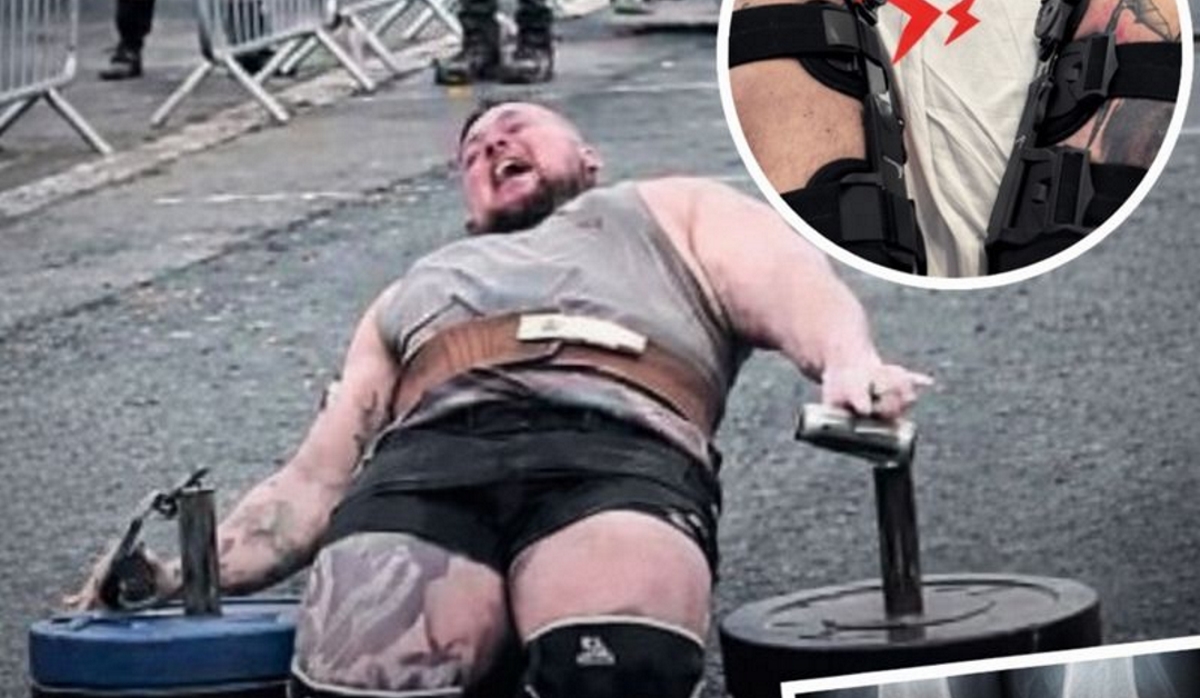
The footage is hard to watch, even for seasoned strength-sport fans. A professional strongman, mid-lift, suddenly collapses as both of his knees buckle inward, his legs giving way in a way that immediately signals catastrophic injury. Within seconds, the crowd realizes something has gone terribly wrong.
Witnesses described the moment as surreal. As the athlete attempted to complete the lift, both patellar tendons ruptured almost simultaneously, causing his kneecaps to retract upward into his thighs — a rare and devastating injury that orthopedic surgeons often describe as one of the most violent failures the human body can endure.
The incident occurred during a high-intensity strongman event, where competitors routinely push their bodies to extreme limits. Video of the injury spread rapidly online, with viewers reacting in horror as medical staff rushed to stabilize the athlete before transporting him for emergency treatment.
Sports medicine experts quickly weighed in, explaining that bilateral patellar tendon ruptures are exceptionally uncommon outside of traumatic accidents. One analysis referenced documented case studies showing that such injuries usually require a perfect storm of load, force, and biomechanical stress.
Strongman competitions demand maximal output under awkward conditions — heavy weights, unstable footing, and time pressure. Unlike controlled gym lifts, these events often involve uneven objects that force the knees to absorb massive shock.
Several fellow competitors later said they heard a loud popping sound before the athlete hit the ground. Others described immediate swelling and visible deformity, signs that seasoned lifters instantly recognize as tendon failure rather than muscle strain.
Doctors familiar with the injury say recovery is long and uncertain. Surgical repair is mandatory, followed by months of immobilization, physical therapy, and gradual load reintroduction. Even then, returning to elite competition is far from guaranteed.
Some pointed to orthopedic breakdowns explaining how the patellar tendon acts as a critical link between the quadriceps and the lower leg. When it fails, basic functions like standing and walking become impossible without surgical intervention.
The incident reignited debate within the strength community about safety margins in modern strongman events. While the sport has always embraced risk, critics argue that escalating weights and spectacle-driven programming increase the chance of irreversible injury.
Others counter that athletes knowingly accept those risks, training for years to handle loads most people will never attempt. They emphasize that freak injuries, while horrifying, remain statistically rare given the volume of competitions held worldwide.
The athlete’s team released a brief statement confirming successful emergency surgery and thanking fans for support. They acknowledged the road ahead would be long but expressed optimism based on early outcomes.
In online discussions, many fans referenced past career-ending cases in other strength and power sports, noting that even world-class rehab does not guarantee full restoration of explosive power.
What shocked viewers most was the visual nature of the injury. Unlike muscle tears that occur internally, patellar tendon ruptures dramatically alter leg anatomy in real time. Medical professionals say that visibility contributes to the intense reaction, even among hardened sports audiences.
Strength coaches also used the moment as a sobering reminder about cumulative load. Years of heavy squatting, jumping, and maximal effort lifts can weaken connective tissue, even when muscles remain strong.
Despite the grim reality, stories of recovery do exist. Some athletes regain functional strength and return to coaching, commentary, or modified competition formats. Others find new paths entirely, channeling their experience into injury prevention and athlete advocacy.
For now, the strongman community is left grappling with the brutal reminder that human limits are real, no matter how strong the athlete. The footage will likely circulate for years, not as spectacle, but as a warning etched into the sport’s collective memory.
As fans wait for further updates, the focus has shifted from competition results to long-term health. One moment of maximum effort changed everything — a split second where strength met anatomy, and anatomy lost.