
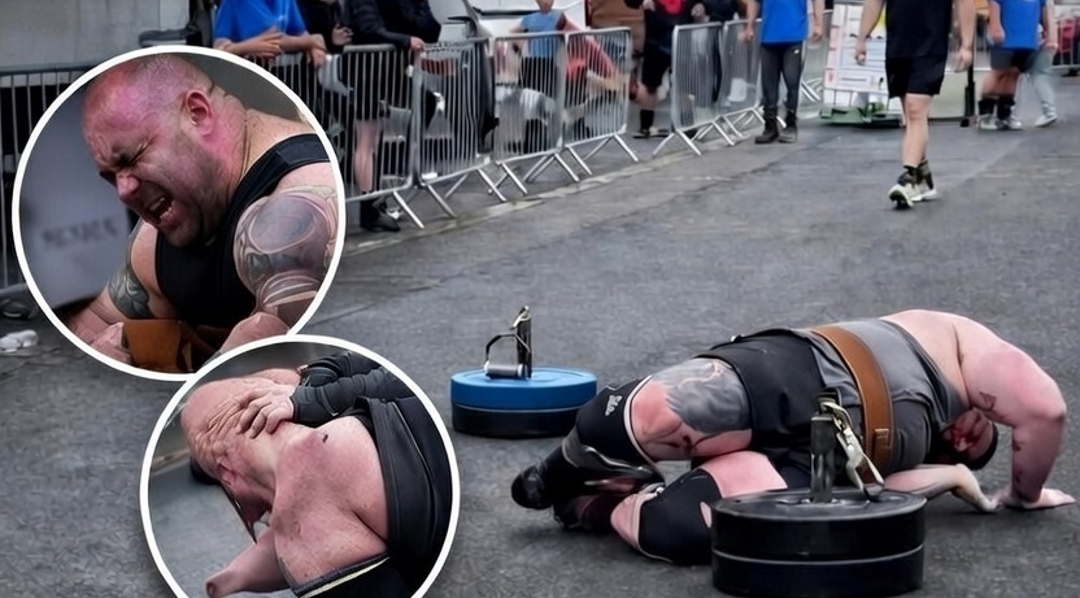
A strongman competition meant to showcase peak human strength turned into a horrifying medical emergency when an athlete suffered one of the most severe leg injuries the sport can produce. In front of stunned spectators, the competitor snapped both patellar tendons, causing his knees to violently shoot upward into his thighs.
The incident occurred during a heavy pulling event, one of the cornerstone challenges in professional strongman contests. These lifts demand extreme force through the legs, knees, and connective tissue, often pushing the human body to its absolute limits.
As the athlete began the lift, everything appeared normal. He braced, tightened his core, and drove upward with explosive power. Then, in a split second, the structure holding his knees in place failed catastrophically.
Witnesses described a sickening moment where his legs appeared to collapse inward while his knees rose unnaturally high. The athlete immediately dropped to the ground, screaming in pain, unable to extend or support either leg.
Medical professionals later confirmed that both patellar tendons had ruptured simultaneously. The patellar tendon connects the kneecap to the shinbone, allowing the leg to straighten. When it tears, the knee loses all structural stability.
Bilateral patellar tendon ruptures are extremely rare outside of high-impact trauma. Seeing both fail at once, without external collision, is almost unheard of outside elite strength sports.
Video of the injury spread rapidly online, with many viewers unprepared for how graphic the mechanism appeared. Sports physicians warned that the visual shock often understates the true severity of the damage.
Unlike muscle tears, tendon ruptures do not heal on their own. Surgery is mandatory, often followed by months of immobilization and years of rehabilitation. Even then, full recovery is never guaranteed.
According to orthopedic specialists, the force required to rupture a patellar tendon can exceed several thousand pounds. In strongman competitions, athletes routinely generate those forces under maximal load.
The injured competitor was rushed to a hospital, where imaging confirmed complete bilateral tendon rupture. Surgeons reportedly described the injury as “devastating” due to its symmetry and severity.
Strongman events are notorious for pushing connective tissue beyond normal physiological limits. While muscles can adapt relatively quickly, tendons strengthen far more slowly, increasing injury risk under repeated maximal stress.
Medical research on tendon injuries in strength sports, including findings summarized by the National Institutes of Health, shows that chronic micro-damage often accumulates long before a catastrophic rupture occurs.
Many experts believe such injuries are rarely caused by a single lift alone. Instead, years of overload, inflammation, and micro-tears silently weaken the tendon until it fails without warning.
In strongman culture, athletes often train through pain, viewing discomfort as a normal part of progression. Unfortunately, tendon pain can be deceptive, sometimes disappearing before a rupture occurs.
The incident reignited debate about safety protocols in strength competitions. Unlike Olympic lifting or powerlifting, strongman events frequently involve unconventional implements and awkward body mechanics.
Critics argue that the lack of standardized load limits and event formats increases the likelihood of unpredictable injuries. Supporters counter that risk is inherent to a sport built around extreme feats.
Former competitors weighed in online, noting that patellar tendon injuries are among the most feared outcomes in strength athletics. Recovery can permanently alter an athlete’s career trajectory.
Even with successful surgical repair, many athletes never regain full confidence in their knees. Some experience lingering instability, reduced explosiveness, or chronic pain that forces early retirement.
Rehabilitation from bilateral tendon rupture typically involves months in braces, followed by gradual weight-bearing, then cautious strength rebuilding. The process can extend well beyond a year.
Sports medicine experts interviewed by BBC Sport have noted that connective tissue injuries often have a heavier psychological toll than muscle damage, due to fear of re-injury.
For the injured strongman, the road ahead is uncertain. While modern surgical techniques offer hope, the injury represents one of the most severe setbacks an athlete in the sport can face.
The footage now serves as a stark reminder of the razor-thin margin between peak performance and catastrophic failure. In sports where strength has no ceiling, the human body eventually sets one.
As the strongman community reflects on the incident, many are left grappling with the same uncomfortable truth: when pushing the limits of human power, sometimes the limits push back—hard.