
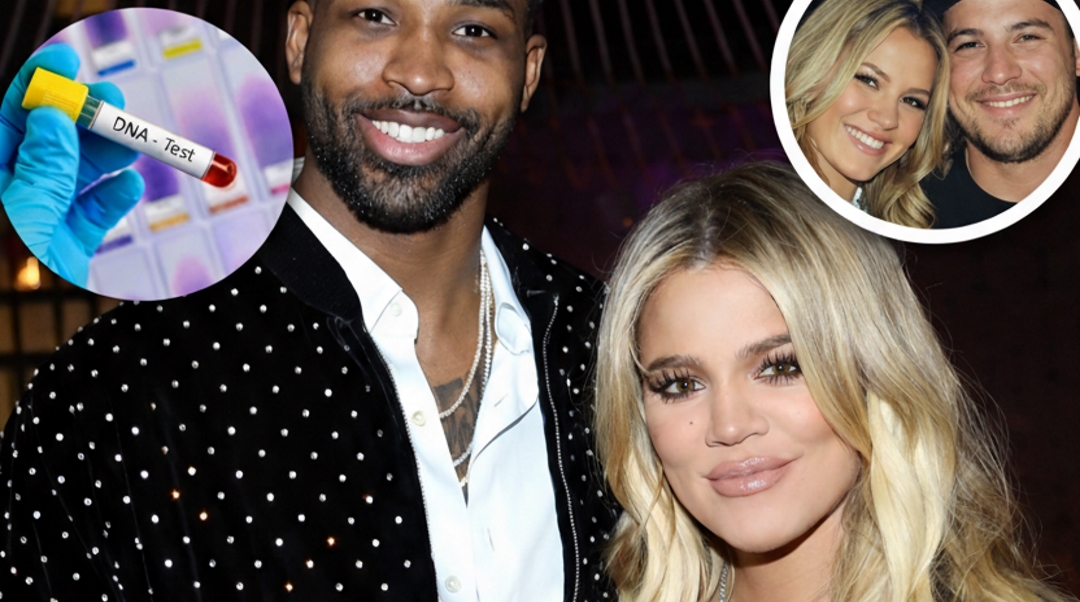
Few celebrity families live under a microscope like the Kardashians, and when a rumor touches bloodlines, children, and betrayal, it spreads with unusual speed. In recent months, viral posts have revived an explosive claim: that Khloé Kardashian allegedly required Tristan Thompson to take multiple paternity tests over fears about her son’s parentage. The story traveled fast, fueled by screenshots, out-of-context clips, and a familiar appetite for scandal.
What’s striking is not just how widely the claim circulated, but how quickly it hardened into “fact” online—despite the lack of evidence. To understand what actually happened, and why the rumor persists, it helps to separate verified information from internet mythology and look at how this family’s very public history made the claim feel plausible to some viewers.
First, the context. Khloé Kardashian and NBA player Tristan Thompson share two children. Their relationship unfolded on reality television alongside repeated infidelity scandals involving Thompson. Those betrayals were real, documented, and devastating—particularly during Khloé’s pregnancies—creating a foundation of mistrust that audiences witnessed in real time. That backdrop matters, because it’s what allowed later rumors to feel believable even without proof.
The specific allegation—that Khloé demanded three separate paternity tests because she feared her son might not be Tristan’s—does not appear in court records, verified interviews, or credible reporting. No documentation supports the idea that multiple tests were ordered, nor that any test raised questions about parentage. In fact, the claim appears to trace back to anonymous social posts and stitched video clips that blurred timelines and implied conclusions never stated.
As fact-checking of the viral claim has noted, the story relies on conjecture rather than evidence, often repackaging long-standing gossip as newly “confirmed” information. The rumor’s endurance says less about new facts and more about how celebrity narratives calcify online.
So why did it gain traction? One reason is the family’s transparency. The Kardashians have shared intensely personal moments—fertility struggles, cheating scandals, surrogacy decisions—inviting audiences to feel like insiders. When trust is broken publicly, viewers sometimes assume every private decision must be extraordinary or extreme. A rumor about repeated testing slots neatly into that expectation, even if it isn’t true.
Another reason is the way internet culture rewards escalation. One paternity test sounds routine. Three sounds shocking. Add a taboo insinuation, and the algorithm does the rest. The more outrageous the framing, the farther it travels—especially when it involves a famous family whose name already trends.
What is verifiable is this: Khloé has acknowledged trust issues stemming from Thompson’s infidelity and has spoken openly about the emotional toll it took. She has also been clear, repeatedly, about protecting her children from adult controversies. That protective instinct is consistent across her public statements, even when addressing painful topics.
In interviews and on the family’s show, she’s emphasized boundaries—what she’ll share and what she won’t—particularly when it comes to her kids. That stance runs counter to the idea that she would publicly or privately entertain a rumor questioning her child’s parentage without cause.
It’s also worth noting how easily medical language is misunderstood online. Paternity testing exists in many forms, for many reasons, and speculation often conflates routine procedures with dramatic motives. In celebrity discourse, nuance is the first casualty.
Coverage that revisited the rumor alongside the couple’s documented history has stressed the absence of proof. In reporting that focuses on Khloé’s approach to parenting, sources consistently describe a priority on stability and privacy for her children, not sensationalism.
The human cost of such rumors is easy to overlook. Children grow up. Search results linger. Claims that trend today can resurface years later, detached from context and stamped with undeserved credibility. That’s why unverified allegations—especially those involving family relationships—carry consequences far beyond clicks.
There’s also a gendered dimension at play. Mothers in the public eye are often subjected to harsher scrutiny around reproduction, fidelity, and “proof,” as if they must continually validate what is presumed about fathers. When a relationship ends badly, suspicion tends to land disproportionately on women’s decisions and bodies.
Meanwhile, Thompson’s documented infidelities—confirmed and widely reported—created a narrative vacuum the internet rushed to fill. Instead of stopping at what was known, speculation leapt to what would be most shocking. The result was a rumor that felt narratively “right” to some viewers, even as it remained unsupported.
What endures from this episode isn’t a revelation about paternity; it’s a lesson about how quickly celebrity misinformation metastasizes. The same visibility that allows stars to correct the record also makes them targets for ever more extreme claims. And once a story is framed as scandal, debunking it rarely travels as far as the initial spark.
In the end, the available evidence points to a familiar conclusion: a dramatic allegation without documentation, amplified by a fraught relationship history and an attention economy that prizes shock. Khloé Kardashian’s real story here is not about secret tests or hidden doubts—it’s about navigating motherhood under relentless scrutiny, and drawing lines around what her children should never have to answer for.
As celebrity culture continues to blur entertainment and reality, the responsibility to distinguish rumor from fact doesn’t rest only with the people being talked about. It belongs to the audiences who share, the platforms that amplify, and the outlets that choose restraint over reach.