
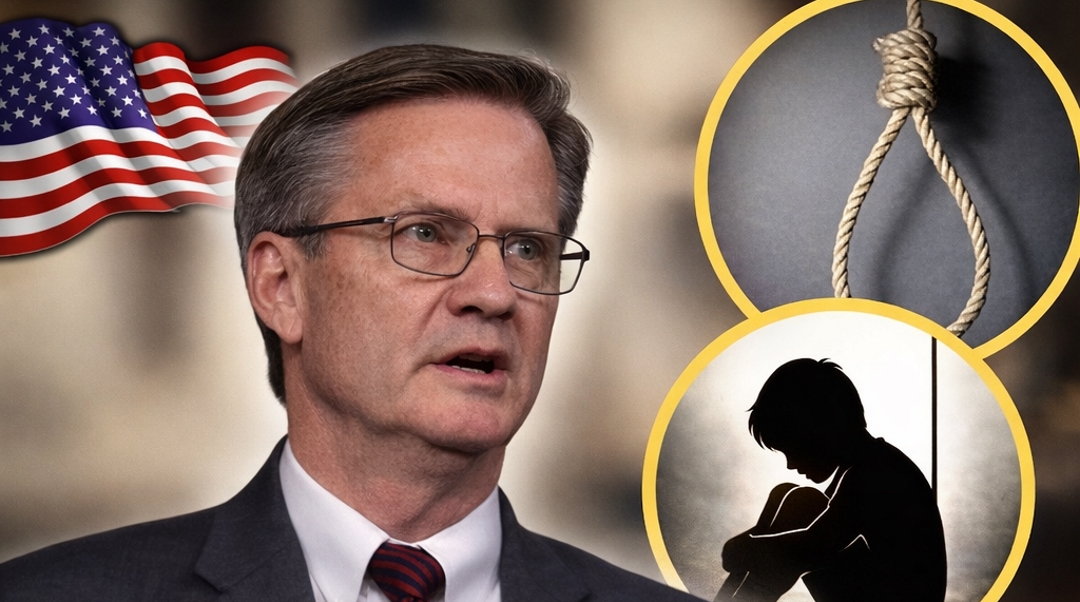
Republican Congressman Tim Burchett is facing sharp criticism after declaring that individuals convicted of sex crimes against children “deserve to be hanged in public.” The Tennessee lawmaker made the remark during a discussion about penalties for child exploitation offenses, framing his comments as a reflection of outrage over crimes against minors.
The statement immediately ignited fierce reactions from civil rights advocates, legal scholars, and even some fellow lawmakers who said the language crossed a dangerous line. While Burchett emphasized that he was referring to those found guilty through the judicial system, critics argued that calling for public executions evokes imagery that clashes with constitutional protections and modern legal standards.
Capital punishment remains legal in certain U.S. jurisdictions, but the Supreme Court has ruled that the death penalty cannot be imposed for crimes in which the victim does not die. In a landmark 2008 decision, the Court held that executing someone for child rape violates the Eighth Amendment’s prohibition on cruel and unusual punishment, a ruling outlined in the Supreme Court’s opinion in Kennedy v. Louisiana. That precedent effectively bars capital punishment in non-homicide child sex crime cases under current constitutional law.
Burchett did not outline specific legislative proposals to implement his remarks. Instead, he framed the statement as an expression of moral outrage, saying the most severe crimes against children demand the harshest consequences. Supporters on social media praised his bluntness, arguing that the justice system often fails victims.
Opponents countered that inflammatory rhetoric risks undermining due process and could inflame public passions in ways that harm fair trials. Legal experts stressed that even in capital cases involving murder, public executions are not permitted under American law. Executions, where allowed, are conducted under strict protocols and are not public spectacles.
Advocacy organizations focused on child protection said the discussion should center on prevention, survivor support, and effective prosecution rather than symbolic punishments. They argue that improving investigative resources and ensuring consistent sentencing would better serve victims than calls for unconstitutional measures.
The broader debate also touches on how lawmakers use emotionally charged language in response to heinous crimes. Sexual offenses against children generate intense public anger, and political leaders often face pressure to demonstrate toughness. However, constitutional limits constrain how far penalties can go.
The Supreme Court’s 2008 ruling made clear that while states may impose life sentences for child rape and similar offenses, the death penalty is reserved for crimes resulting in death. That decision reaffirmed evolving standards of decency in American jurisprudence, as explained in summaries of the ruling by the Legal Information Institute’s breakdown of the case. Any effort to expand capital punishment to non-homicide crimes would require either a constitutional amendment or a reversal by the Court.
Some conservatives defended Burchett’s comments as a reflection of frustration with what they see as lenient sentencing in certain cases. They pointed to instances where plea deals reduced potential penalties or where offenders later reoffended after release. In their view, harsher deterrents would better protect communities.
But constitutional scholars warn that expanding capital punishment has historically faced strong judicial resistance. The Supreme Court has repeatedly narrowed its application over the past several decades, limiting it in cases involving juveniles, intellectual disability, and non-lethal crimes.
Beyond legal feasibility, the phrase “public hanging” carries heavy historical baggage. Public executions were largely abolished in the United States in the early 20th century, in part due to concerns about mob mentality and the spectacle of state-sanctioned violence. Historians note that such practices often fueled rather than prevented brutality.
Burchett’s office later clarified that he was speaking rhetorically and expressing moral condemnation rather than announcing a formal policy initiative. Nonetheless, the remark continues to circulate widely online, with both supporters and critics amplifying clips of his statement.
The controversy highlights the tension between emotional responses to horrific crimes and the constitutional guardrails that shape American law. While outrage is understandable, legal systems operate within established limits designed to protect rights — even for those accused of serious offenses.
Survivors’ advocacy groups emphasize that the most urgent needs involve funding for counseling services, improving reporting mechanisms, and strengthening child protection systems. They argue that debates over extreme punishments can distract from practical reforms that would prevent abuse in the first place.
Meanwhile, the political fallout continues. Some lawmakers privately expressed discomfort with the tone of the comment, fearing it could be used to portray their party as endorsing unconstitutional policies. Others insisted that strong language is sometimes necessary to underscore the gravity of crimes against children.
As the debate unfolds, the constitutional framework remains unchanged. Under current Supreme Court precedent, the death penalty cannot be applied in child sex crime cases where the victim survives. Public executions are not part of the American legal system.
What remains is a heated national conversation about punishment, deterrence, and the role of rhetoric in politics. Burchett’s statement may have been intended as an expression of anger on behalf of victims, but its legal implications — and its political consequences — continue to reverberate far beyond the original remark.