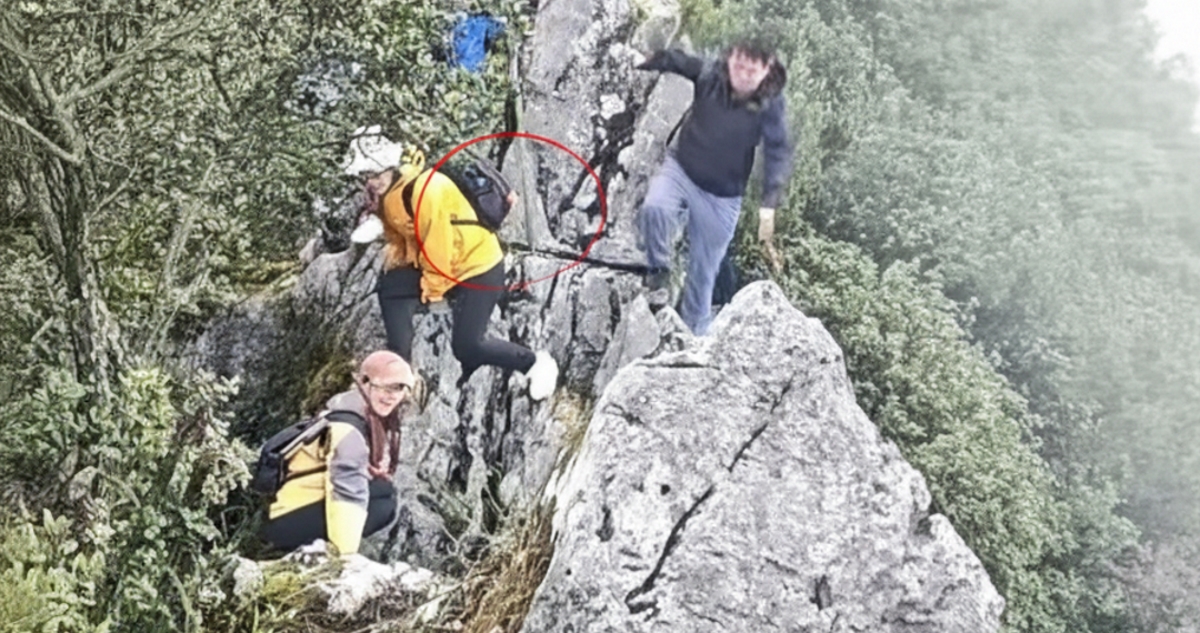
The screams echoed across the overlook before anyone understood what had happened. One moment a traveler stood near the edge of a scenic cliff, angling for the perfect photo — the next, bystanders were scrambling as he slipped and disappeared over the ledge, a scenario disturbingly similar to cases documented in a global safety report on selfie-related falls that shows dozens of tourists losing their lives every year.
Witnesses said the victim had stepped backward to widen the frame of his shot, a move that public-safety researchers warn is one of the most common factors in fatal photography accidents, a pattern outlined inside a New York Times investigation into tourism risks that identified cliffs, waterfalls, and rooftops as the deadliest environments.
People underestimate how fast you lose balance on uneven rock. One wrong step and that’s it. These accidents are happening everywhere. — Ranger L. Morgan (@TrailWatchMorgan) Dec 10, 2025
Authorities say incidents like this have surged dramatically over the past decade. Researchers who analyzed tourism fatalities noted in a Reuters overview of selfie deaths worldwide that hundreds of people have died attempting dangerous photos at high elevations. Many victims were young, confident smartphone users unaware of how quickly a stable pose can turn into a fatal fall.
The latest incident mirrors a widely reported case from Portugal, where a couple died after stepping too close to the edge — an event reconstructed through a Guardian summary of the tragedy that showed how sudden slips can occur even on dry rock. Investigators said the victims had no intention of risk; they simply underestimated the terrain.
Locals near this week’s cliff fall told journalists that park officials had repeatedly warned tourists about unstable edges, a concern echoed by safety officers whose briefings were referenced in a National Geographic examination of high-risk tourist sites. According to those experts, visitors often focus more on capturing the moment than on the environment beneath their feet.
Phones give people a false sense of security. You frame the shot, not the ground. And by the time you look up — it’s too late. — Dr. A. Reimer (@RiskResearchAR) Dec 10, 2025
Emergency crews reached the scene within minutes, but rescuers around the world have repeatedly reported how difficult cliffside recoveries are — a challenge discussed in a CBS segment on rescue conditions at scenic overlooks that highlighted how steep drops and loose rock drastically reduce survival chances.
Tourism experts say the rise of social media pressure is intensifying the risk. Sites like Instagram and TikTok push travelers toward dramatic visuals, a phenomenon explored in a Vox cultural analysis that documented how “performative travel” encourages people to approach hazardous edges for the sake of viral aesthetics.
In several regions, authorities have installed barriers and warning signs after fatal falls — measures referenced in a Washington Post review of national-park safety upgrades. But enforcement remains inconsistent, and many tourists simply bypass signage in search of a better angle.
We tell visitors every day: that extra step for a photo isn’t worth your life. But people think they’re invincible until the ground gives out. — E. Simmons (@CliffRescueSim) Dec 10, 2025
Public-health researchers now classify risky photography behaviors as a global problem requiring targeted education. One study — referenced in a BMJ safety briefing — found that most victims were unaware of warning signs like shifting gravel, strong winds, or deceptive footing near cliff edges.
Travel organizations have begun creating awareness programs, including campaigns modeled after initiatives described in a high-visibility tourism advisory urging visitors to prioritize safety over social-media engagement. Officials hope education can slow the rising number of fall-related deaths.
For bystanders who witnessed this week’s incident, the trauma was immediate — and unforgettable. Their descriptions match dozens of accounts collected in a USA Today review of global selfie fatalities, which found that falls from cliffs, waterfalls, and high rooftops remain the leading cause of photo-related deaths worldwide.
I’ll never forget that scream. One second he was there — the next he was gone. People need to stop treating cliffs like photo studios. — M. Ortega (@OrtegaWitness) Dec 10, 2025
Authorities are once again urging travelers to stay aware of their surroundings and avoid positioning themselves near loose edges, especially while distracted by a camera. As global tourism continues to rebound, safety teams say they expect incidents like this to increase — unless visitors change their behavior.