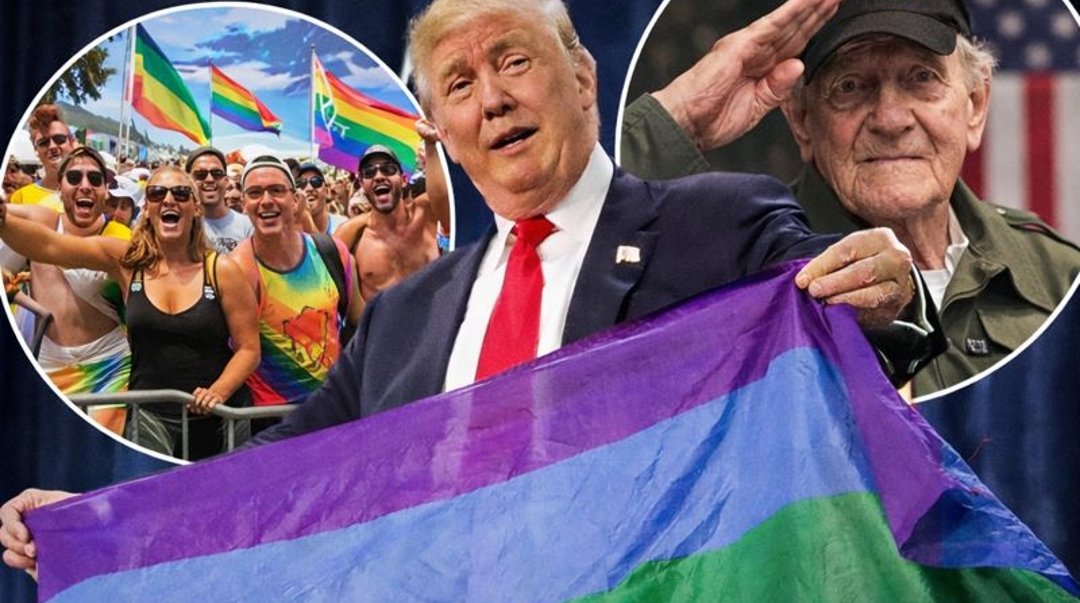
The image circulating online is designed to provoke a reaction. Donald Trump stands holding a rainbow flag altered with the words “LGBT for TRUMP,” flanked by cheering Pride crowds on one side and a saluting World War II veteran on the other. Beneath it, a bold claim: that President Trump is reportedly replacing LGBTQ+ Pride Month with Veterans Month.
That headline didn’t come out of nowhere. In recent days, comments made by Trump allies and campaign figures reignited debate over how a second Trump administration might reshape federal observances, especially those tied to LGBTQ+ recognition. While no executive order has been signed, the messaging alone has been enough to set off political and cultural shockwaves.
According to reporting that traced the controversy back to campaign rhetoric and conservative media appearances, Trump has repeatedly criticized Pride Month as “divisive” while emphasizing the need to expand recognition for military veterans. That framing, outlined in recent coverage dissecting his remarks, quickly turned into viral claims that Pride Month itself could be scrapped.
Legally, presidents do not “create” or “remove” Pride Month through statute. June has been recognized by presidential proclamation since the Clinton era, with each administration choosing whether and how to observe it. Trump notably declined to issue Pride Month proclamations during his first term, a departure documented in fact-based breakdowns of prior practice.
Veterans Month, meanwhile, already exists in a different form. November is recognized as National Veterans and Military Families Month, alongside Veterans Day on November 11. Critics argue the “replacement” narrative falsely pits two groups against each other, creating a zero-sum culture war where none is required.
That tension is exactly what exploded online. LGBTQ+ advocates accused the Trump campaign of using veterans as a political shield, while some conservative supporters applauded the idea as a return to “traditional values.” The clash quickly spilled onto social media, where interpretations outran confirmed policy.
There is no executive action replacing Pride Month. But rhetoric matters — and this rhetoric is loud. — Election Desk (@ElectionDeskHQ) January 2026
Trump himself has sent mixed signals. While he has courted some gay conservatives and previously touted international efforts to decriminalize homosexuality, his administration also rolled back protections for transgender service members and narrowed interpretations of civil rights law. Those contradictions are detailed in summaries of his first-term record.
Veterans groups have also expressed discomfort at being pulled into the debate. Several organizations emphasized that honoring service members does not require erasing LGBTQ+ visibility, noting that tens of thousands of veterans are themselves LGBTQ+. A similar point was raised in reporting on military community responses.
What makes the image especially powerful is how it compresses multiple narratives into one frame: patriotism, sexuality, generational loyalty, and political authority. It turns a nuanced policy discussion into a symbolic showdown, something Trump has long excelled at weaponizing.
Experts say this is less about calendars and more about signaling. By framing Pride Month as optional and veterans as the “replacement,” Trump positions himself as a cultural counterweight to progressive symbolism, a move aimed squarely at his base during an election cycle where identity politics remain combustible.
This isn’t about veterans vs LGBTQ people. It’s about manufacturing outrage and forcing a choice. — Policy Watch (@PolicyWatchNow) January 2026
So far, no formal policy has been introduced to eliminate Pride Month. But the reaction proves how quickly campaign language can reshape public belief, especially when amplified through viral imagery. Whether intentional or not, the claim has already done its work — shifting the conversation and hardening lines.
As the election approaches, observers expect more symbolic fights like this one, where perception matters as much as reality. Pride Month isn’t going anywhere on paper, but the debate over who gets recognized — and who decides — is clearly far from over.